Cork Gentry K, Thompson Jeffrey, Slawson Chad
Department of Biochemistry and Molecular Biology, University of Kansas Medical Center, Kansas City, KS, United States.
Department of Pathology, University of Kansas Medical Center, Kansas City, KS, United States.
Front Endocrinol (Lausanne). 2018 Sep 6;9:522. doi: 10.3389/fendo.2018.00522. eCollection 2018.
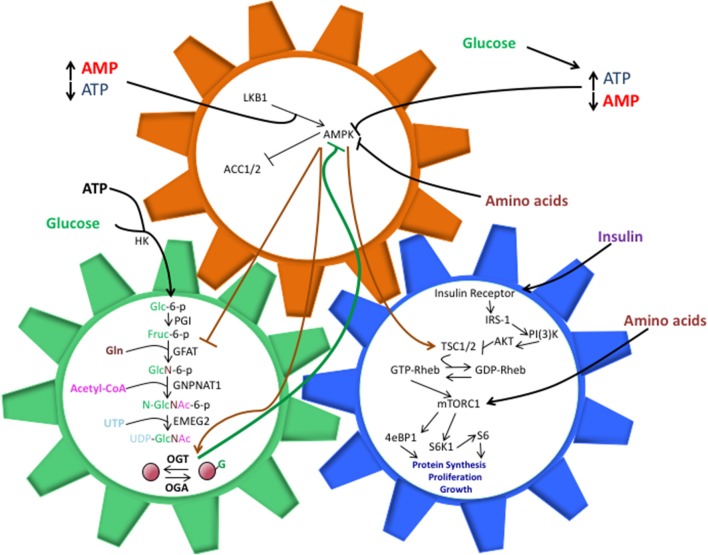
O-linked N-acetylglucosamine, better known as O-GlcNAc, is a sugar post-translational modification participating in a diverse range of cell functions. Disruptions in the cycling of O-GlcNAc mediated by O-GlcNAc transferase (OGT) and O-GlcNAcase (OGA), respectively, is a driving force for aberrant cell signaling in disease pathologies, such as diabetes, obesity, Alzheimer's disease, and cancer. Production of UDP-GlcNAc, the metabolic substrate for OGT, by the Hexosamine Biosynthetic Pathway (HBP) is controlled by the input of amino acids, fats, and nucleic acids, making O-GlcNAc a key nutrient-sensor for fluctuations in these macromolecules. The mammalian target of rapamycin (mTOR) and AMP-activated protein kinase (AMPK) pathways also participate in nutrient-sensing as a means of controlling cell activity and are significant factors in a variety of pathologies. Research into the individual nutrient-sensitivities of the HBP, AMPK, and mTOR pathways has revealed a complex regulatory dynamic, where their unique responses to macromolecule levels coordinate cell behavior. Importantly, cross-talk between these pathways fine-tunes the cellular response to nutrients. Strong evidence demonstrates that AMPK negatively regulates the mTOR pathway, but O-GlcNAcylation of AMPK lowers enzymatic activity and promotes growth. On the other hand, AMPK can phosphorylate OGT leading to changes in OGT function. Complex sets of interactions between the HBP, AMPK, and mTOR pathways integrate nutritional signals to respond to changes in the environment. In particular, examining these relationships using systems biology approaches might prove a useful method of exploring the complex nature of cell signaling. Overall, understanding the complex interactions of these nutrient pathways will provide novel mechanistic information into how nutrients influence health and disease.
O-连接的N-乙酰葡糖胺,更广为人知的名称是O-GlcNAc,是一种参与多种细胞功能的糖基化翻译后修饰。由O-GlcNAc转移酶(OGT)和O-GlcNAcase(OGA)分别介导的O-GlcNAc循环紊乱,是糖尿病、肥胖症、阿尔茨海默病和癌症等疾病病理过程中异常细胞信号传导的驱动力。己糖胺生物合成途径(HBP)产生OGT的代谢底物UDP-GlcNAc,受氨基酸、脂肪和核酸的输入控制,使O-GlcNAc成为这些大分子波动的关键营养传感器。雷帕霉素的哺乳动物靶点(mTOR)和AMP激活的蛋白激酶(AMPK)途径也参与营养感知,作为控制细胞活性的一种方式,并且是多种病理过程中的重要因素。对HBP、AMPK和mTOR途径的个体营养敏感性的研究揭示了一种复杂的调节动态,其中它们对大分子水平的独特反应协调细胞行为。重要的是,这些途径之间的相互作用微调了细胞对营养物质的反应。有力证据表明,AMPK对mTOR途径具有负调节作用,但AMPK的O-GlcNAc化会降低酶活性并促进生长。另一方面,AMPK可以磷酸化OGT,导致OGT功能发生变化。HBP、AMPK和mTOR途径之间复杂的相互作用集整合营养信号以响应环境变化。特别是,使用系统生物学方法研究这些关系可能是探索细胞信号传导复杂性质的一种有用方法。总体而言,了解这些营养途径的复杂相互作用将为营养物质如何影响健康和疾病提供新的机制信息。