
3-溴-4,5-二羟基苯甲醛治疗通过抑制小鼠巨噬细胞浸润改善心脏功能。
Treatment with 3-Bromo-4,5-Dihydroxybenzaldehyde Improves Cardiac Function by Inhibiting Macrophage Infiltration in Mice.
作者信息
Ji Ningning, Lou Honghong, Gong Xinyan, Fu Ting, Ni Shimao
机构信息
Department of Cardiology, Yiwu Hospital of Wenzhou Medical University (Yiwu Central Hospital), Yiwu, China.
出版信息
Korean Circ J. 2018 Oct;48(10):933-943. doi: 10.4070/kcj.2017.0373.
BACKGROUND AND OBJECTIVES
Appropriate inflammatory response is necessary for cardiac repairing after acute myocardial infarction (MI). Three-Bromo-4,5-dihydroxybenzaldehyde (BDB) is a potent antioxidant and natural bromophenol compound derived from red algae. Although BDB has been shown to have an anti-inflammatory effect, it remains unclear whether BDB affects cardiac remolding after MI. The aim of this study was to investigate the potential role of BDB on cardiac function recovery after MI in mice.
METHODS
Mice were intraperitoneally injected with BDB (100 mg/kg) or vehicle control respectively 1 hour before MI and then treated every other day. Cardiac function was monitored by transthoracic echocardiography at day 7 after MI. The survival of mice was observed for 2 weeks and hematoxylin and eosin (H&E) staining was used to determine the infarct size. Macrophages infiltration was examined by immunofluorescence staining. Enzyme-linked immunosorbent assay (ELISA) was used to test the production of cytokines associated with macrophages. The phosphorylation status of nuclear factor (NF)-κB was determined by western blot.
RESULTS
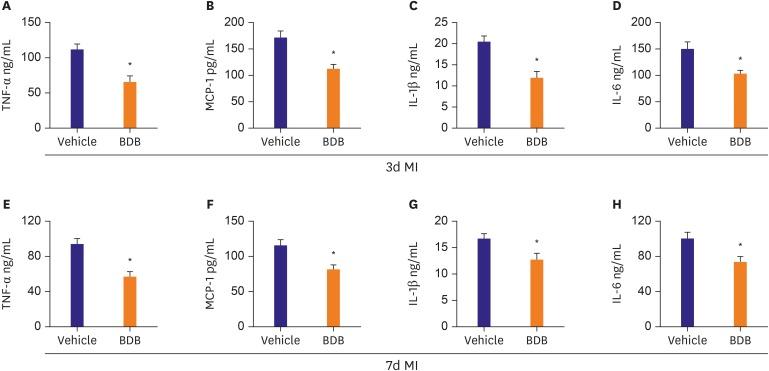
BDB administration dramatically improved cardiac function recovery, and decreased mortality and infarcted size after MI. Treatment with BDB reduced CD68⁺ macrophages, M1 and M2 macrophages infiltration post-MI, and suppressed the secretion of pro-inflammatory cytokines, such as tumor necrosis factor (TNF)-α, interleukin (IL)-1β, monocyte chemoattractant protein (MCP)-1, and IL-6 in the injured hearts. Furthermore, BDB inhibited the phosphorylation of NF-κB in the infarcted hearts.
CONCLUSIONS
These data demonstrate, for the first time, that BDB treatment facilitated cardiac healing by suppressing pro-inflammatory cytokine secretion, and indicate that BDB may serve as a therapeutic agent for acute MI.
背景与目的
适当的炎症反应对于急性心肌梗死(MI)后的心脏修复是必要的。三溴-4,5-二羟基苯甲醛(BDB)是一种强效抗氧化剂,是从红藻中提取的天然溴酚化合物。尽管BDB已被证明具有抗炎作用,但BDB是否影响MI后的心脏重塑仍不清楚。本研究的目的是探讨BDB对小鼠MI后心脏功能恢复的潜在作用。
方法
在MI前1小时分别给小鼠腹腔注射BDB(100mg/kg)或溶剂对照,然后隔天进行处理。MI后第7天通过经胸超声心动图监测心脏功能。观察小鼠存活2周情况,并用苏木精-伊红(H&E)染色确定梗死面积。通过免疫荧光染色检查巨噬细胞浸润情况。采用酶联免疫吸附测定(ELISA)检测与巨噬细胞相关的细胞因子产生情况。通过蛋白质印迹法测定核因子(NF)-κB的磷酸化状态。
结果
给予BDB可显著改善MI后的心脏功能恢复,降低死亡率和梗死面积。BDB治疗可减少MI后CD68⁺巨噬细胞、M1和M2巨噬细胞浸润,并抑制损伤心脏中促炎细胞因子如肿瘤坏死因子(TNF)-α、白细胞介素(IL)-1β、单核细胞趋化蛋白(MCP)-1和IL-6的分泌。此外,BDB可抑制梗死心脏中NF-κB的磷酸化。
结论
这些数据首次证明,BDB治疗通过抑制促炎细胞因子分泌促进心脏愈合,并表明BDB可能作为急性MI的治疗药物。




 Zotero 插件