Department of Physiology, Augusta University , Augusta, Georgia.
Department of Oral Biology, Augusta University , Augusta, Georgia.
Am J Physiol Heart Circ Physiol. 2018 Dec 1;315(6):H1713-H1723. doi: 10.1152/ajpheart.00389.2018. Epub 2018 Sep 21.
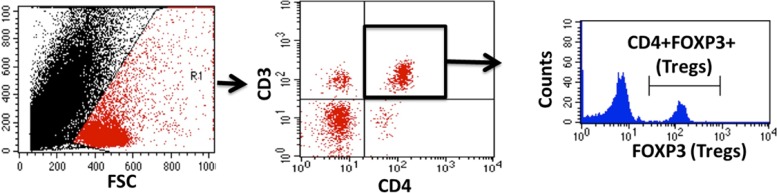
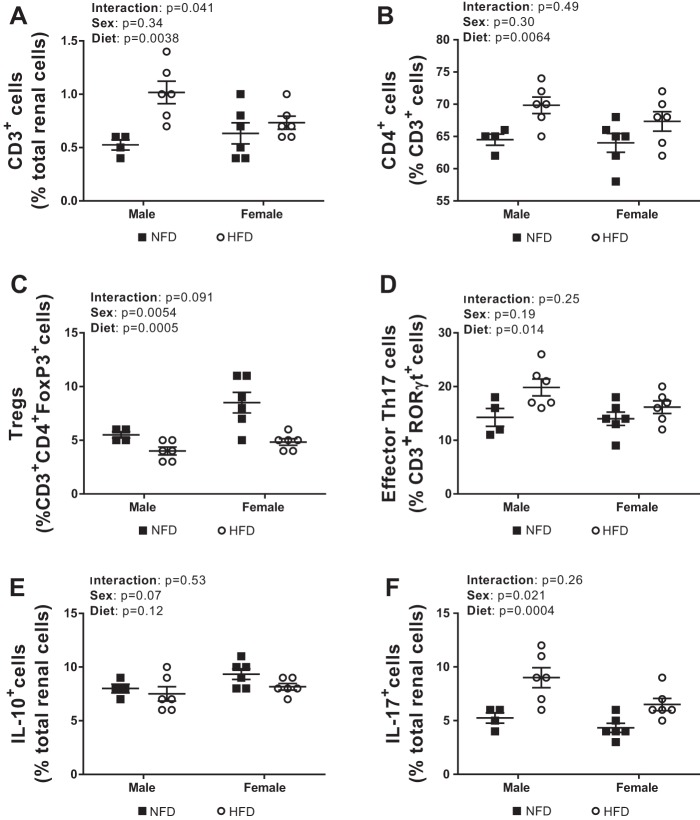
Evidence supports a sex difference in the impact of a high-fat diet (HFD) on cardiovascular outcomes, with male experimental animals exhibiting greater increases in blood pressure (BP) than female experimental animals. The immune system has been implicated in HFD-induced increases in BP, and there is a sex difference in T-cell activation in hypertension. The goal of this study was to determine the impact of HFD on BP and aortic and renal T cell profiles in male and female Dahl salt-sensitive (DSS) rats. We hypothesized that male DSS rats would have greater increases in BP and T cell infiltration in response to a HFD compared with female DSS rats. BP was measured by tail-cuff plethysmography, and aortic and renal T cells were assessed by flow cytometric analysis in male and female DSS rats on a normal-fat diet (NFD) or HFD from 12 to 16 wk of age. Four weeks of HFD increased BP in male and female DSS rats to a similar degree. Increases in BP were accompanied by increased percentages of CD4 T cells and T helper (Th)17 cells in both sexes, although male rats had more proinflammatory T cells. Percentages of renal CD3 and CD4 T cells as well as Th17 cells were increased in both sexes by the HFD, although the increase in CD3 T cells was greater in male rats. HFD also decreased the percentage of aortic and renal regulatory T cells in both sexes, although female rats maintained more regulatory T cells than male rats regardless of diet. In conclusion, both male and female DSS rats exhibit BP sensitivity to a HFD; however, the mechanisms mediating HFD-induced increases in BP may be distinct as male rats exhibit greater increases in the percentage of proinflammatory T cells than female rats. NEW & NOTEWORTHY Our study demonstrates that male and female Dahl salt-sensitive rats exhibit similar increases in blood pressure to a high-fat diet and an increase in aortic and renal T cells. These results are in contrast to studies showing that female rats remain normotensive and/or upregulate regulatory T cells in response to hypertensive stimuli compared with male rats. Our data suggest that a 4-wk high-fat diet has sex-specific effects on the T cell profile in Dahl salt-sensitive rats.
证据支持高脂肪饮食(HFD)对心血管结果的影响存在性别差异,雄性实验动物的血压(BP)升高幅度大于雌性实验动物。免疫系统被认为与 HFD 引起的 BP 升高有关,高血压中 T 细胞的激活也存在性别差异。本研究的目的是确定 HFD 对雄性和雌性 Dahl 盐敏感(DSS)大鼠的 BP 以及主动脉和肾脏 T 细胞谱的影响。我们假设与雌性 DSS 大鼠相比,雄性 DSS 大鼠对 HFD 的反应会导致更大的 BP 升高和 T 细胞浸润。通过尾套容积描记法测量 BP,并通过流式细胞术分析评估雄性和雌性 DSS 大鼠在正常脂肪饮食(NFD)或 12 至 16 周龄时的 HFD 下的主动脉和肾脏 T 细胞。4 周的 HFD 使雄性和雌性 DSS 大鼠的 BP 升高到相似的程度。BP 升高伴随着两种性别中 CD4 T 细胞和辅助性 T 细胞 17(Th17)细胞的百分比增加,尽管雄性大鼠具有更多的促炎性 T 细胞。两种性别中 HFD 还增加了肾 CD3 和 CD4 T 细胞以及 Th17 细胞的百分比,但雄性大鼠的 CD3 T 细胞增加更多。HFD 还降低了两种性别主动脉和肾脏调节性 T 细胞的百分比,但无论饮食如何,雌性大鼠维持的调节性 T 细胞都多于雄性大鼠。总之,雄性和雌性 DSS 大鼠对 HFD 均表现出 BP 敏感性;然而,介导 HFD 引起的 BP 升高的机制可能不同,因为雄性大鼠表现出比雌性大鼠更高的促炎性 T 细胞百分比。本研究表明,雄性和雌性 Dahl 盐敏感大鼠对高脂肪饮食表现出相似的血压升高,并增加了主动脉和肾脏 T 细胞。这些结果与研究结果形成对比,研究表明与雄性大鼠相比,雌性大鼠对高血压刺激保持正常血压和/或上调调节性 T 细胞。我们的数据表明,4 周的高脂肪饮食对 Dahl 盐敏感大鼠的 T 细胞谱具有性别特异性影响。