Gausden Elizabeth B, Sin Danielle, Levack Ashley E, Wessel Lauren E, Moloney Gele, Lane Joseph M, Lorich Dean G
Department of Orthopaedic Surgery, Hospital for Special Surgery, New York, NY.
Department of Orthopaedic Surgery, University of Pittsburgh Medical Center, Pittsburgh, PA.
J Orthop Trauma. 2018 Nov;32(11):554-558. doi: 10.1097/BOT.0000000000001283.
To determine the association between fracture collapse with altered gait after intertrochanteric (IT) fracture using the trochanteric fixation nail (TFN) and helical blade.
Prospective cohort study.
Academic Level I trauma center.
Seventy-two patients with IT hip fractures (OTA/AO 31) treated between 2012 and 2016. The average age was 79.7 years (range, 51-94 years); there were 59 women and 13 men.
All patients were treated with cephalomedullary nailing using the TFN (DePuy-Synthes, West Chester, PA) with a helical blade.
At follow-up appointments, temporospatial gait parameters were measured and recorded. Radiographs were analyzed at the time of surgery and at each follow-up visit. Amount of radiographic femoral neck shortening was measured radiographically. Patients completed the Harris Hip Score, visual analog scale for pain, Short Form-36 Physical Component Score, and Short Form-36 Mental Component Score.
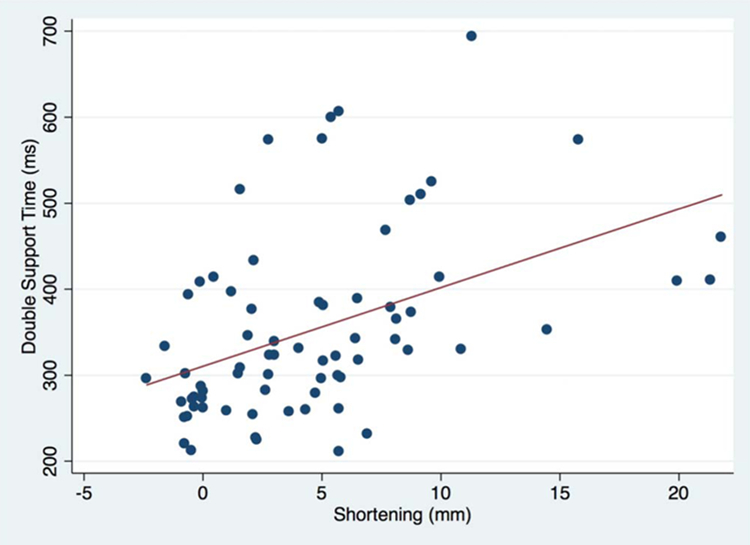
The mean length of follow-up between the surgery and the gait analysis was 8.6 months (±0.7 months). The mean amount of shortening was 4.7 mm (±0.6 mm). Out of the 72 patients analyzed, there were 15 patients (20.8%) who shortened more than 8 mm, 7 patients (9.7%) who shortened 10 mm or more, and 2 patients (2.8%) who shortened more than 20 mm. Mean shortening was 3.0 mm for stable OTA/AO 31-A1 fractures, whereas the unstable patterns (OTA/AO 31-A2, 31-A3) demonstrated a mean shortening of 5.9 mm (P = 0.02). There was significant correlation between increased shortening and decreased cadence (P = 0.008), increased double support time (P < 0.001), decreased step length (P = 0.001), and increased single support asymmetry (P = 0.04) during gait analysis. The threshold of 8 mm of shortening predicted decreased cadence (P = 0.008), increased double support time (P < 0.001), and decreased step length (P = 0.006). Analysis of patient-reported outcome scores, including the Harris Hip Score, visual analog scale, SF-36 Physical Component Score, and SF-36 Mental Component Score, revealed no significant association with shortening.
Results from this study indicate that shortening after cephallomedullary nailing of IT hip fractures using the TFN with a helical blade is associated with altered gait, specifically decreased cadence, increased double support time, decreased step length, and increased single support time asymmetry.
Prognostic Level II. See Instructions for Authors for a complete description of levels of evidence.
使用股骨转子间固定钉(TFN)和螺旋刀片,确定股骨转子间(IT)骨折后骨折塌陷与步态改变之间的关联。
前瞻性队列研究。
一级学术创伤中心。
2012年至2016年间接受治疗的72例IT型髋部骨折(OTA/AO 31)患者。平均年龄为79.7岁(范围51 - 94岁);其中59例女性,13例男性。
所有患者均使用带螺旋刀片的TFN(DePuy-Synthes,宾夕法尼亚州韦斯特切斯特)进行髓内钉固定治疗。
在随访预约时,测量并记录时空步态参数。在手术时及每次随访时分析X线片。通过X线片测量股骨颈缩短的程度。患者完成Harris髋关节评分、疼痛视觉模拟量表、简明健康状况调查简表36(SF-36)身体成分评分和SF-36精神成分评分。
手术至步态分析的平均随访时间为8.6个月(±0.7个月)。平均缩短量为4.7 mm(±0.6 mm)。在分析的72例患者中,有15例(20.8%)缩短超过8 mm,7例(9.7%)缩短10 mm或更多,2例(2.8%)缩短超过20 mm。稳定的OTA/AO 31-A1骨折平均缩短3.0 mm,而不稳定型(OTA/AO 31-A2、31-A3)平均缩短5.9 mm(P = 0.02)。在步态分析中,缩短增加与步频降低(P = 0.008)、双支撑时间增加(P < 0.001)、步长减小(P = 0.001)以及单支撑不对称性增加(P = 0.04)之间存在显著相关性。缩短8 mm的阈值可预测步频降低(P = 0.008)、双支撑时间增加(P < 0.001)和步长减小(P = 0.006)。对患者报告的结局评分进行分析,包括Harris髋关节评分、视觉模拟量表、SF-36身体成分评分和SF-36精神成分评分,结果显示与缩短无显著关联。
本研究结果表明,使用带螺旋刀片的TFN对IT型髋部骨折进行髓内钉固定后出现的缩短与步态改变有关,具体表现为步频降低、双支撑时间增加、步长减小以及单支撑时间不对称性增加。
预后性II级。有关证据水平的完整描述,请参阅作者指南。