Department of Oncology, Athens Medical Center, Marousi, Greece.
Laboratory of Molecular Oncology, Hellenic Foundation for Cancer Research/Aristotle University of Thessaloniki, Thessaloniki, Greece.
Cancer Med. 2018 Oct;7(10):5066-5082. doi: 10.1002/cam4.1730. Epub 2018 Sep 21.
Tumor-infiltrating lymphocytes (TILs) have been shown to be of prognostic value in several cancer types. In early breast cancer, TILs have a prognostic utility, as well, especially in HER2-positive and triple-negative breast cancer. TILs presence is broadly associated with improved survival; however, there is controversy regarding TILs subpopulations.
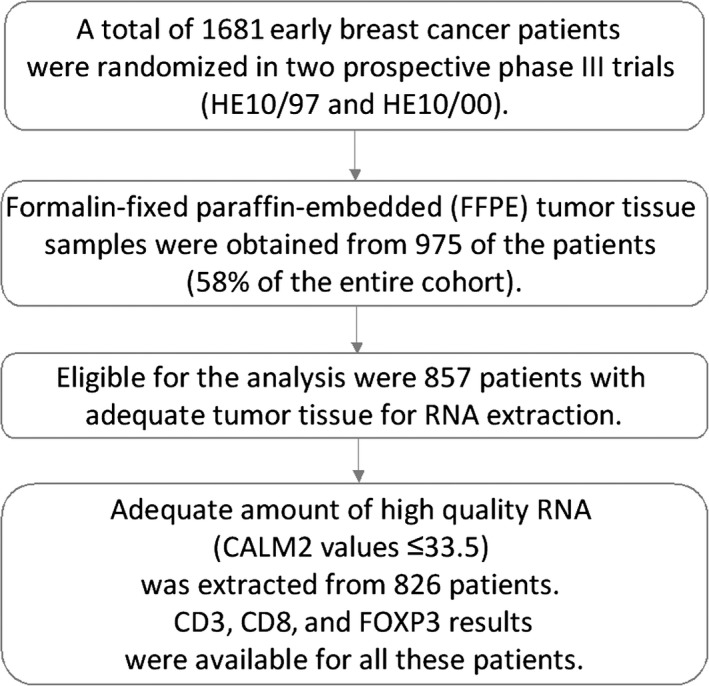
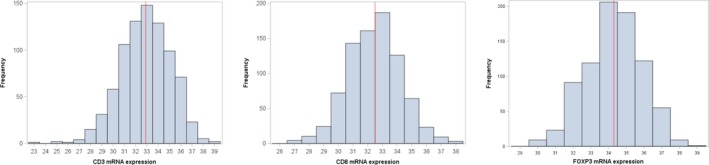
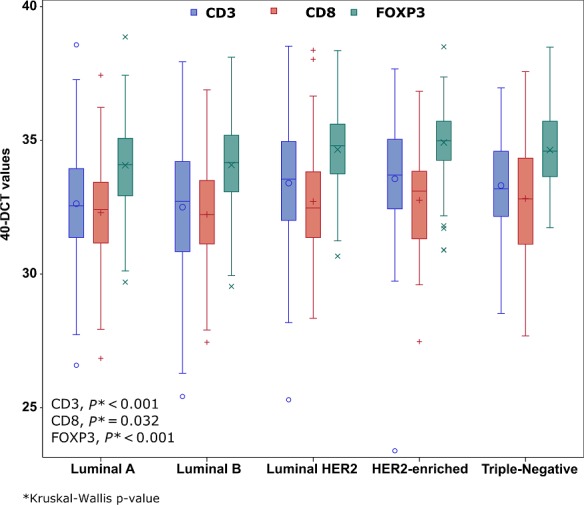
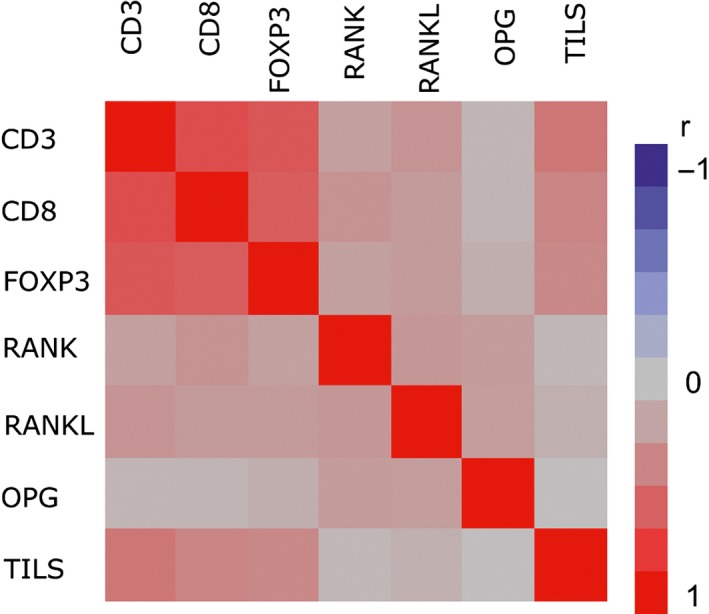
Early-stage breast cancer patients treated with anthracycline-based chemotherapy within two randomized trials were included in the study. We evaluated, by qRT-PCR, 826 tumor tissue samples for mRNA expression of CD3, CD8, and FOXP3 for potential prognostic significance in terms of disease-free survival (DFS) and overall survival (OS).
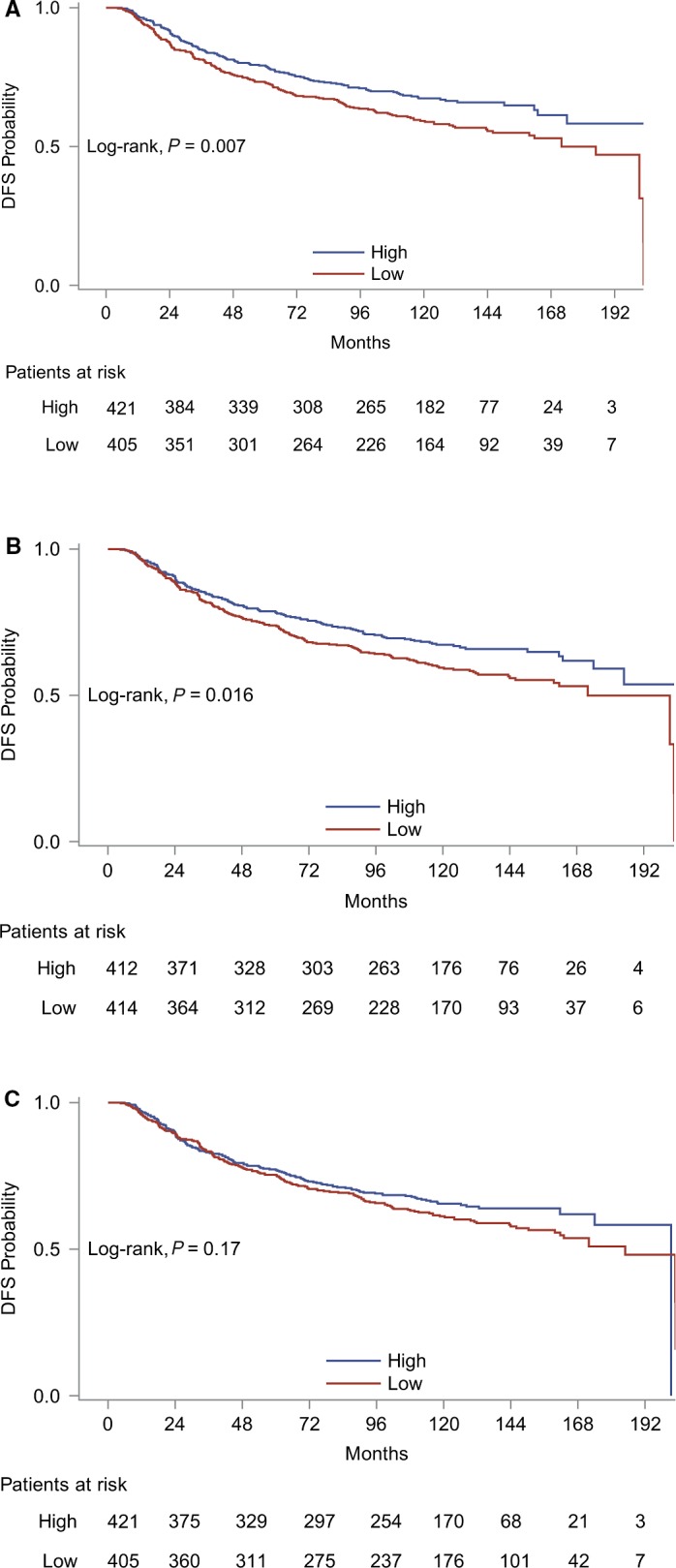
After a median follow-up of 133.0 months, 255 patients (30.9%) had died and 314 (38.0%) had disease progression. In the univariate analysis, high CD3 and CD8 mRNA expression was found to be of favorable prognostic value for DFS (P = 0.007 and P = 0.016, respectively). In multivariate analyses, the association of high CD8 mRNA expression with increased DFS was retained (HR = 0.77, 95% CI 0.60-0.998, Wald's P = 0.048), whereas that of high CD3 mRNA expression was of marginal statistical significance (HR = 0.77, 95% CI 0.59-1.01, P = 0.059). Moreover, a significant interaction was observed between HER2 status and CD3 mRNA expression with respect to DFS (interaction P = 0.032). In the HER2-positive subgroup, the hazard ratio associated with high CD3 mRNA expression was of greater magnitude (HR = 0.48, 95% CI 0.30-0.76, P = 0.002) compared with the hazard ratio presented above, for the entire cohort. No significant findings were observed for FOXP3 in terms of DFS, while none of the studied markers were of prognostic value for OS.
High CD3 and CD8 mRNA expression in early-stage breast cancer patients is of prognostic value for decreased risk of relapse and, in the future, could potentially be of importance in deciding the most appropriate therapeutic strategy in light of the recent immune-related treatment developments.
肿瘤浸润淋巴细胞(TILs)已被证明在多种癌症类型中具有预后价值。在早期乳腺癌中,TILs 也具有预后作用,尤其是在 HER2 阳性和三阴性乳腺癌中。TILs 的存在与生存率的提高广泛相关;然而,关于 TILs 的亚群存在争议。
本研究纳入了两项随机试验中接受基于蒽环类药物化疗的早期乳腺癌患者。我们通过 qRT-PCR 评估了 826 个肿瘤组织样本中 CD3、CD8 和 FOXP3 的 mRNA 表达,以评估其在无病生存(DFS)和总生存(OS)方面的潜在预后意义。
中位随访 133.0 个月后,255 例患者(30.9%)死亡,314 例患者(38.0%)疾病进展。在单因素分析中,高 CD3 和 CD8 mRNA 表达与 DFS 呈正相关(P=0.007 和 P=0.016)。在多因素分析中,高 CD8 mRNA 表达与 DFS 增加的关联仍然存在(HR=0.77,95%CI 0.60-0.998,Wald's P=0.048),而高 CD3 mRNA 表达的相关性具有统计学意义(HR=0.77,95%CI 0.59-1.01,P=0.059)。此外,在 DFS 方面,观察到 HER2 状态与 CD3 mRNA 表达之间存在显著的交互作用(交互 P=0.032)。在 HER2 阳性亚组中,与高 CD3 mRNA 表达相关的风险比更大(HR=0.48,95%CI 0.30-0.76,P=0.002),与上述整个队列的风险比相比。在 DFS 方面,FOXP3 没有显著的发现,而研究的标志物都没有对 OS 有预后价值。
早期乳腺癌患者中高 CD3 和 CD8 mRNA 表达具有预后价值,可降低复发风险,并且未来根据最近的免疫相关治疗进展,在决定最合适的治疗策略方面可能具有重要意义。