Laferton Johannes A C, Vijapura Sagar, Baer Lee, Clain Alisabet J, Cooper Abigail, Papakostas George, Price Lawrence H, Carpenter Linda L, Tyrka Audrey R, Fava Maurizio, Mischoulon David
Department of Psychiatry, Brigham and Women's Hospital, Harvard Medical School, Harvard University, Boston, MA, United States.
Department of Clinical Psychology and Psychotherapy, Friedrich-Alexander-Universität Erlangen-Nürnberg, Erlangen, Germany.
Front Psychiatry. 2018 Sep 7;9:424. doi: 10.3389/fpsyt.2018.00424. eCollection 2018.
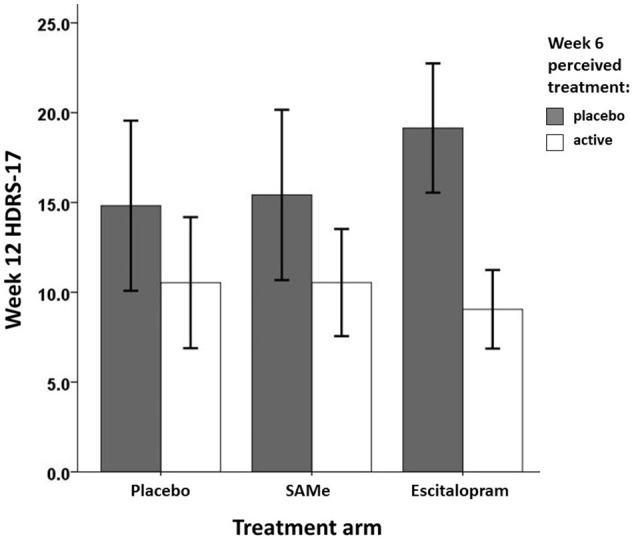
It has been suggested that patients' perception of treatment assignment might serve to bias results of double blind randomized controlled trials (RCT). Most previous evidence on the effects of patients' perceptions and the mechanisms influencing these perceptions relies on cross-sectional associations. This re-analysis of a double blind, placebo controlled RCT of pharmacological treatment of major depression set out to gather longitudinal evidence on the mechanism and effects of patients' perceived treatment assignment in the pharmacological treatment of major depression. One-hundred eighty-nine outpatients with DSM-IV diagnosed major depression were randomized to SAMe 1,600-3,200 mg/d, escitalopram 10-20 mg/days, or placebo for 12 weeks. Data on depressive symptoms (17-item Hamilton Depression Scale; HDRS-17), adverse events and patients' perceived treatment assignment was collected at baseline, week 6, and week 12. The re-analysis focused on = 166 (out of the originally included 189 participants) with available data on perceived treatment assignment. As in the parent trial, depressive symptoms (HDRS-17) significantly decreased over the course of 12 weeks and there was no difference between placebo, SAMe or escitalopram. A significant number of patients changed their perceptions about treatment assignment throughout the trial, especially between baseline and week 6. Improvement in depressive symptoms, but not adverse events significantly predicted perceived treatment assignment at week 6. In turn, perceived treatment assignment at week 6, but not actual treatment, predicted further improvement in depressive symptoms at week 12. The current results provide longitudinal evidence that patients' perception of treatment assignment systematically change despite a double blind procedure and in turn might trigger expectancy effects with the potential to bias the validity of an RCT. Parent study grant number: R01 AT001638 Parent study ClinicalTrials. gov Identifier: NCT00101452.
有人提出,患者对治疗分配的认知可能会使双盲随机对照试验(RCT)的结果产生偏差。以前关于患者认知的影响以及影响这些认知的机制的大多数证据都依赖于横断面关联。这项对重度抑郁症药物治疗的双盲、安慰剂对照RCT的重新分析,旨在收集关于患者在重度抑郁症药物治疗中对治疗分配的认知机制和影响的纵向证据。189名被诊断为DSM-IV重度抑郁症的门诊患者被随机分为三组,分别接受每天1600 - 3200毫克的S-腺苷甲硫氨酸(SAMe)、每天10 - 20毫克的艾司西酞普兰或安慰剂治疗,为期12周。在基线、第6周和第12周收集了关于抑郁症状(17项汉密尔顿抑郁量表;HDRS-17)、不良事件以及患者对治疗分配的认知的数据。重新分析聚焦于166名(最初纳入的189名参与者中的)有治疗分配认知可用数据的患者。与原试验一样,抑郁症状(HDRS-17)在12周的过程中显著下降,安慰剂、SAMe或艾司西酞普兰之间没有差异。在整个试验过程中,相当数量的患者改变了他们对治疗分配的认知,尤其是在基线和第6周之间。抑郁症状的改善而非不良事件显著预测了第6周的治疗分配认知。反过来,第6周的治疗分配认知而非实际治疗,预测了第12周抑郁症状的进一步改善。当前结果提供了纵向证据,表明尽管采用了双盲程序,但患者对治疗分配的认知仍会系统性地改变,进而可能引发期望效应,有可能使RCT的有效性产生偏差。母研究资助编号:R01 AT001638 母研究ClinicalTrials.gov标识符:NCT00101452