Department of Medical Biotechnologies and Translational Medicine, University of Milan, Milan, Italy.
Humanitas Clinical and Research Center, Rozzano, Italy.
Front Immunol. 2018 Sep 7;9:2037. doi: 10.3389/fimmu.2018.02037. eCollection 2018.
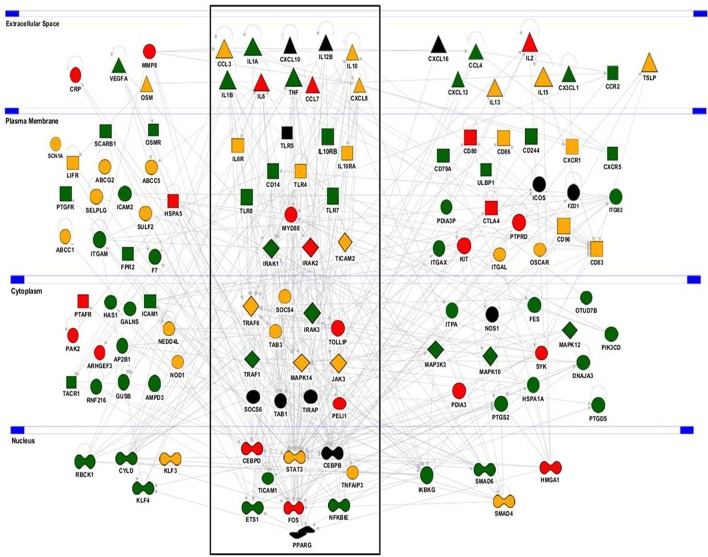
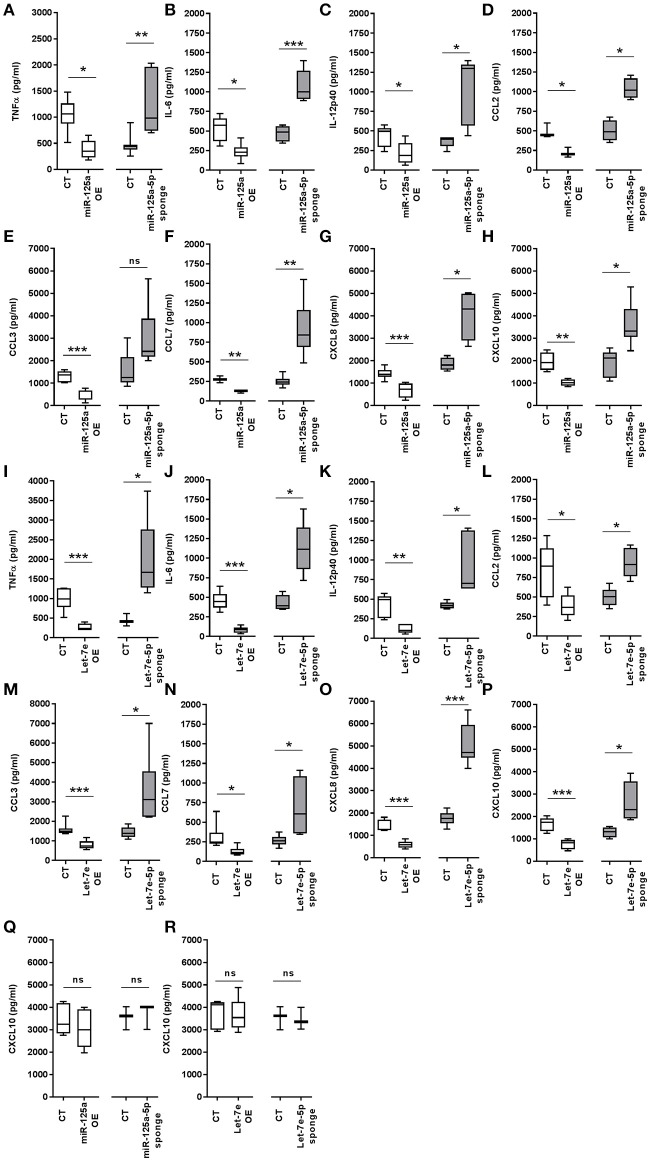
An appropriate immune response requires a tight balance between pro- and anti-inflammatory mechanisms. IL-10 is induced at late time-points during acute inflammatory conditions triggered by TLR-dependent recognition of infectious agents and is involved in setting this balance, operating as a negative regulator of the TLR-dependent signaling pathway. We identified miR-125a99blet-7e as an evolutionary conserved microRNA cluster late-induced in human monocytes exposed to the TLR4 agonist LPS as an effect of this IL-10-dependent regulatory loop. We demonstrated that microRNAs generated by this cluster perform a pervasive regulation of the TLR signaling pathway by direct targeting receptors (TLR4, CD14), signaling molecules (IRAK1), and effector cytokines (TNFα, IL-6, CCL3, CCL7, CXCL8). Modulation of miR-125a99blet-7e cluster influenced the production of proinflammatory cytokines in response to LPS and the IL-10-mediated tolerance to LPS, thus identifying this gene as a previously unrecognized major regulatory element of the inflammatory response and endotoxin tolerance.
适当的免疫反应需要在促炎和抗炎机制之间保持紧密平衡。IL-10 在 TLR 依赖性识别感染因子引发的急性炎症条件下,在晚期被诱导产生,并参与这种平衡的建立,作为 TLR 依赖性信号通路的负调节剂发挥作用。我们发现,在人类单核细胞中,miR-125a99blet-7e 作为 IL-10 依赖的调节环的一种效应,在 TLR4 激动剂 LPS 作用下晚期诱导,是一个进化保守的 microRNA 簇。我们证明,这个簇产生的 microRNAs 通过直接靶向受体(TLR4、CD14)、信号分子(IRAK1)和效应细胞因子(TNFα、IL-6、CCL3、CCL7、CXCL8),对 TLR 信号通路进行广泛调节。miR-125a99blet-7e 簇的调节影响了 LPS 反应中促炎细胞因子的产生和 LPS 介导的 IL-10 耐受,从而将这个基因确定为炎症反应和内毒素耐受的一个以前未被识别的主要调节元件。