
肾母细胞瘤的心脏内扩展。国家肾母细胞瘤研究报告。
Intracardiac extension of Wilms' tumor. A report of the National Wilms' Tumor Study.
作者信息
Nakayama D K, Norkool P, deLorimier A A, O'Neill J A, D'Angio G J
出版信息
Ann Surg. 1986 Dec;204(6):693-7. doi: 10.1097/00000658-198612000-00013.
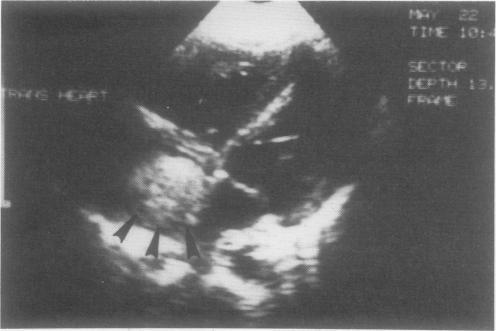
Extension of Wilms' tumor through the inferior vena cava into the heart presents a formidable clinical challenge. Excision of such a tumor without provoking emobilization may require cardiopulmonary bypass (CPB). The completeness of excision and the likelihood of tumor embolization during operation guide subsequent radiation therapy (RT) and chemotherapy. To help define these issues, the clinical records of 15 patients enrolled in three National Wilms' Tumor Studies (NWTS) who had intracardiac tumor extension (ICE) were reviewed. The median age at diagnosis was 4 years. One patient had clear cell sarcoma (CCS); the remainder had favorable histologic findings (FH). The clinicopathologic stage was stage II in one patient, stage III in eight patients, and stage IV in six patients. ICE was detected before operation in six patients, during operation in five patients, and after operation in five patients. CPB was used in 10 patients. Eleven patients (73%) had operative complications, with major intraoperative hemorrhage occurring most often (six patients). Complications occurred less often when ICE was recognized before operation (three of six patients) than when it was not (eight of nine patients). Embolization occurred in only two patients. There were no operative deaths. The patient with CCS died. Eleven of 14 patients with FH survived, with an actuarial event-free, 2-year survival rate of 86%. There were no patients in the first NWTS. Of the six patients in the second NWTS (NWTS-2), four died (67%). All nine patients in the third NWTS (NWTS-3) survived, but follow-up was shorter (median 4 years 9 months vs. 2 years 7 months). No particular surgical procedure was associated with an increased death rate. This review suggests Wilms' tumor with ICE presents a formidable surgical undertaking but has a relatively good prognosis. Embolization is an uncommon event in ICE (two patients, 13.3%), allowing a planned operative approach. Echocardiography and ultrasonography provide accurate preoperative diagnosis. And ICE should be suspected in patients with extensive vena cava thrombosis or who have hypotension or heart failure during examination or surgery.
肾母细胞瘤经下腔静脉延伸至心脏带来了严峻的临床挑战。在不引发栓塞的情况下切除此类肿瘤可能需要体外循环(CPB)。手术切除的完整性以及术中肿瘤栓塞的可能性指导后续的放射治疗(RT)和化疗。为了明确这些问题,回顾了参加三项国家肾母细胞瘤研究(NWTS)的15例有心脏内肿瘤延伸(ICE)患者的临床记录。诊断时的中位年龄为4岁。1例患者为透明细胞肉瘤(CCS);其余患者组织学表现良好(FH)。临床病理分期,1例患者为Ⅱ期,8例患者为Ⅲ期,6例患者为Ⅳ期。6例患者在术前检测到ICE,5例患者在术中检测到,5例患者在术后检测到。10例患者使用了CPB。11例患者(73%)出现手术并发症,其中最常见的是术中大出血(6例患者)。术前识别出ICE的患者并发症发生率(6例中的3例)低于未识别出的患者(9例中的8例)。仅2例患者发生栓塞。无手术死亡病例。CCS患者死亡。14例FH患者中有11例存活,2年无事件生存率为86%。第一项NWTS中无患者。第二项NWTS(NWTS - 2)的6例患者中有4例死亡(67%)。第三项NWTS(NWTS - 3)的9例患者全部存活,但随访时间较短(中位时间4年9个月对2年7个月)。没有特定的手术操作与死亡率增加相关。该综述表明,伴有ICE的肾母细胞瘤是一项艰巨的外科手术,但预后相对较好。栓塞在ICE中是罕见事件(2例患者,13.3%),允许采用有计划的手术方法。超声心动图和超声检查可提供准确的术前诊断。对于有广泛腔静脉血栓形成或在检查或手术期间出现低血压或心力衰竭的患者,应怀疑有ICE。
 Zotero 插件