Department of Life Sciences, Imperial College London, UK.
Nat Biotechnol. 2018 Dec;36(11):1062-1066. doi: 10.1038/nbt.4245. Epub 2018 Sep 24.
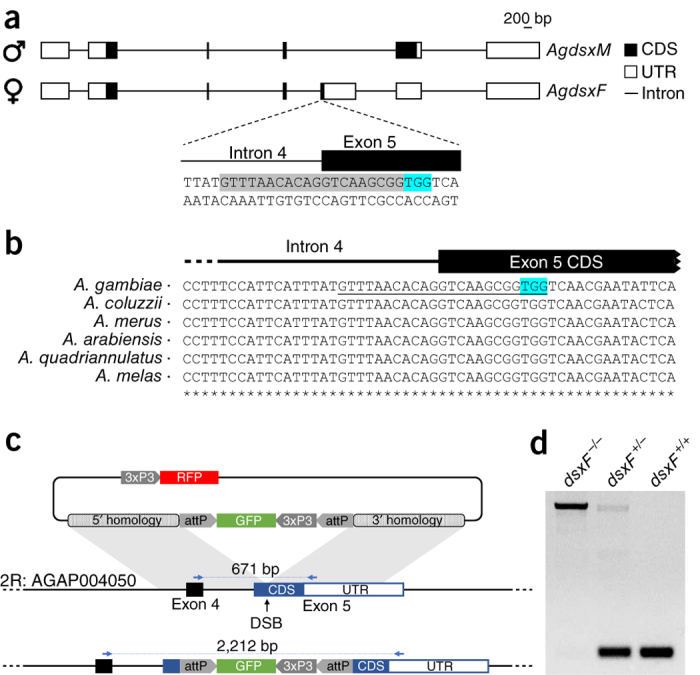
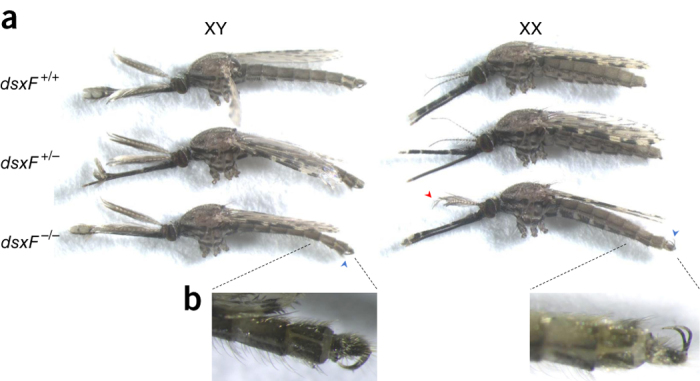
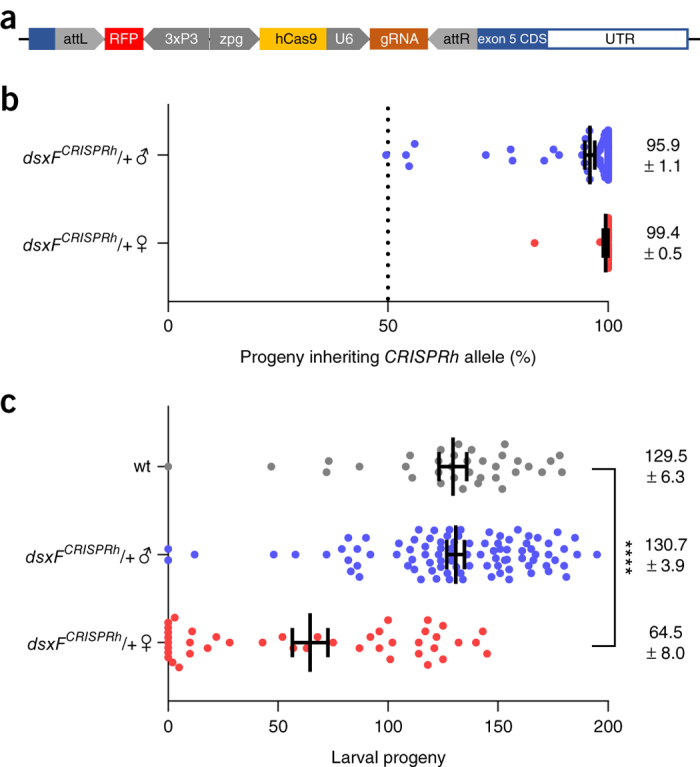
In the human malaria vector Anopheles gambiae, the gene doublesex (Agdsx) encodes two alternatively spliced transcripts, dsx-female (AgdsxF) and dsx-male (AgdsxM), that control differentiation of the two sexes. The female transcript, unlike the male, contains an exon (exon 5) whose sequence is highly conserved in all Anopheles mosquitoes so far analyzed. We found that CRISPR-Cas9-targeted disruption of the intron 4-exon 5 boundary aimed at blocking the formation of functional AgdsxF did not affect male development or fertility, whereas females homozygous for the disrupted allele showed an intersex phenotype and complete sterility. A CRISPR-Cas9 gene drive construct targeting this same sequence spread rapidly in caged mosquitoes, reaching 100% prevalence within 7-11 generations while progressively reducing egg production to the point of total population collapse. Owing to functional constraint of the target sequence, no selection of alleles resistant to the gene drive occurred in these laboratory experiments. Cas9-resistant variants arose in each generation at the target site but did not block the spread of the drive.
在人类疟疾传播媒介冈比亚按蚊中,性别决定基因 doublesex(Agdsx)编码两个选择性剪接的转录本,dsx-female(AgdsxF)和 dsx-male(AgdsxM),它们控制着两性的分化。与雄性不同,雌性转录本包含一个外显子(外显子 5),其序列在迄今为止分析的所有按蚊中高度保守。我们发现,针对内含子 4-外显子 5 边界的 CRISPR-Cas9 靶向破坏旨在阻止功能性 AgdsxF 的形成,不会影响雄性的发育或生育能力,而杂合子雌性表现出雌雄间性表型和完全不育。针对该相同序列的 CRISPR-Cas9 基因驱动构建体在笼养蚊子中迅速传播,在 7-11 代内达到 100%的流行率,同时逐渐减少产卵量,导致种群完全崩溃。由于靶序列的功能限制,在这些实验室实验中没有出现对基因驱动有抗性的等位基因的选择。在靶位点,Cas9 抗性变体在每一代都会出现,但不会阻止驱动的传播。