Research Laboratory and Academic Division of Clinical Rheumatology, Department of Internal Medicine, University of Genova, Polyclinic San Martino Hospital, Genoa, Italy.
Clinical Immunology, Department of Internal Medicine, University of Genova, Genoa, Italy.
Respir Res. 2018 Sep 24;19(1):186. doi: 10.1186/s12931-018-0891-z.
Systemic sclerosis (SSc) is a disorder characterized by immune system alterations, vasculopathy and fibrosis. SSc-related interstitial lung disease (ILD) represents a common and early complication, being the leading cause of mortality. Monocytes/macrophages seem to have a key role in SSc-related ILD. Interestingly, the classically (M1) and alternatively (M2) activated monocyte/macrophage phenotype categorization is currently under revision. Our aim was to evaluate if circulating monocyte/macrophage phenotype could be used as biomarker for lung involvement in SSc. To this purpose we developed a wide phenotype characterization of circulating monocyte/macrophage subsets in SSc patients and we evaluated possible relations with lung involvement parameter values.
A single centre cross-sectional study was performed in fifty-five consecutive SSc patients, during the year 2017. All clinical and instrumental tests requested for SSc follow up and in particular, lung computed tomography (CT) scan, pulmonary function tests (PFTs), Doppler echocardiography with systolic pulmonary artery pressure (sPAP) measurement, blood pro-hormone of brain natriuretic peptide (pro-BNP) evaluation, were performed in each patient in a maximum one-month period. Flow cytometry characterization of circulating cells belonging to the monocyte/macrophage lineage was performed using specific M1 (CD80, CD86, TLR2 and TLR4) and M2 surface markers (CD204, CD163 and CD206). Non-parametric tests were used for statistical analysis.
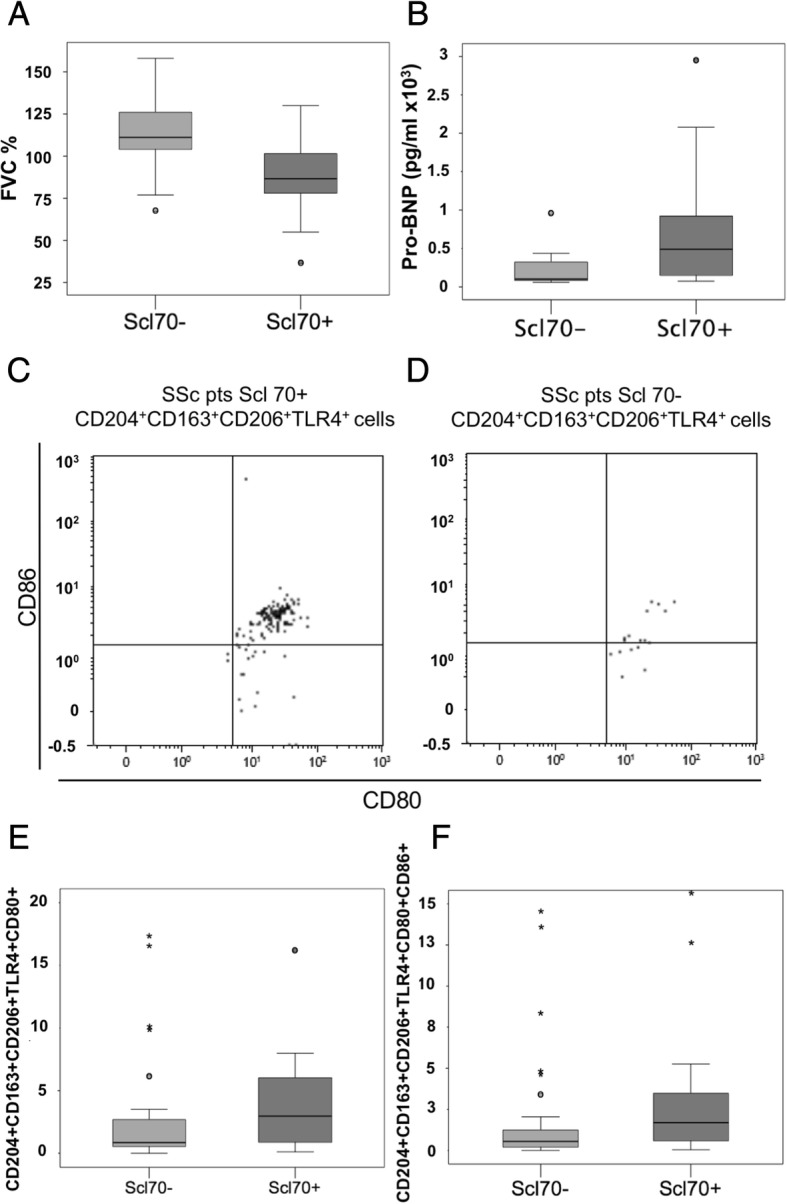
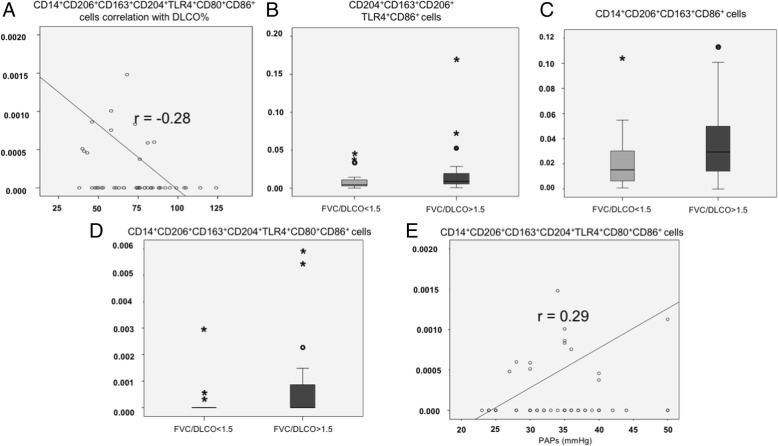
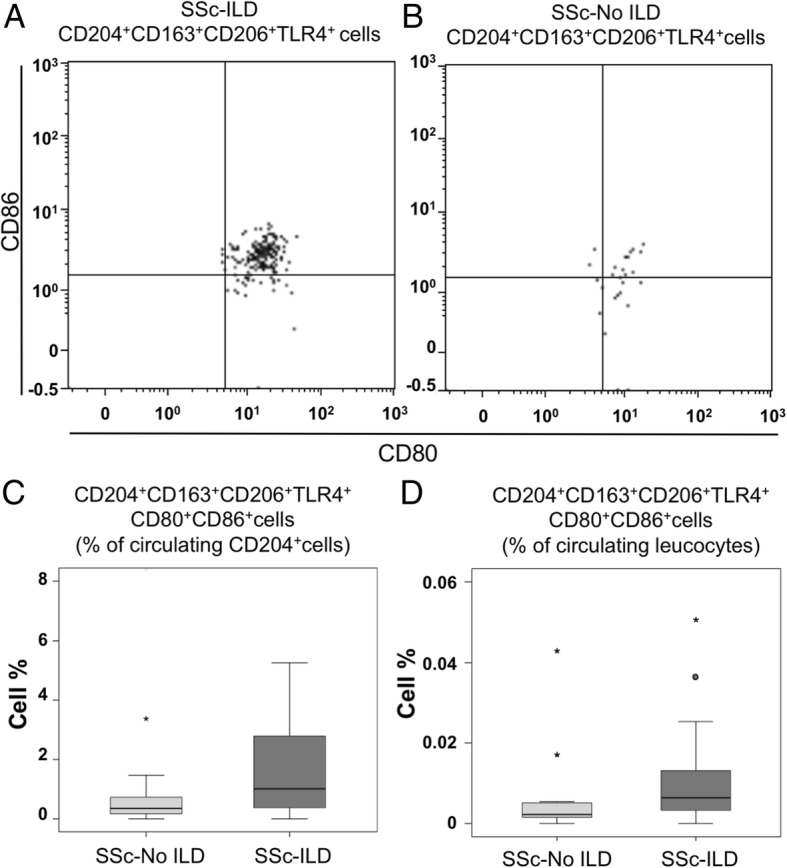
A higher percentage of circulating CD204CD163CD206TLR4CD80CD86 and CD14CD206CD163CD204TLR4CD80CD86 mixed M1/M2 monocyte/macrophage subsets, was identified to characterize patients affected by SSc-related ILD and higher systolic pulmonary artery pressure. Mixed M1/M2 monocyte/macrophage subset showed higher percentages in patients positive for anti-topoisomerase antibody, a known lung involvement predictor.
The present study shows for the first time, through a wide flow cytometry surface marker analysis, that higher circulating mixed M1/M2 monocyte/macrophage cell percentages are associated with ILD, sPAP and anti-topoisomerase antibody positivity in SSc, opening the path for research on their possible role as pathogenic or biomarker elements for SSc lung involvement.
系统性硬化症(SSc)是一种以免疫系统改变、血管病变和纤维化为特征的疾病。SSc 相关的间质性肺病(ILD)是一种常见的早期并发症,也是导致死亡的主要原因。单核细胞/巨噬细胞似乎在 SSc 相关的 ILD 中起着关键作用。有趣的是,经典(M1)和替代(M2)激活的单核细胞/巨噬细胞表型分类目前正在修订中。我们的目的是评估循环单核细胞/巨噬细胞表型是否可作为 SSc 肺受累的生物标志物。为此,我们对 SSc 患者的循环单核细胞/巨噬细胞亚群进行了广泛的表型特征描述,并评估了它们与肺受累参数值之间的可能关系。
在 2017 年,对 55 例连续 SSc 患者进行了一项单中心横断面研究。对所有用于 SSc 随访的临床和仪器检查,特别是肺计算机断层扫描(CT)、肺功能检查(PFT)、测量收缩期肺动脉压(sPAP)的多普勒超声心动图、血液脑钠肽前体(pro-BNP)的评估,都在每个患者在一个月内进行。使用特定的 M1(CD80、CD86、TLR2 和 TLR4)和 M2 表面标志物(CD204、CD163 和 CD206)对属于单核细胞/巨噬细胞谱系的循环细胞进行流式细胞术特征描述。采用非参数检验进行统计学分析。
发现更高比例的循环 CD204+CD163+CD206+TLR4+CD80+CD86+和 CD14+CD206+CD163+CD204+TLR4+CD80+CD86+混合 M1/M2 单核细胞/巨噬细胞亚群,可用于表征患有 SSc 相关 ILD 和更高收缩期肺动脉压的患者。混合 M1/M2 单核细胞/巨噬细胞亚群在抗拓扑异构酶抗体阳性的患者中显示出更高的百分比,抗拓扑异构酶抗体是一种已知的肺受累预测因子。
本研究首次通过广泛的流式细胞术表面标志物分析表明,更高的循环混合 M1/M2 单核细胞/巨噬细胞细胞百分比与 SSc 中的 ILD、sPAP 和抗拓扑异构酶抗体阳性相关,为研究它们作为 SSc 肺受累的致病或生物标志物元素的可能作用开辟了道路。