• 文献检索
  • 文档翻译
  • 深度研究
  • 学术资讯
  • Suppr Zotero 插件Zotero 插件
  • 邀请有礼
  • 套餐&价格
  • 历史记录
应用&插件
Suppr Zotero 插件Zotero 插件浏览器插件Mac 客户端Windows 客户端微信小程序
定价
高级版会员购买积分包购买API积分包
服务
文献检索文档翻译深度研究API 文档MCP 服务
关于我们
关于 Suppr公司介绍联系我们用户协议隐私条款
关注我们

Suppr 超能文献

核心技术专利:CN118964589B侵权必究
粤ICP备2023148730 号-1Suppr @ 2026

文献检索

告别复杂PubMed语法,用中文像聊天一样搜索,搜遍4000万医学文献。AI智能推荐,让科研检索更轻松。

立即免费搜索

文件翻译

保留排版,准确专业,支持PDF/Word/PPT等文件格式,支持 12+语言互译。

免费翻译文档

深度研究

AI帮你快速写综述,25分钟生成高质量综述,智能提取关键信息,辅助科研写作。

立即免费体验

他们不在乎我们!护理人员对环境辅助生活技术使用的看法:基于情景的调查研究。

They Don't Care About Us! Care Personnel's Perspectives on Ambient Assisted Living Technology Usage: Scenario-Based Survey Study.

作者信息

Offermann-van Heek Julia, Ziefle Martina

机构信息

Human-Computer Interaction Center, RWTH Aachen University, Aachen, Germany.

出版信息

JMIR Rehabil Assist Technol. 2018 Sep 24;5(2):e10424. doi: 10.2196/10424.

DOI:10.2196/10424
PMID:30249592
原文链接:https://pmc.ncbi.nlm.nih.gov/articles/PMC6231777/
Abstract

BACKGROUND

Demographic change represents enormous burdens for the care sectors, resulting in high proportions of (older) people in need of care and a lack of care staff. Ambient Assisted Living (AAL) technologies have the potential to support the bottlenecks in care supply but are not yet in widespread use in professional care contexts.

OBJECTIVE

The objective of our study was to investigate professional caregivers' AAL technology acceptance and their perception regarding specific technologies, data handling, perceived benefits, and barriers. In particular, this study focuses on the perspectives on AAL technologies differing between care professionals working in diverse care contexts to examine the extent to which the care context influences the acceptance of assistive technologies.

METHODS

A Web-based survey (N=170) was carried out focusing on professional caregivers including medical, geriatric, and disabled people's caregivers. Based on a scenario, the participants were asked for their perceptions concerning specific technologies, specific types of gathered data, and potential benefits of and barriers to AAL technology usage.

RESULTS

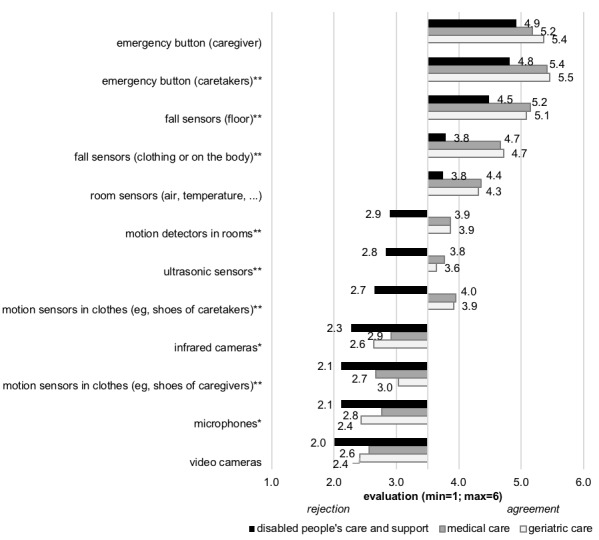
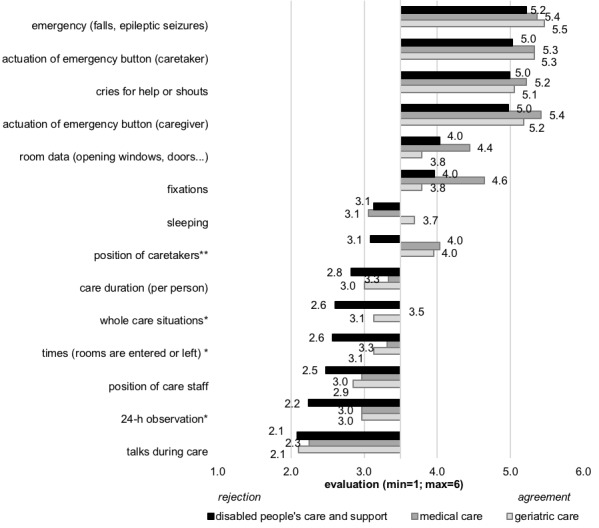
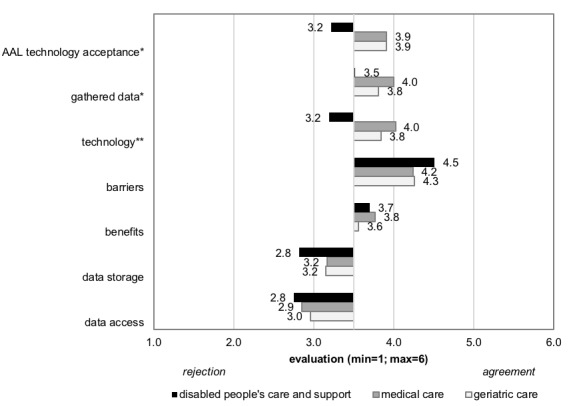
The care context significantly impacted the evaluations of AAL technologies (F=2.514; P=.002). Professional caregivers of disabled people had a significantly more critical attitude toward AAL technologies than medical and geriatric caregivers, indicated (1) by being the only caregiver group that rejected evaluations of AAL technology acceptance (F=4.570; P=.01) and specific technologies (F=11.727; P<.001) applied for gathering data and (2) by the comparatively lowest agreements referring to the evaluations of data types (F=4.073, P=.02) that are allowed to be gathered.

CONCLUSIONS

AAL technology acceptance is critical because of technology implementation reasons, especially in the care of people with disabilities. AAL technologies in care contexts have to be tailored to care professional's needs and concerns ("care about us"). The results contribute to a broader understanding of professional caregivers' needs referring to specific data and technology configurations and enclose major differences concerning diverse care contexts. Integrating these findings into user group-tailored technology concepts and communication strategies will support a sustainable adoption of AAL systems in professional care contexts.

摘要

背景

人口结构变化给护理行业带来了巨大负担,导致需要护理的(老年)人群比例很高,且护理人员短缺。环境辅助生活(AAL)技术有潜力缓解护理供应方面的瓶颈,但在专业护理环境中尚未得到广泛应用。

目的

我们研究的目的是调查专业护理人员对AAL技术的接受程度,以及他们对特定技术、数据处理、感知到的益处和障碍的看法。特别是,本研究关注不同护理环境中的护理专业人员对AAL技术的不同观点,以考察护理环境在多大程度上影响对辅助技术的接受度。

方法

开展了一项基于网络的调查(N = 170),调查对象为包括医疗、老年护理和残疾人护理人员在内的专业护理人员。基于一个场景,询问参与者对特定技术、收集到的特定数据类型以及AAL技术使用的潜在益处和障碍的看法。

结果

护理环境对AAL技术的评价有显著影响(F = 2.514;P = 0.002)。残疾人专业护理人员对AAL技术的态度明显比医疗和老年护理人员更为挑剔,这体现在:(1)他们是唯一拒绝接受AAL技术接受度评价的护理人员群体(F = 4.570;P = 0.01)以及用于收集数据的特定技术(F = 11.727;P < 0.001);(2)在允许收集的数据类型评价方面,他们的认同度相对最低(F = 4.073,P = 0.02)。

结论

由于技术实施原因,AAL技术的接受度很关键,尤其是在残疾人护理方面。护理环境中的AAL技术必须根据护理专业人员的需求和关注点进行定制(“关心我们”)。这些结果有助于更广泛地理解专业护理人员对特定数据和技术配置的需求,并揭示不同护理环境之间的主要差异。将这些发现整合到针对用户群体定制的技术概念和沟通策略中,将有助于AAL系统在专业护理环境中可持续地采用。
https://cdn.ncbi.nlm.nih.gov/pmc/blobs/fcf9/6231777/e4e3b099fa89/rehab_v5i2e10424_fig3.jpg
https://cdn.ncbi.nlm.nih.gov/pmc/blobs/fcf9/6231777/6781eb71b713/rehab_v5i2e10424_fig1.jpg
https://cdn.ncbi.nlm.nih.gov/pmc/blobs/fcf9/6231777/78d63052d01d/rehab_v5i2e10424_fig2.jpg
https://cdn.ncbi.nlm.nih.gov/pmc/blobs/fcf9/6231777/e4e3b099fa89/rehab_v5i2e10424_fig3.jpg
https://cdn.ncbi.nlm.nih.gov/pmc/blobs/fcf9/6231777/6781eb71b713/rehab_v5i2e10424_fig1.jpg
https://cdn.ncbi.nlm.nih.gov/pmc/blobs/fcf9/6231777/78d63052d01d/rehab_v5i2e10424_fig2.jpg
https://cdn.ncbi.nlm.nih.gov/pmc/blobs/fcf9/6231777/e4e3b099fa89/rehab_v5i2e10424_fig3.jpg

相似文献

1
They Don't Care About Us! Care Personnel's Perspectives on Ambient Assisted Living Technology Usage: Scenario-Based Survey Study.他们不在乎我们!护理人员对环境辅助生活技术使用的看法:基于情景的调查研究。
JMIR Rehabil Assist Technol. 2018 Sep 24;5(2):e10424. doi: 10.2196/10424.
2
Bare necessities? How the need for care modulates the acceptance of ambient assisted living technologies.基本需求?关怀需求如何调节对环境辅助生活技术的接受程度。
Int J Med Inform. 2019 Jul;127:147-156. doi: 10.1016/j.ijmedinf.2019.04.025. Epub 2019 May 4.
3
Nothing Else Matters! Trade-Offs Between Perceived Benefits and Barriers of AAL Technology Usage.别无他事!辅助生活技术使用的感知收益与障碍之间的权衡。
Front Public Health. 2019 Jun 12;7:134. doi: 10.3389/fpubh.2019.00134. eCollection 2019.
4
Ambient Assisted Living as Support for Aging in Place: Quantitative Users' Acceptance Study on Ultrasonic Whistles.环境辅助生活对就地养老的支持:关于超声波哨子的用户接受度定量研究。
JMIR Aging. 2018 Dec 12;1(2):e11825. doi: 10.2196/11825.
5
Eyes on privacy: acceptance of video-based AAL impacted by activities being filmed.关注隐私:基于视频的 AAL 的接受程度受到被拍摄活动的影响。
Front Public Health. 2023 Jul 4;11:1186944. doi: 10.3389/fpubh.2023.1186944. eCollection 2023.
6
Acceptance and Privacy Perceptions Toward Video-based Active and Assisted Living Technologies: Scoping Review.接受度和隐私感知视角下的基于视频的主动和辅助生活技术:范围综述。
J Med Internet Res. 2023 May 1;25:e45297. doi: 10.2196/45297.
7
Acceptance of Technologies for Aging in Place: A Conceptual Model.接受技术以实现原地老龄化:一个概念模型。
J Med Internet Res. 2021 Mar 31;23(3):e22613. doi: 10.2196/22613.
8
Implementing Active Assisted Living Technology in the Long-term Care of People Living With Dementia to Address Loneliness: European Survey.在痴呆症患者的长期护理中应用主动辅助生活技术以解决孤独问题:欧洲调查
JMIR Aging. 2023 Jun 14;6:e45231. doi: 10.2196/45231.
9
Shapes of You? Investigating the Acceptance of Video-Based AAL Technologies Applying Different Visualization Modes.你的形状?研究不同可视化模式的基于视频的 AAL 技术的接受度。
Sensors (Basel). 2023 Jan 19;23(3):1143. doi: 10.3390/s23031143.
10
Ambient Assisted Living: Scoping Review of Artificial Intelligence Models, Domains, Technology, and Concerns.环境辅助生活:人工智能模型、领域、技术和关注点的范围综述。
J Med Internet Res. 2022 Nov 4;24(11):e36553. doi: 10.2196/36553.

引用本文的文献

1
Values of Stakeholders Involved in Applying Surveillance Technology for People With Dementia in Nursing Homes: Scoping Review.养老院中痴呆症患者应用监测技术所涉及利益相关者的价值观:范围审查
JMIR Aging. 2025 Mar 20;8:e64074. doi: 10.2196/64074.
2
Factors Affecting Clinician Readiness to Adopt Smart Home Technology for Remote Health Monitoring: Systematic Review.影响临床医生采用智能家居技术进行远程健康监测意愿的因素:系统评价
JMIR Aging. 2024 Dec 5;7:e64367. doi: 10.2196/64367.
3
Exploring the Role of Active Assisted Living in the Continuum of Care for Older Adults: Thematic Analysis.

本文引用的文献

1
SmartSenior@home: Acceptance of an integrated ambient assisted living system. Results of a clinical field trial in 35 households.智能居家养老:对集成式环境辅助生活系统的接受度。35户家庭的临床现场试验结果。
Inform Health Soc Care. 2016 Dec;41(4):430-47. doi: 10.3109/17538157.2015.1064425. Epub 2016 Jan 25.
2
Economic and social implications of aging societies.老龄化社会的经济和社会影响。
Science. 2014 Oct 31;346(6209):587-91. doi: 10.1126/science.1254405.
3
Fall detection in homes of older adults using the Microsoft Kinect.使用微软Kinect在老年人家庭中进行跌倒检测。
探索积极辅助生活在老年人连续护理中的作用:主题分析
JMIR Aging. 2023 May 22;6:e40606. doi: 10.2196/40606.
4
[Factors influencing the intention of caregivers to use digital technologies in outpatient care - A case study examining the introduction of a textile sensor mat].[影响门诊护理中照护者使用数字技术意愿的因素——一项关于引入纺织传感器垫的案例研究]
Z Arbeitswiss. 2021;75(4):470-490. doi: 10.1007/s41449-021-00277-4. Epub 2021 Oct 13.
5
A Digital Platform for Facilitating Personalized Dementia Care in Nursing Homes: Formative Evaluation Study.一个促进养老院个性化痴呆症护理的数字平台:形成性评估研究。
JMIR Form Res. 2021 May 28;5(5):e25705. doi: 10.2196/25705.
6
Perceptions About Technologies That Help Community-Dwelling Older Adults Remain at Home: Qualitative Study.关于帮助居家老年人居家养老技术的认知:定性研究
J Med Internet Res. 2020 Jun 4;22(6):e17930. doi: 10.2196/17930.
7
Nothing Else Matters! Trade-Offs Between Perceived Benefits and Barriers of AAL Technology Usage.别无他事!辅助生活技术使用的感知收益与障碍之间的权衡。
Front Public Health. 2019 Jun 12;7:134. doi: 10.3389/fpubh.2019.00134. eCollection 2019.
IEEE J Biomed Health Inform. 2015 Jan;19(1):290-301. doi: 10.1109/JBHI.2014.2312180. Epub 2014 Mar 17.
4
Ambient assisted living healthcare frameworks, platforms, standards, and quality attributes.环境辅助生活医疗保健框架、平台、标准和质量属性。
Sensors (Basel). 2014 Mar 4;14(3):4312-41. doi: 10.3390/s140304312.
5
Telemedical versus conventional heart patient monitoring: a survey study with German physicians.远程医疗与传统心脏病患者监测:一项针对德国医生的调查研究
Int J Technol Assess Health Care. 2013 Oct;29(4):378-83. doi: 10.1017/S026646231300041X.
6
A framework for daily activity monitoring and fall detection based on surface electromyography and accelerometer signals.基于表面肌电和加速度计信号的日常活动监测和跌倒检测框架。
IEEE J Biomed Health Inform. 2013 Jan;17(1):38-45. doi: 10.1109/TITB.2012.2226905.
7
In-home monitoring of older adults with vision impairment: exploring patients', caregivers' and professionals' views.居家监测视力障碍老年人:探索患者、照护者和专业人员的观点。
J Am Med Inform Assoc. 2014 Jan-Feb;21(1):56-63. doi: 10.1136/amiajnl-2012-001586. Epub 2013 May 15.
8
Elderly patients' participation in emergency medical services when offered an alternative care pathway.当提供替代护理途径时,老年患者参与紧急医疗服务。
Int J Qual Stud Health Well-being. 2013 Feb 26;8:20014. doi: 10.3402/qhw.v8i0.20014.
9
A review of wearable sensors and systems with application in rehabilitation.可穿戴传感器及系统综述及其在康复中的应用。
J Neuroeng Rehabil. 2012 Apr 20;9:21. doi: 10.1186/1743-0003-9-21.
10
The meaning of "aging in place" to older people.“原地老化”对老年人的意义。
Gerontologist. 2012 Jun;52(3):357-66. doi: 10.1093/geront/gnr098. Epub 2011 Oct 7.