Laboratory of Enzyme Chemistry, Laboratory of Marine Biochemistry, Laboratory of Bioassays and Mechanism of action of Biologically Active Substances, Laboratory of Instrumental and Radioisotope Testing Methods, Group of NMR-Spectroscopy of G.B. Elyakov Pacific Institute of Bioorganic Chemistry, Far Eastern Branch, Russian Academy of Sciences, Vladivostok 690022, Russia.
School of Economics and Management, School of Natural Sciences of Far Eastern Federal University, Russky Island, Vladivostok 690022, Russia.
Mar Drugs. 2018 Sep 24;16(10):349. doi: 10.3390/md16100349.
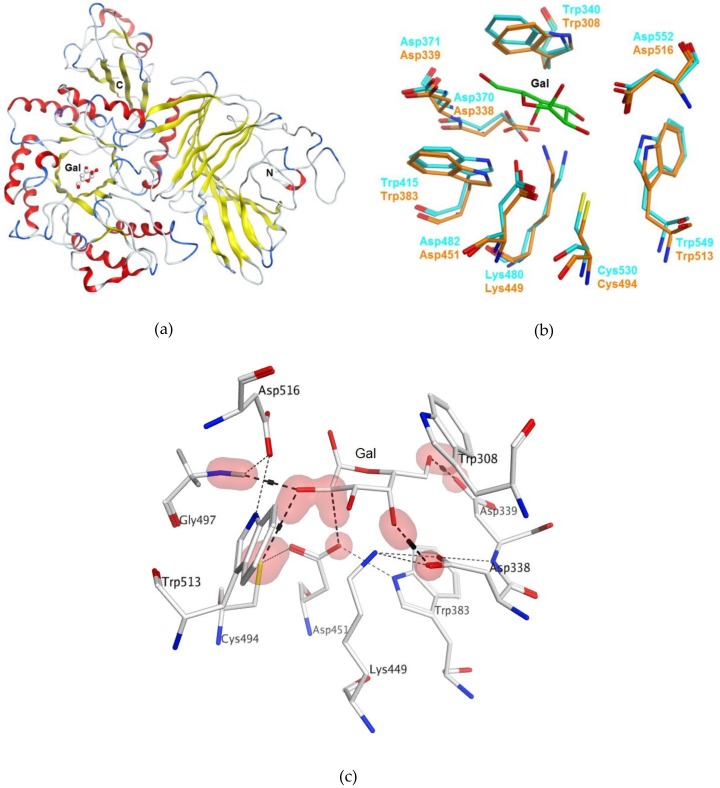
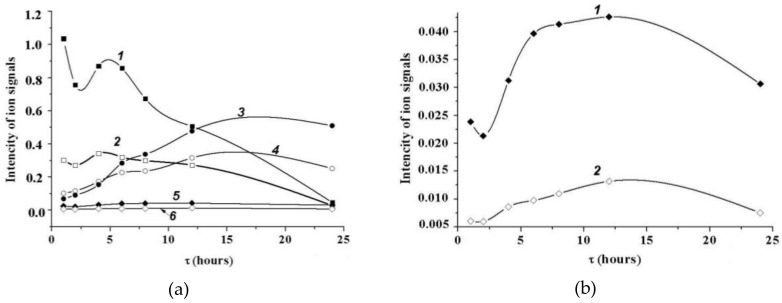
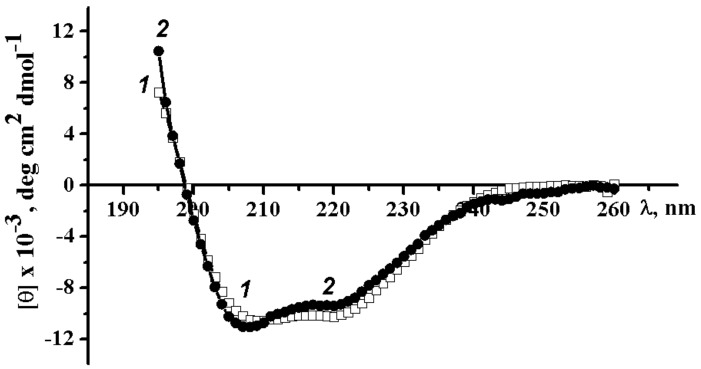
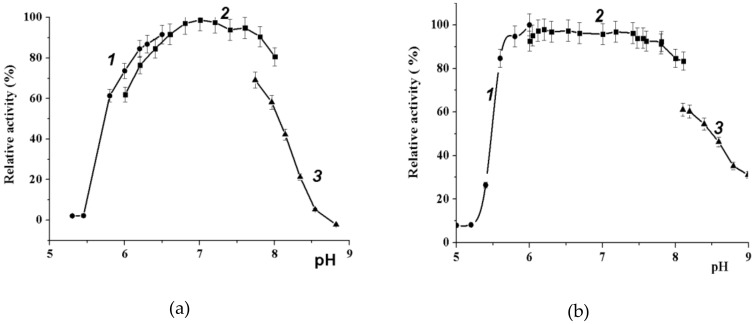
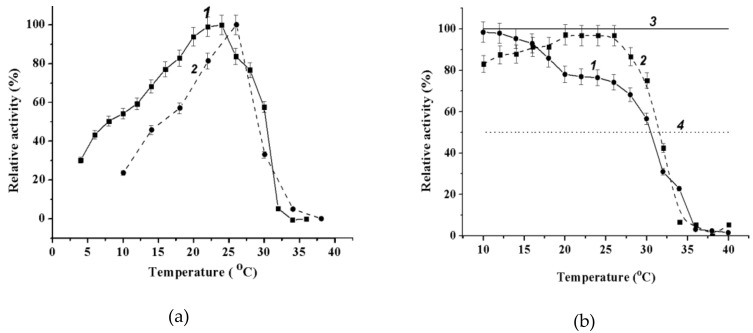
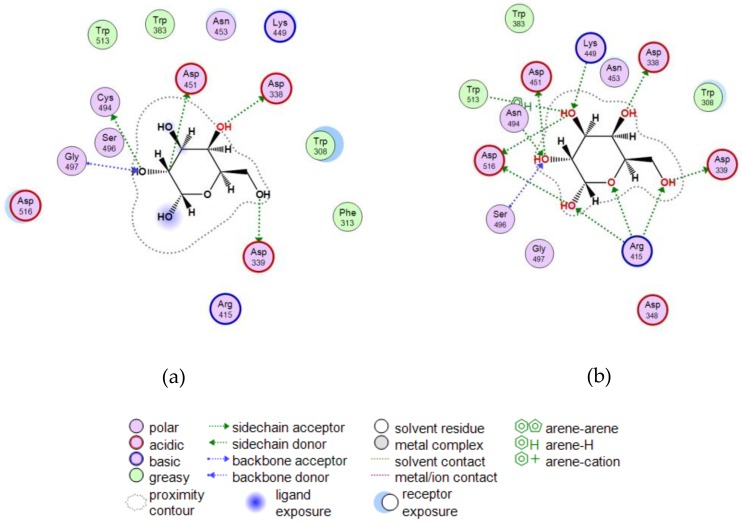
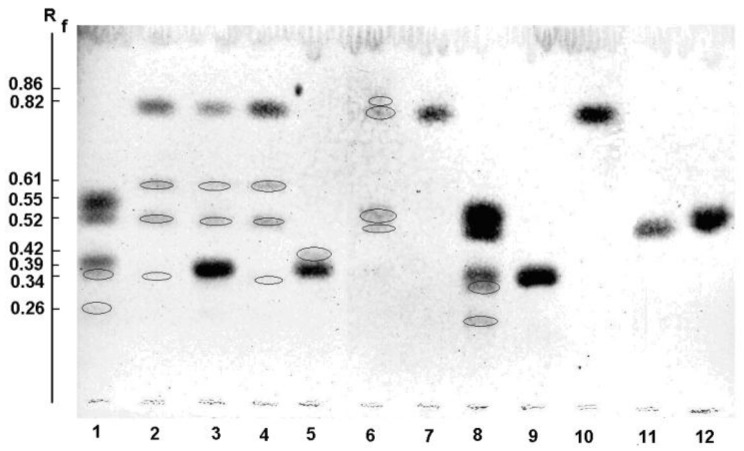
A novel wild-type recombinant cold-active α-d-galactosidase (α-PsGal) from the cold-adapted marine bacterium sp. KMM 701, and its mutants D451A and C494N, were studied in terms of their structural, physicochemical, and catalytic properties. Homology models of the three-dimensional α-PsGal structure, its active center, and complexes with D-galactose were constructed for identification of functionally important amino acid residues in the active site of the enzyme, using the crystal structure of the α-galactosidase from as a template. The circular dichroism spectra of the wild α-PsGal and mutant C494N were approximately identical. The C494N mutation decreased the efficiency of retaining the affinity of the enzyme to standard p-nitrophenyl-α-galactopiranoside (pNP-α-Gal). Thin-layer chromatography, matrix-assisted laser desorption/ionization mass spectrometry, and nuclear magnetic resonance spectroscopy methods were used to identify transglycosylation products in reaction mixtures. α-PsGal possessed a narrow acceptor specificity. Fructose, xylose, fucose, and glucose were inactive as acceptors in the transglycosylation reaction. α-PsGal synthesized -α(1→6)- and -α(1→4)-linked galactobiosides from melibiose as well as -α(1→6)- and -α(1→3)-linked p-nitrophenyl-digalactosides (Gal₂-pNP) from pNP-α-Gal. The D451A mutation in the active center completely inactivated the enzyme. However, the substitution of C494N discontinued the Gal-α(1→3)-Gal-pNP synthesis and increased the Gal-α(1→4)-Gal yield compared to Gal-α(1→6)-Gal-pNP.
从耐冷海洋细菌 sp. KMM 701 中分离出一种新型野生型重组冷活性α-D-半乳糖苷酶(α-PsGal)及其突变体 D451A 和 C494N,研究了它们的结构、物理化学和催化特性。利用 α-半乳糖苷酶的晶体结构作为模板,构建了三个三维α-PsGal 结构、其活性中心和与 D-半乳糖的复合物的同源模型,以鉴定酶活性中心中功能重要的氨基酸残基。野生型α-PsGal 和突变体 C494N 的圆二色谱谱几乎相同。C494N 突变降低了酶保持与标准对硝基苯基-α-半乳糖吡喃糖苷(pNP-α-Gal)亲和力的效率。薄层层析、基质辅助激光解吸/电离质谱和核磁共振波谱方法用于鉴定反应混合物中的转糖苷产物。α-PsGal 具有狭窄的受体特异性。果糖、木糖、岩藻糖和葡萄糖在转糖苷反应中均不作为受体。α-PsGal 从棉子糖合成 -α(1→6)-和 -α(1→4)-连接的半乳糖二糖苷,以及从 pNP-α-Gal 合成 -α(1→6)-和 -α(1→3)-连接的对硝基苯基二半乳糖苷(Gal₂-pNP)。活性中心的 D451A 突变完全使酶失活。然而,C494N 的取代中断了 Gal-α(1→3)-Gal-pNP 的合成,并与 Gal-α(1→6)-Gal-pNP 相比增加了 Gal-α(1→4)-Gal 的产量。