
用于实现高容量、长寿命锂硫电池的硫@碳化钛(MXene)墨水原位形成的保护屏障
In Situ Formed Protective Barrier Enabled by Sulfur@Titanium Carbide (MXene) Ink for Achieving High-Capacity, Long Lifetime Li-S Batteries.
作者信息
Tang Huan, Li Wenlong, Pan Limei, Cullen Conor P, Liu Yu, Pakdel Amir, Long Donghui, Yang Jian, McEvoy Niall, Duesberg Georg S, Nicolosi Valeria, Zhang Chuanfang John
机构信息
College of Materials Science and Engineering, and Jiangsu Collaborative Innovation Center for Advanced Inorganic Function Composites Nanjing Tech University Nanjing 210009 P. R. China.
Centre for Research on Adaptive Nanostructures and Nanodevices (CRANN) & Advanced Materials Bio-Engineering Research Centre (AMBER) School of Chemistry Trinity College Dublin Dublin 2 Ireland.
出版信息
Adv Sci (Weinh). 2018 Jul 4;5(9):1800502. doi: 10.1002/advs.201800502. eCollection 2018 Sep.
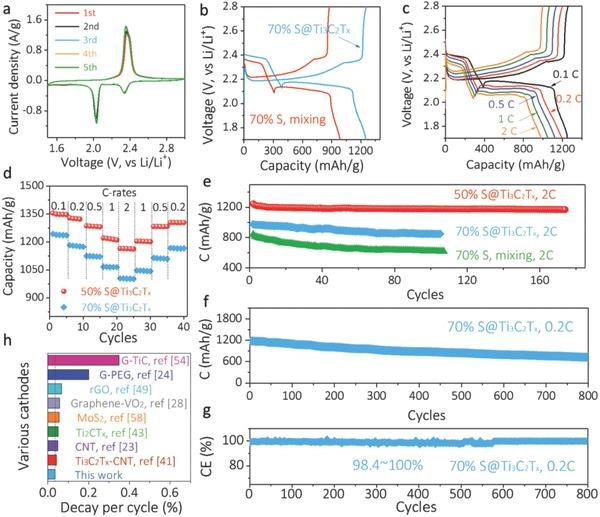
Sulfur (S) is an attractive cathode material with advantages including high theoretical capacity and low cost. However, issues such as the lithium polysulfide shuttle effect and its insulating properties greatly limit the future applications of lithium-sulfur (Li-S) batteries. Here, a viscous aqueous ink with nanoscale S uniformly decorated on the polar, metallically conductive titanium carbide MXene nanosheets (S@TiCT ) is reported to address these issues. Importantly, it is observed that the conductive TiCT mediator efficiently chemisorbs the soluble polysulfides and converts them into thiosulfate/sulfate. The in situ formed sulfate complex layer acts as a thick protective barrier, which significantly retards the shuttling of polysulfides upon cycling and improves the sulfur utilization. Consequently, the binder-free, robust, highly electrically conductive composite film exhibits outstanding electrochemical performance, including high capacities (1244-1350 mAh g), excellent rate handling, and impressive cycling stability (0.035-0.048% capacity loss per cycle), surpassing the best MXene-S batteries known. The fabrication of a pouch cell based on the freestanding S@TiCT film is also reported. The prototype device showcases high capacities and excellent mechanical flexibility. Considering the broad family of MXenes and their unique roles in immobilizing the polysulfides, various S@MXene composites can be similarly fabricated with promising Li storage capability and long lifetime performance.
硫(S)是一种具有吸引力的正极材料,具有理论容量高和成本低等优点。然而,多硫化锂穿梭效应及其绝缘性能等问题极大地限制了锂硫(Li-S)电池的未来应用。在此,报道了一种粘性水性油墨,其中纳米级S均匀地装饰在极性金属导电碳化钛MXene纳米片(S@TiCT )上,以解决这些问题。重要的是,观察到导电的TiCT 介质有效地化学吸附可溶性多硫化物并将它们转化为硫代硫酸盐/硫酸盐。原位形成的硫酸盐复合层充当厚的保护屏障,这在循环时显著阻碍多硫化物的穿梭并提高硫的利用率。因此,这种无粘结剂、坚固且高导电的复合膜表现出出色的电化学性能,包括高容量(1244 - 1350 mAh g)、优异的倍率性能和令人印象深刻的循环稳定性(每循环容量损失0.035 - 0.048%),超过了已知的最佳MXene-S电池。还报道了基于独立式S@TiCT 膜制造软包电池。该原型器件展示了高容量和出色的机械柔韧性。考虑到MXene的广泛家族及其在固定多硫化物方面的独特作用,可以类似地制造各种具有有前景的锂存储能力和长寿命性能的S@MXene复合材料。




 Zotero 插件