Alwosaifer Aisha M, Alawadh Salwa A, Abdel Wahab Moataza M, Boubshait Leila A, Almutairi Bader A
Department of Family Medicine, King Fahad Military Medical Complex, Dammam, Kingdom of Saudi Arabia. E-mail.
Saudi Med J. 2018 Sep;39(9):910-921. doi: 10.15537/smj.2018.9.23314.
To estimate the prevalence of eating disorders among Imam Abdulrahman bin Faisal University (IAU) in Dammam, Kingdom of Saudi Arabia, female students and to investigate the associated factors. Methods: A cross-sectional study was conducted at IAU, Dammam, Kingdom of Saudi Arabia, in 2016 with 670 participants. Data was collected by self-administered questionnaires, including the Eating attitude test 26 (EAT-26) and the sociocultural attitudes toward appearance questionnaire (SATAQ-4). Eating behavior questions were asked to determine whether the respondents should seek evaluation for an eating disorder (ED) from a professional.
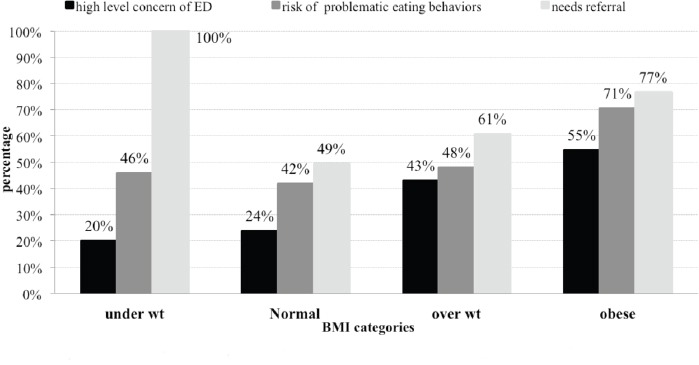
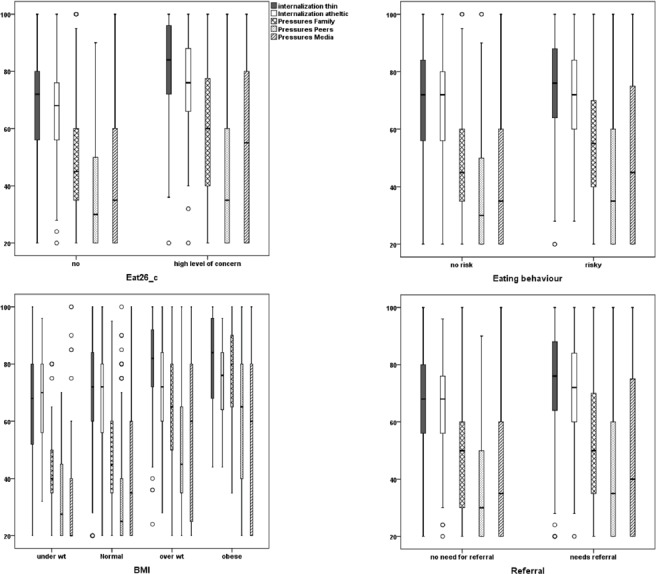
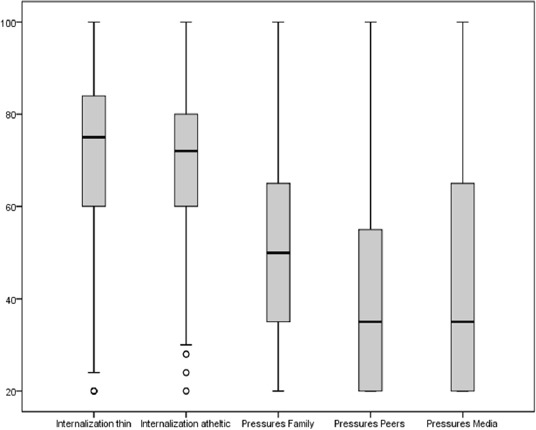
Eating attitude test 26 results showed that 29.4% of participants were categorized at a high level of concern for an ED, and 45.5% were categorized as at risk of having problematic feeding behaviors. Of the participants who scored above 20 on the EAT-26, 60.7% demonstrated high-risk feeding behavior attitudes, and approximately 11.5% who scored a body mass index (BMI) classified as underweight or very underweight required referral to a psychologist. A significant relationship was found between family stress to lose weight and EAT-26 scores above 20. The media was also found to represent external influence to lose weight.
This study concluded that early detection of EDs or problematic feeding behaviors and attitude is vital to minimize the risks to physical health and well-being of the sufferers' experiences.
评估沙特阿拉伯王国达曼市伊玛目阿卜杜勒拉赫曼·本·费萨尔大学(IAU)女学生饮食失调的患病率,并调查相关因素。方法:2016年在沙特阿拉伯王国达曼市的IAU进行了一项横断面研究,有670名参与者。通过自填问卷收集数据,包括饮食态度测试26(EAT - 26)和对外表的社会文化态度问卷(SATAQ - 4)。询问饮食行为问题以确定受访者是否应寻求专业人士对饮食失调(ED)的评估。
饮食态度测试26的结果显示,29.4%的参与者被归类为对饮食失调高度关注,45.5%被归类为有喂养行为问题的风险。在EAT - 26得分高于20的参与者中,60.7%表现出高风险的喂养行为态度,体重指数(BMI)被归类为体重过轻或非常体重过轻的参与者中约11.5%需要转介给心理学家。发现家庭减肥压力与EAT - 26得分高于20之间存在显著关系。还发现媒体是减肥的外部影响因素。
本研究得出结论,早期发现饮食失调或有问题的喂养行为及态度对于将对患者身体健康和幸福感的风险降至最低至关重要。