Tsetse and Trypanosomiasis Research Institute, Tanga, Tanzania.
Department of Pathology, Instituto de Investigação Veterinaria, Huambo, Angola.
PLoS Negl Trop Dis. 2018 Sep 25;12(9):e0006831. doi: 10.1371/journal.pntd.0006831. eCollection 2018 Sep.
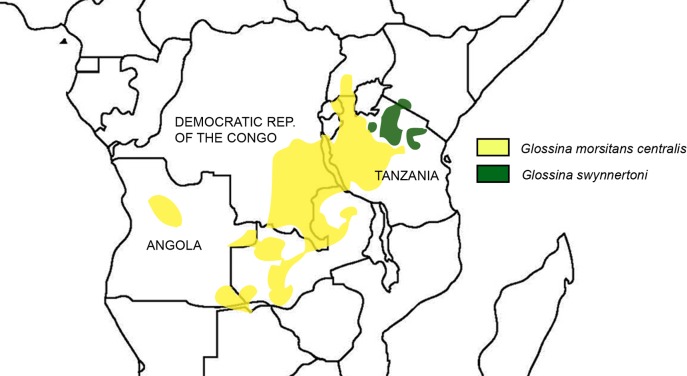
This study focused on the savannah tsetse species Glossina swynnertoni and G. morsitans centralis, both efficient vectors of human and animal trypanosomiasis in, respectively, East and Central Africa. The aim was to develop long-lasting, practical and cost-effective visually attractive devices that induce the strongest landing responses in these two species for use as insecticide-impregnated tools in population suppression.
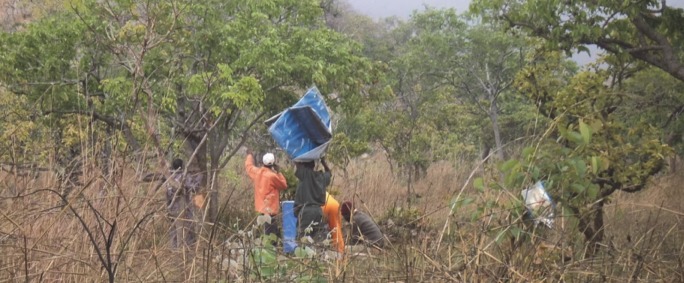
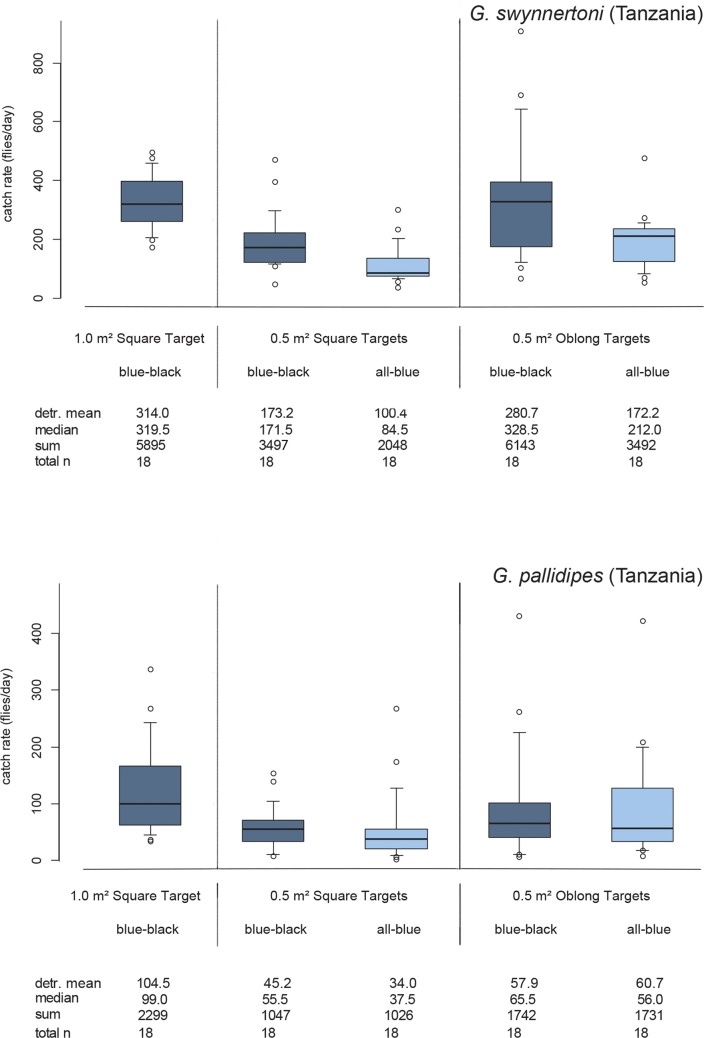
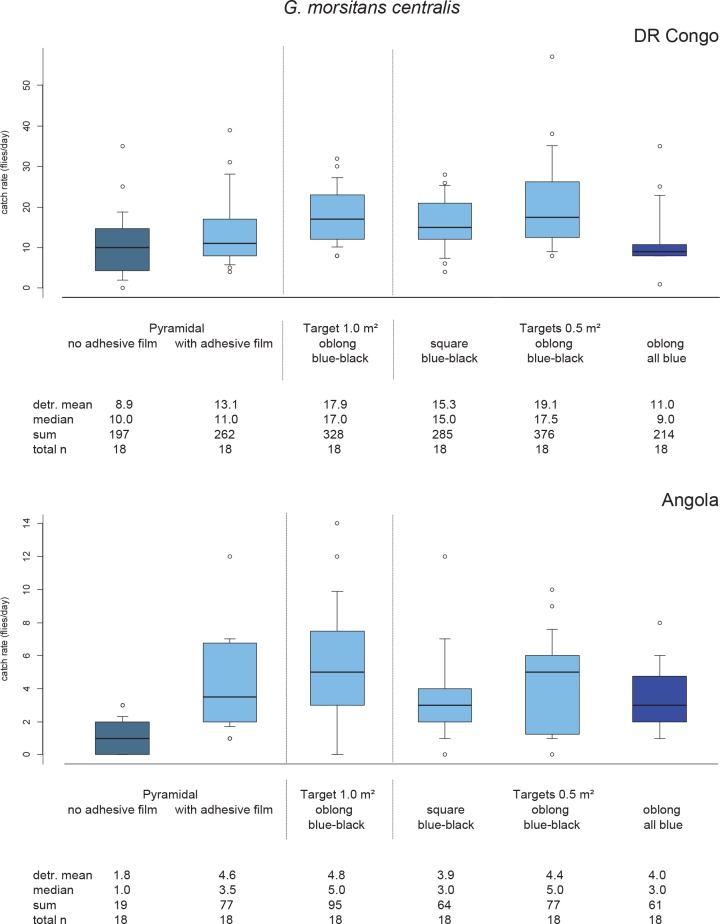
Trials were conducted in different seasons and years in Tanzania (G. swynnertoni) and in Angola and the Democratic Republic of the Congo (DRC, G. m. centralis) to measure the performance of traps (pyramidal and epsilon) and targets of different sizes, shapes and colours, with and without chemical baits, at different population densities and under different environmental conditions. Adhesive film was used to catch flies landing on devices at the remote locations to compare tsetse-landing efficiencies. Landing rates by G. m. centralis in both Angola and the DRC were highest on blue-black 1 m2 oblong and 0.5 m2 square and oblong targets but were not significantly different from landings on the pyramidal trap. Landings by G. swynnertoni on 0.5 m2 blue-black oblong targets were likewise not significantly lower than on equivalent 1 m2 square targets. The length of target horizontal edge was closely correlated with landing rate. Blue-black 0.5 m2 targets performed better than equivalents in all-blue for both G. swynnertoni and G. m. centralis, although not consistently. Baiting with chemicals increased the proportion of G. m. centralis entering pyramidal traps.
This study confirms earlier findings on G. swynnertoni that smaller visual targets, down to 0.5 m2, would be as efficient as using 1 m2 targets for population management of this species. This is also the case for G. m. centralis. An insecticide-impregnated pyramidal trap would also constitute an effective control device for G. m. centralis.
本研究专注于东非和中非的 savannah 采采蝇物种 Glossina swynnertoni 和 G. morsitans centralis,它们分别是人和动物锥虫病的高效传播媒介。目的是开发持久、实用且具有成本效益的、视觉上吸引人的装置,以诱使这两个物种产生最强的降落反应,作为种群抑制的杀虫剂浸渍工具。
在坦桑尼亚(G. swynnertoni)和安哥拉以及刚果民主共和国(DRC,G. m. centralis)的不同季节和年份进行了试验,以测量不同大小、形状和颜色的陷阱(金字塔形和epsilon 形)和目标的性能,以及带有和不带有化学诱饵的情况下,在不同种群密度和不同环境条件下的性能。使用粘性膜来捕捉在偏远地区落在设备上的苍蝇,以比较采采蝇降落效率。在安哥拉和 DRC,G. m. centralis 的降落率在蓝色-黑色 1 m2 长方形和 0.5 m2 正方形和长方形目标上最高,但与金字塔形陷阱上的降落率没有显著差异。G. swynnertoni 在 0.5 m2 蓝色-黑色长方形目标上的降落率也与在等效 1 m2 正方形目标上的降落率没有显著差异。目标水平边缘的长度与降落率密切相关。蓝色-黑色 0.5 m2 目标在所有蓝色的情况下都比 G. swynnertoni 和 G. m. centralis 的等效物表现更好,尽管并不总是如此。用化学物质诱饵增加了 G. m. centralis 进入金字塔形陷阱的比例。
本研究证实了之前对 G. swynnertoni 的发现,即对于这种物种的种群管理,更小的视觉目标,小至 0.5 m2,将与使用 1 m2 目标一样有效。对于 G. m. centralis 也是如此。浸渍杀虫剂的金字塔形陷阱也将成为 G. m. centralis 的有效控制装置。