Lundwall Kristina, Jacobson Stefan H, Jörneskog Gun, Spaak Jonas
Department of Clinical Sciences, Danderyd University Hospital, Karolinska Institutet, Stockholm, Sweden.
Department of Cardiology, Danderyd University Hospital, 182 88, Stockholm, Sweden.
BMC Nephrol. 2018 Sep 25;19(1):247. doi: 10.1186/s12882-018-1042-y.
Vitamin D deficiency is common in patients with chronic kidney disease (CKD), and is associated with endothelial dysfunction and cardiovascular disease. We performed a meta-analysis to assess the effect of vitamin D treatment on flow mediated vasodilation (FMD) in CKD patients.
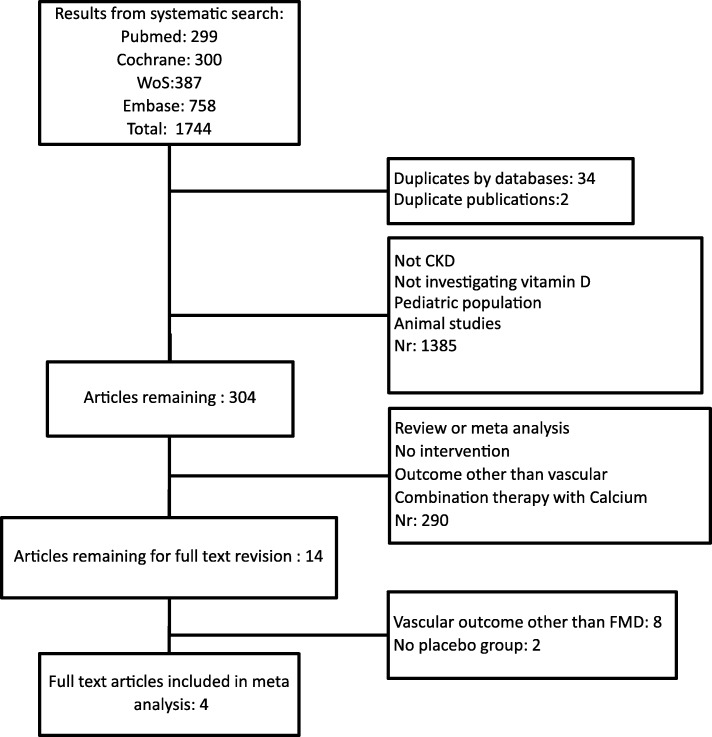
PubMed/Medline, Web of Science, Embase and Cochrane trials and reviews were searched systematically for randomized controlled trials (RCT:s) using any vitamin D compound, at any stage of CKD, with FMD as outcome. Fixed and random effects models were performed using the standardized mean difference effect size post treatment for each trial. Heterogeneity was assessed by I statistics.
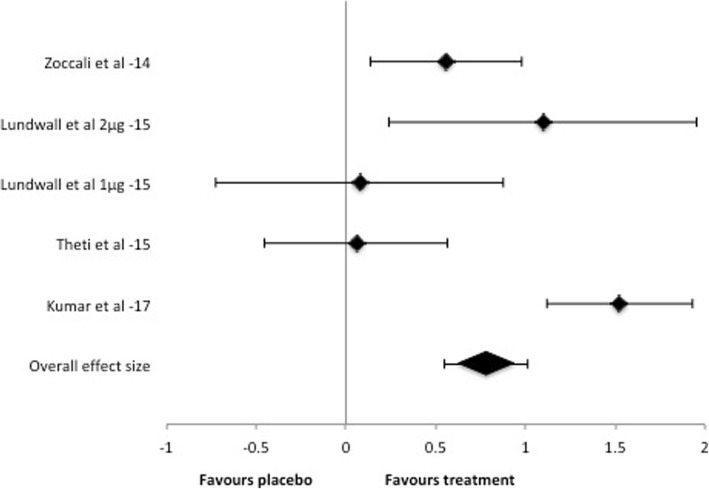
4 trials were included, comprising 305 patients. One used both 1 and 2 μg for two intervention groups and was therefore split in two during the analysis. Patients in the included trials had a mean age of 44-65 years and were all in CKD 3 to 4. One study used cholecalciferol, the others all used paricalcitol as treatment. Study duration was 12-16 weeks. Intervention with vitamin D was associated with ameliorated FMD (STANDmean ES 0.78, 95% CI 0.55-1.01) in a fixed model. Heterogeneity was substantial (I = 84%). Secondary analysis with random model analysis also showed significant results.
Short term intervention with vitamin D is associated with improvements in endothelial function, as measured by FMD. This indicates positive effects of vitamin D on vascular disease in CKD. Limitations of this meta-analysis are the small number of studies performed, and the short duration of intervention.
维生素D缺乏在慢性肾脏病(CKD)患者中很常见,并且与内皮功能障碍和心血管疾病相关。我们进行了一项荟萃分析,以评估维生素D治疗对CKD患者血流介导的血管舒张(FMD)的影响。
系统检索PubMed/Medline、科学网、Embase和Cochrane试验及综述,查找使用任何维生素D化合物、处于CKD任何阶段、以FMD为结局的随机对照试验(RCT)。对每个试验使用治疗后标准化均数差值效应量,进行固定效应模型和随机效应模型分析。通过I统计量评估异质性。
纳入4项试验,共305例患者。其中1项试验对两个干预组分别使用了1μg和2μg剂量,因此在分析时拆分为两项。纳入试验的患者平均年龄为44 - 65岁,均处于CKD 3至4期。1项研究使用胆钙化醇,其他研究均使用帕立骨化醇作为治疗药物。研究持续时间为12 - 16周。在固定效应模型中,维生素D干预与FMD改善相关(标准化均数差值效应量为0.78,95%置信区间为0.55 - 1.01)。异质性较大(I = 84%)。随机效应模型的二次分析也显示出显著结果。
维生素D短期干预与FMD所测量的内皮功能改善相关。这表明维生素D对CKD患者血管疾病具有积极作用。本荟萃分析存在研究数量少和干预持续时间短的局限性。