Habegger Simon, Wiest Roland, Weder Bruno J, Mordasini Pasquale, Gralla Jan, Häni Levin, Jung Simon, Reyes Mauricio, McKinley Richard
Support Center for Advanced Neuroimaging, Institute for Diagnostic and Interventional Neuroradiology, Inselspital, University of Bern, Bern, Switzerland.
Department of Neurosurgery, Inselspital, University of Bern, Bern, Switzerland.
Front Neurol. 2018 Sep 11;9:737. doi: 10.3389/fneur.2018.00737. eCollection 2018.
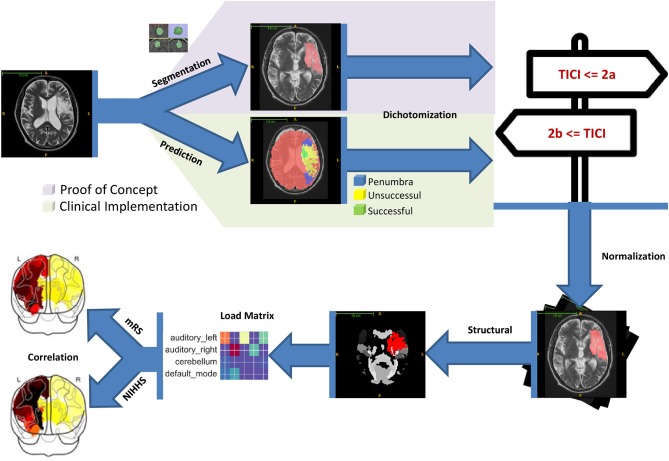
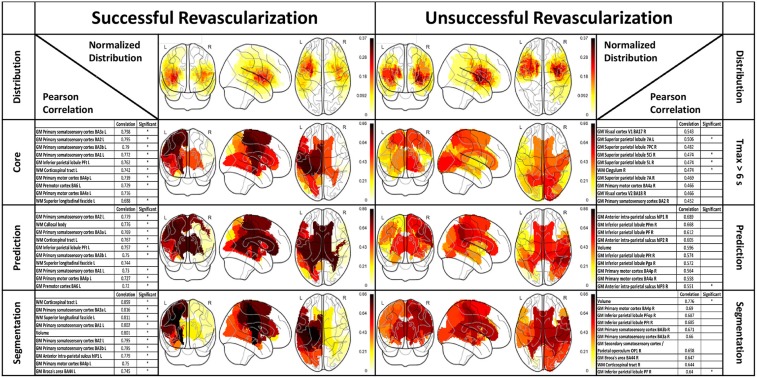
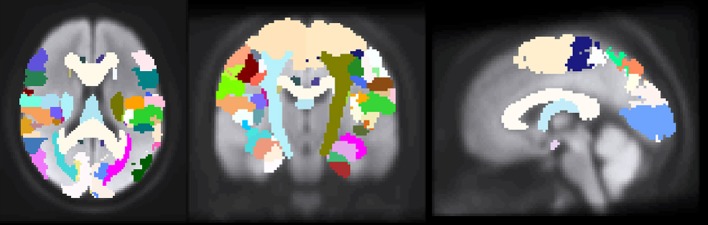
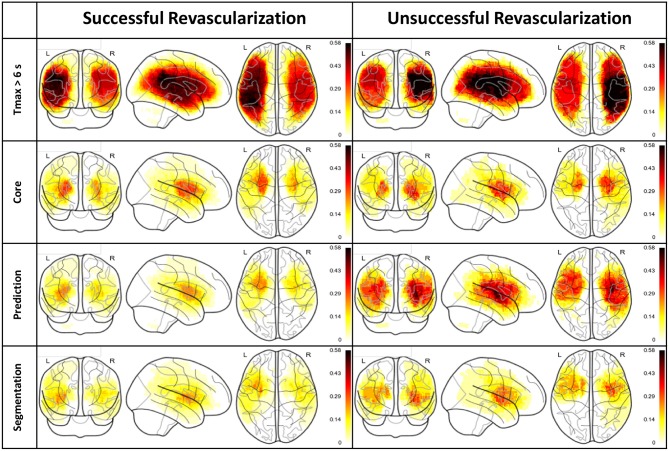
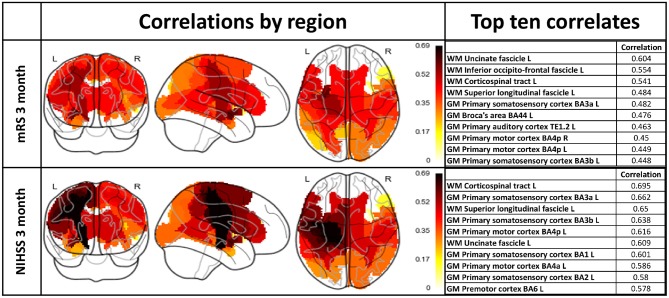
To investigate the relationship between imaging features derived from lesion loads and 3 month clinical assessments in ischemic stroke patients. To support clinically implementable predictive modeling with information from lesion-load features. A retrospective cohort of ischemic stroke patients was studied. The dataset was dichotomized based on revascularization treatment outcome (TICI score). Three lesion delineations were derived from magnetic resonance imaging in each group: two clinically implementable (threshold based and fully automatic prediction) and 90-day follow-up as final groundtruth. Lesion load imaging features were created through overlay of the lesion delineations on a histological brain atlas, and were correlated with the clinical assessment (NIHSS). Significance of the correlations was assessed by constructing confidence intervals using bootstrap sampling. Overall, high correlations between lesion loads and clinical score were observed (up to 0.859). Delineations derived from acute imaging yielded on average somewhat lower correlations than delineations derived from 90-day follow-up imaging. Correlations suggest that both total lesion volume and corticospinal tract lesion load are associated with functional outcome, and in addition highlight other potential areas associated with poor clinical outcome, including the primary somatosensory cortex BA3a. Fully automatic prediction was comparable to ADC threshold-based delineation on the successfully treated cohort and superior to the Tmax threshold-based delineation in the unsuccessfully treated cohort. The confirmation of established predictors for stroke outcome (e.g., corticospinal tract integrity and total lesion volume) gives support to the proposed methodology-relating acute lesion loads to 3 month outcome assessments by way of correlation. Furthermore, the preliminary results indicate an association of further brain regions and structures with three month NIHSS outcome assessments. Hence, prediction models might observe an increased accuracy when incorporating regional (instead of global) lesion loads. Also, the results lend support to the clinical utilization of the automatically predicted volumes from FASTER, rather than the simpler DWI and PWI lesion delineations.
探讨缺血性脑卒中患者基于病变负荷得出的影像特征与3个月临床评估之间的关系。利用病变负荷特征信息支持临床可实施的预测模型。对一组缺血性脑卒中患者进行回顾性队列研究。根据血管再通治疗结果(TICI评分)将数据集进行二分。每组通过磁共振成像得出三种病变轮廓:两种临床可实施的(基于阈值和全自动预测)以及90天随访作为最终标准真值。通过将病变轮廓叠加在组织学脑图谱上创建病变负荷影像特征,并将其与临床评估(美国国立卫生研究院卒中量表)相关联。通过使用自助抽样构建置信区间来评估相关性的显著性。总体而言,观察到病变负荷与临床评分之间存在高度相关性(高达0.859)。与90天随访影像得出的轮廓相比,急性影像得出的轮廓平均相关性略低。相关性表明,总病变体积和皮质脊髓束病变负荷均与功能结局相关,此外还突出了与临床结局不佳相关的其他潜在区域,包括初级躯体感觉皮层BA3a。在成功治疗的队列中,全自动预测与基于ADC阈值的轮廓相当,在未成功治疗的队列中优于基于Tmax阈值的轮廓。对已确立的卒中结局预测指标(如皮质脊髓束完整性和总病变体积)的确认支持了所提出的将急性病变负荷与3个月结局评估通过相关性联系起来的方法。此外,初步结果表明其他脑区和结构与3个月美国国立卫生研究院卒中量表结局评估之间存在关联。因此,当纳入区域(而非整体)病变负荷时,预测模型的准确性可能会提高。而且,结果支持在临床中使用FASTER自动预测的体积,而非更简单的扩散加权成像和灌注加权成像病变轮廓。