Martin E M, Schirmer J M, Jones S L, Davis J L
North Carolina State University College of Veterinary Medicine, Raleigh, North Carolina, USA.
VA-MD College of Veterinary Medicine, Blacksburg, Virginia, USA.
Equine Vet J. 2019 May;51(3):415-421. doi: 10.1111/evj.13024. Epub 2018 Oct 23.
Misoprostol is an E prostanoid (EP) 2, 3 and 4 receptor agonist that is anecdotally used to treat and prevent NSAID-induced GI injury in horses. Misoprostol elicits anti-inflammatory effects in vivo in men and rodents, and inhibits TNFα production in equine leucocytes in vitro.
Define the pharmacokinetic parameters of oral misoprostol in horses, and determine the inhibitory effect of oral misoprostol administration on equine leucocyte TNFα production in an ex vivo inflammation model.
Pharmacokinetic study, ex vivo experimental study.
Six healthy adult horses of mixed breeds were used. In phase one, horses were given 5 μg/kg misoprostol orally, and blood was collected at predetermined times for determination of misoprostol free acid (MFA) by UHPLC-MS/MS. Pharmacokinetic parameters were calculated. In phase two, horses were dosed as in phase one, and blood was collected at T0, 0.5, 1 and 4 h following misoprostol administration for leucocyte isolation. Leucocytes were stimulated with 100 ng/mL LPS, and TNFα mRNA concentrations were determined via quantitative real-time PCR.
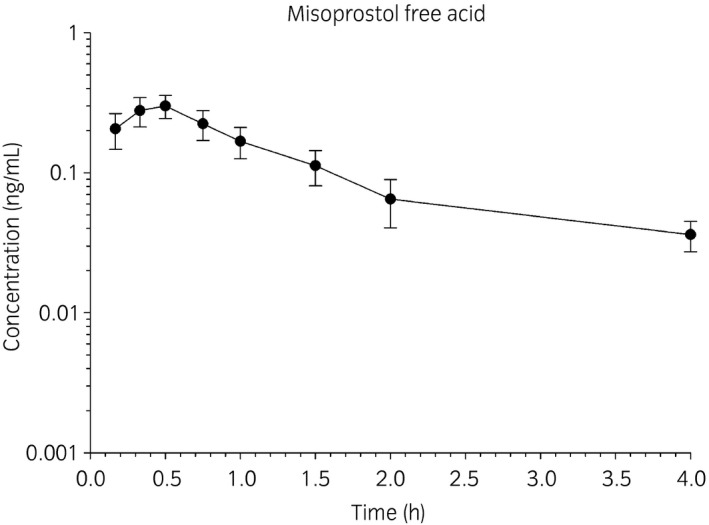
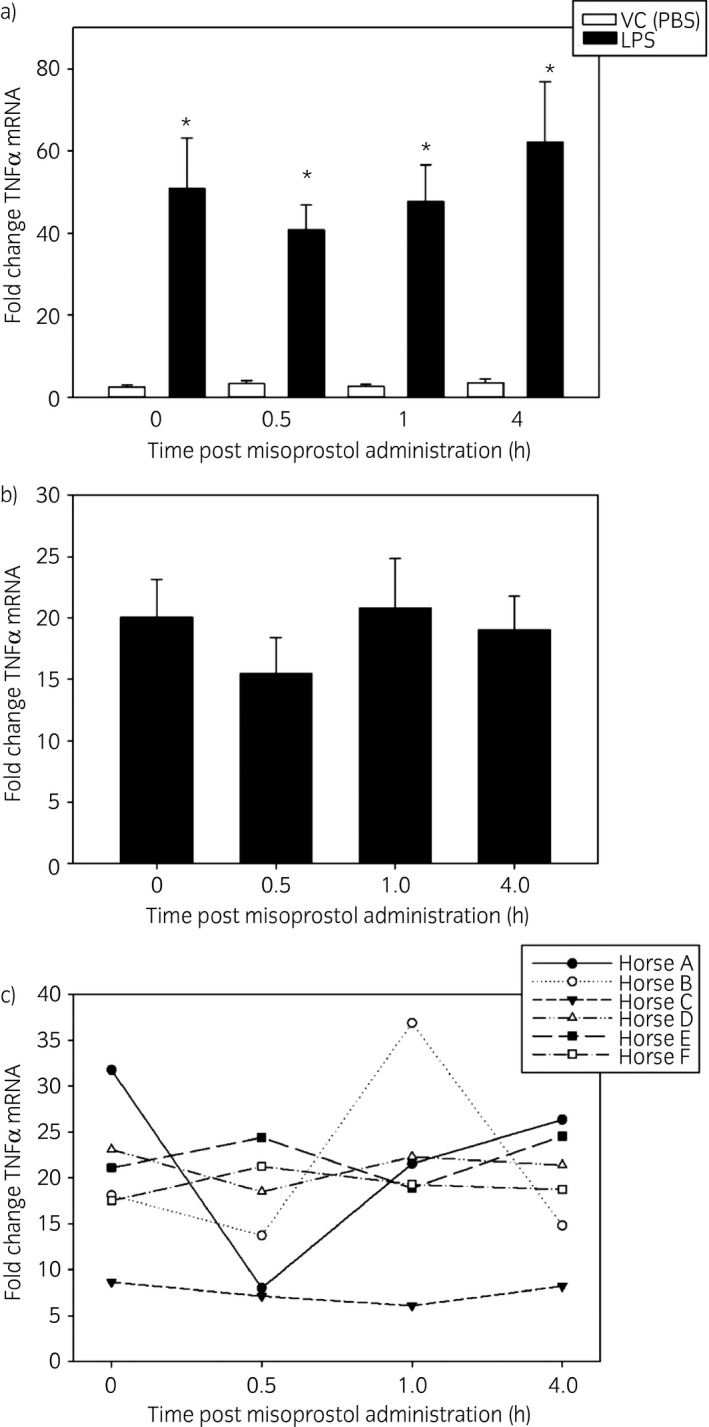
About 5 μg/kg oral misoprostol produced a rapid time to maximum concentration (T ) of 23.4 ± 2.4 min, with a maximum concentration (C ) of 0.29 ± 0.07 ng/mL and area under the curve (AUC ) of 0.4 ± 0.12 h ng/mL. LPS stimulation of equine leucocytes ex vivo significantly increased TNFα mRNA concentrations, and there was no significant effect of misoprostol even at the T .
Only a single dose was used, and sample size was small.
Misoprostol is rapidly absorbed following oral administration in horses, and a single 5 μg/kg dose had no significant inhibitory effect on ex vivo LPS-stimulated TNFα mRNA production in leucocytes. Further studies analysing different dosing strategies, including repeat administration or combination with other anti-inflammatory drugs, are warranted.
米索前列醇是一种E前列腺素(EP)2、3和4受体激动剂,据传闻可用于治疗和预防马匹非甾体抗炎药(NSAID)引起的胃肠道损伤。米索前列醇在人和啮齿动物体内具有抗炎作用,并在体外抑制马白细胞中肿瘤坏死因子α(TNFα)的产生。
确定马匹口服米索前列醇的药代动力学参数,并在体外炎症模型中确定口服米索前列醇对马白细胞TNFα产生的抑制作用。
药代动力学研究,体外实验研究。
使用6匹健康的成年杂种马。在第一阶段,给马口服5μg/kg米索前列醇,并在预定时间采集血液,通过超高效液相色谱-串联质谱法(UHPLC-MS/MS)测定米索前列醇游离酸(MFA)。计算药代动力学参数。在第二阶段,马匹给药方式同第一阶段,在米索前列醇给药后0、0.5、1和4小时采集血液用于分离白细胞。用100 ng/mL脂多糖(LPS)刺激白细胞,并通过定量实时聚合酶链反应(PCR)测定TNFα mRNA浓度。
口服约5μg/kg米索前列醇后,达峰时间(Tmax)迅速,为23.4±2.4分钟,最大浓度(Cmax)为0.29±0.07 ng/mL,曲线下面积(AUC)为0.4±0.12 h ng/mL。体外LPS刺激马白细胞显著增加了TNFα mRNA浓度,即使在达峰时间,米索前列醇也没有显著作用。
仅使用了单剂量,样本量较小。
马匹口服米索前列醇后吸收迅速,单次5μg/kg剂量对体外LPS刺激的白细胞TNFα mRNA产生没有显著抑制作用。有必要进一步研究分析不同的给药策略,包括重复给药或与其他抗炎药物联合使用。