Ernest and Julio Gallo Management Program, Management of Complex Systems Department, School of Engineering, University of California, Merced, CA 95343, USA
J R Soc Interface. 2018 Sep 26;15(146):20180580. doi: 10.1098/rsif.2018.0580.
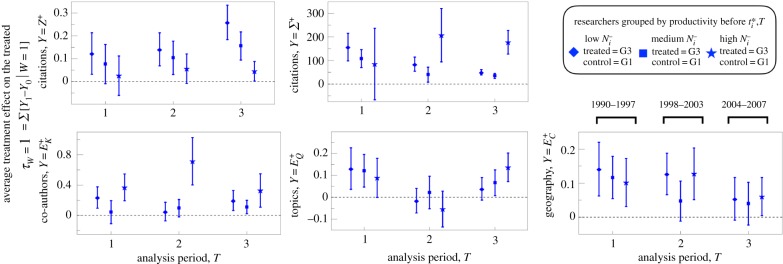
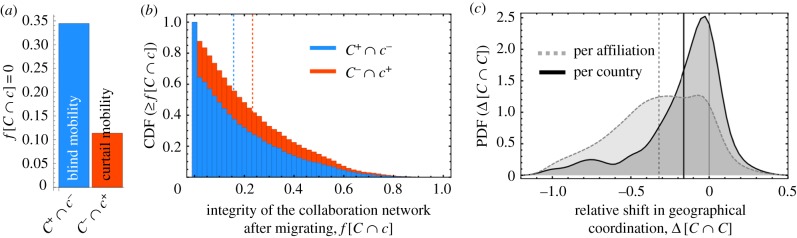
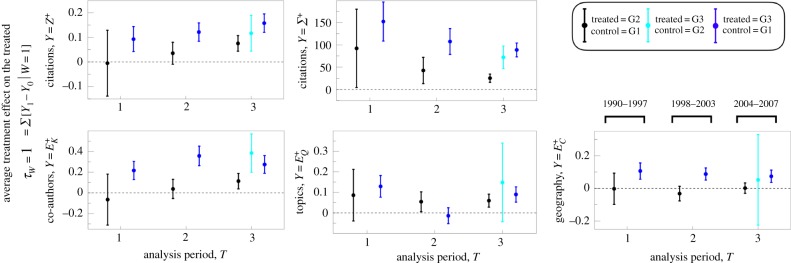
International mobility facilitates the exchange of scientific, institutional and cultural knowledge. Yet whether globalization and advances in virtual communication technologies have altered the impact of researcher mobility is a relevant and open question that we address by analysing a broad international set of 26 170 physicists from 1980 to 2009, focusing on the 10-year period centred around each mobility event to assess the impact of mobility on research outcomes. We account for secular globalization trends by splitting the analysis into three periods, measuring for each period the effect of mobility on researchers' citation impact, research topic diversity, collaboration networks and geographical coordination. In order to identify causal effects we leverage statistical matching methods that pair mobile researchers with non-mobile researchers that are similar in research profile attributes prior the mobility event. We find that mobile researchers gain up to a 17% increase in citations relative to their non-mobile counterparts, which can be explained by the simultaneous increase in their diversity of co-authors, topics and geographical coordination in the period immediately following migration. Nevertheless, we also observe that researcher's completely curtail prior collaborations with their source country in 11% of the cross-border mobility events. As such, these individual-level perturbations fuel multiscale churning in scientific networks, e.g. rewiring the connectivity of individuals and ideas and affecting international integration. Together these results provide additional clarity on the complex relationship between human capital mobility and the dynamics of social capital investment, with implications for immigration and national innovation system policy.
国际流动促进了科学、机构和文化知识的交流。然而,全球化和虚拟通信技术的进步是否改变了研究人员流动的影响,这是一个相关的开放性问题,我们通过分析一组来自 1980 年至 2009 年的 26170 名物理学家的广泛国际数据集来解决这个问题,重点关注每个流动事件前后的 10 年时间,以评估流动对研究成果的影响。我们通过将分析分为三个时期来考虑长期的全球化趋势,为每个时期衡量流动对研究人员引用影响力、研究主题多样性、合作网络和地理协调的影响。为了识别因果效应,我们利用统计匹配方法,在流动事件之前,根据研究概况属性,将流动研究人员与非流动研究人员进行配对。我们发现,流动研究人员的引用量相对于非流动研究人员增加了 17%,这可以解释为他们在迁移后的时期内,合著者、主题和地理协调的多样性同时增加。然而,我们也观察到,在 11%的跨境流动事件中,研究人员完全终止了与原籍国的先前合作。因此,这些个体层面的干扰推动了科学网络的多尺度混乱,例如重新连接个人和思想的连接性,并影响了国际融合。这些结果共同为人力资本流动与社会资本投资动态之间的复杂关系提供了更多的明确性,对移民和国家创新系统政策具有重要意义。