CSIRO Manufacturing, PO Box 218, Lindfield, NSW, 2070, Australia.
CSIRO Agriculture and Food, Australian Cotton Research Institute, Narrabri, NSW, 2390, Australia.
Sci Rep. 2018 Sep 26;8(1):14372. doi: 10.1038/s41598-018-32692-9.
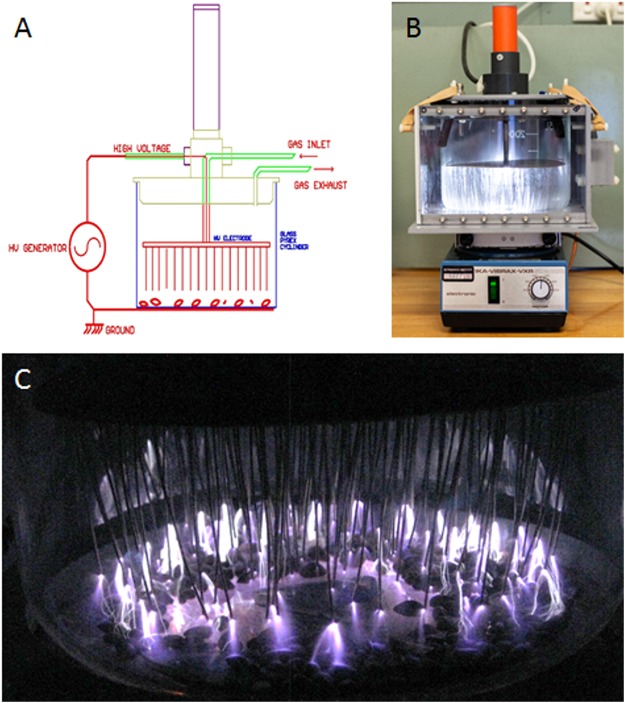
Adverse environmental conditions at planting, such as cold temperature or water limitation, can lead to a reduced level of seed germination and plant establishment for cotton. Cold atmospheric-pressure plasma (CAP) treatment of cotton seeds prior to planting may help alleviate this problem. CAP is ionised gas that has a range of biological activities due to the formation of a mix of reactive oxygen and nitrogen species (RONS), excited molecules, charged particles and UV photons. Our results show that a 27 minutes CAP treatment using air can significantly increase water absorption of the seed, and improve warm germination, metabolic chill test germination and chilling tolerance in cotton. We also observe that the beneficial effect of CAP treatment is long-lasting and stable as improved germination activity is still seen when treatment occurs 4 months before germination testing, suggesting that future large-scale industrial seed plasma treatments may still be effectively applied well (months) before the seed planting. We conclude that CAP treatment is a promising new tool for use in the cotton industry that has the potential to significantly improve plant establishment in a wider range of environmental conditions.
种植时的不利环境条件,如低温或水分限制,可能导致棉花种子的发芽率和植物定植率降低。在种植前对棉花种子进行冷大气压等离子体 (CAP) 处理可能有助于缓解这个问题。CAP 是一种电离气体,由于形成混合的活性氧和氮物种 (RONS)、激发分子、带电粒子和紫外光子,具有多种生物学活性。我们的结果表明,使用空气进行 27 分钟的 CAP 处理可以显著增加种子的吸水性,并提高棉花的温暖发芽、代谢冷却试验发芽和耐冷性。我们还观察到,CAP 处理的有益效果是持久而稳定的,因为即使在发芽试验前 4 个月进行处理,仍然可以看到发芽活性得到改善,这表明未来大规模的工业种子等离子体处理在种子种植前几个月(数月)仍然可以有效地应用。我们得出结论,CAP 处理是棉花产业中一种有前途的新工具,有可能在更广泛的环境条件下显著提高植物定植率。