Alzheimer Center Amsterdam, Department of Neurology, Amsterdam Neuroscience, Vrije Universiteit Amsterdam, Amsterdam UMC, Amsterdam, The Netherlands.
Department of Clinical Genetics, Amsterdam UMC, Amsterdam, The Netherlands.
Eur J Hum Genet. 2019 Feb;27(2):244-253. doi: 10.1038/s41431-018-0273-5. Epub 2018 Sep 26.
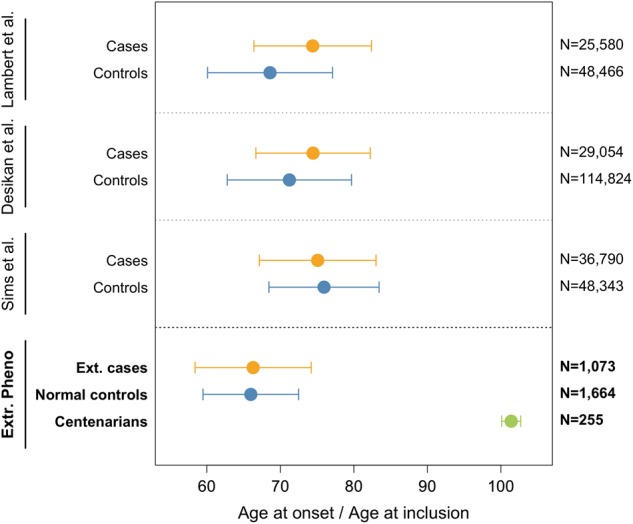
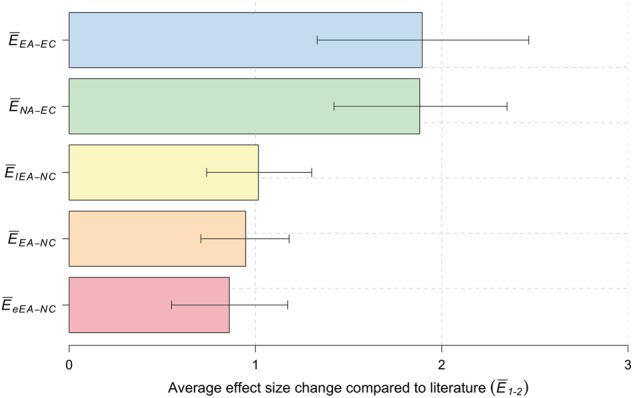
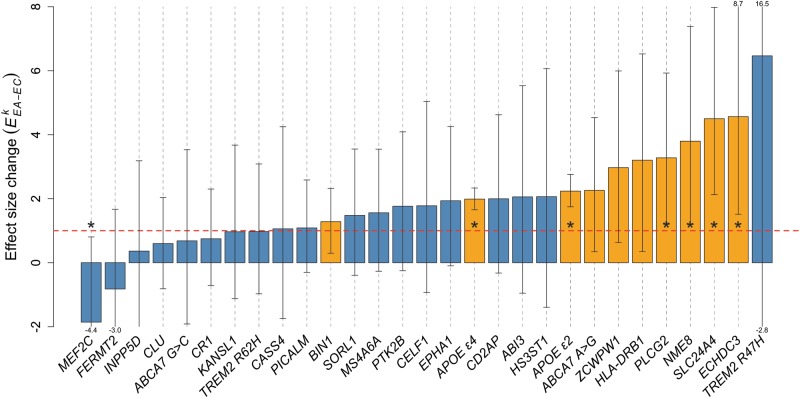
The detection of genetic loci associated with Alzheimer's disease (AD) requires large numbers of cases and controls because variant effect sizes are mostly small. We hypothesized that variant effect sizes should increase when individuals who represent the extreme ends of a disease spectrum are considered, as their genomes are assumed to be maximally enriched or depleted with disease-associated genetic variants. We used 1,073 extensively phenotyped AD cases with relatively young age at onset as extreme cases (66.3 ± 7.9 years), 1,664 age-matched controls (66.0 ± 6.5 years) and 255 cognitively healthy centenarians as extreme controls (101.4 ± 1.3 years). We estimated the effect size of 29 variants that were previously associated with AD in genome-wide association studies. Comparing extreme AD cases with centenarian controls increased the variant effect size relative to published effect sizes by on average 1.90-fold (SE = 0.29, p = 9.0 × 10). The effect size increase was largest for the rare high-impact TREM2 (R74H) variant (6.5-fold), and significant for variants in/near ECHDC3 (4.6-fold), SLC24A4-RIN3 (4.5-fold), NME8 (3.8-fold), PLCG2 (3.3-fold), APOE-ε2 (2.2-fold), and APOE-ε4 (twofold). Comparing extreme phenotypes enabled us to replicate the AD association for 10 variants (p < 0.05) in relatively small samples. The increase in effect sizes depended mainly on using centenarians as extreme controls: the average variant effect size was not increased in a comparison of extreme AD cases and age-matched controls (0.94-fold, p = 6.8 × 10), suggesting that on average the tested genetic variants did not explain the extremity of the AD cases. Concluding, using centenarians as extreme controls in AD case-control studies boosts the variant effect size by on average twofold, allowing the replication of disease-association in relatively small samples.
我们假设,当考虑代表疾病谱两端的个体时,变体的效应大小应该会增加,因为这些个体的基因组应该最大程度地富集或耗尽与疾病相关的遗传变体。我们使用了 1073 名经过广泛表型分析的 AD 病例作为极端病例(发病年龄为 66.3±7.9 岁),1664 名年龄匹配的对照者(66.0±6.5 岁)和 255 名认知健康的百岁老人作为极端对照者(101.4±1.3 岁)。我们估计了 29 个先前在全基因组关联研究中与 AD 相关的变体的效应大小。与百岁老人对照者相比,极端 AD 病例的比较增加了平均 1.90 倍的变体效应大小(SE=0.29,p=9.0×10)。罕见高影响 TREM2(R74H)变体的效应大小增加最大(6.5 倍),而 ECHDC3 内/附近(4.6 倍)、SLC24A4-RIN3(4.5 倍)、NME8(3.8 倍)、PLCG2(3.3 倍)、APOE-ε2(2.2 倍)和 APOE-ε4(两倍)的变体也具有显著的效应大小增加。比较极端表型使我们能够在相对较小的样本中复制 10 个与 AD 相关的变体(p<0.05)。效应大小的增加主要取决于使用百岁老人作为极端对照者:极端 AD 病例与年龄匹配的对照者之间的平均变体效应大小没有增加(0.94 倍,p=6.8×10),这表明平均而言,所测试的遗传变体并未解释 AD 病例的极端性。结论是,在 AD 病例对照研究中,使用百岁老人作为极端对照者可使变体的效应大小平均增加两倍,从而使疾病关联在相对较小的样本中得以复制。