Department of Psychiatry and Behavioral Sciences, University of California, Davis, USA.
UC Davis MIND Institute, University of California, Davis, USA.
Transl Psychiatry. 2018 Sep 26;8(1):202. doi: 10.1038/s41398-018-0244-1.
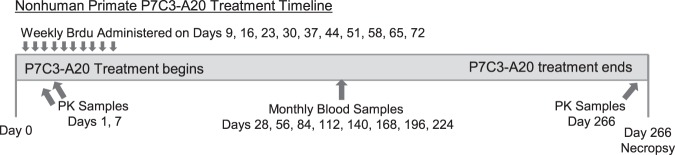
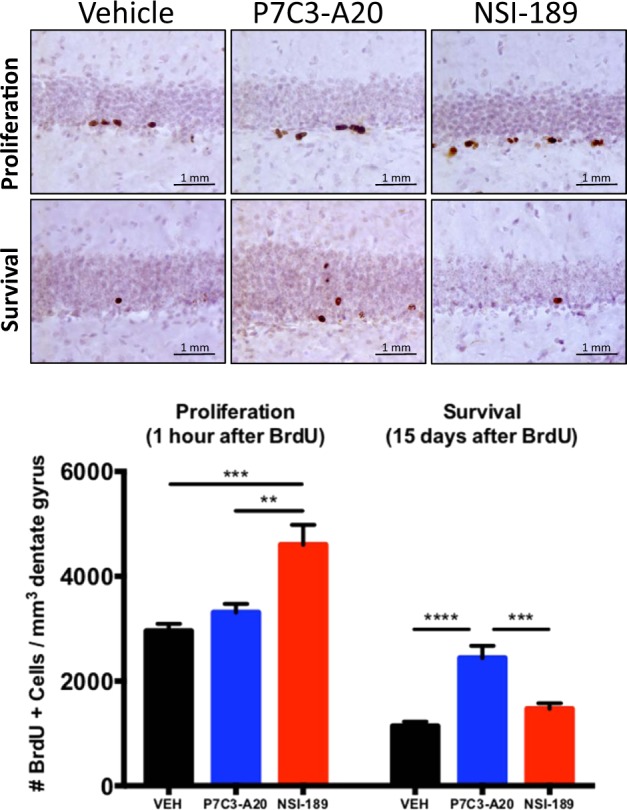
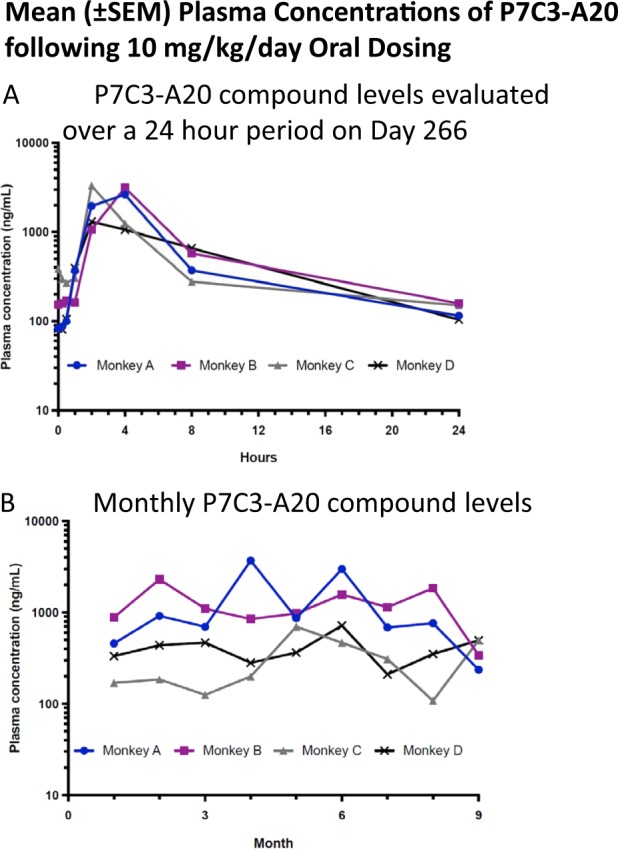
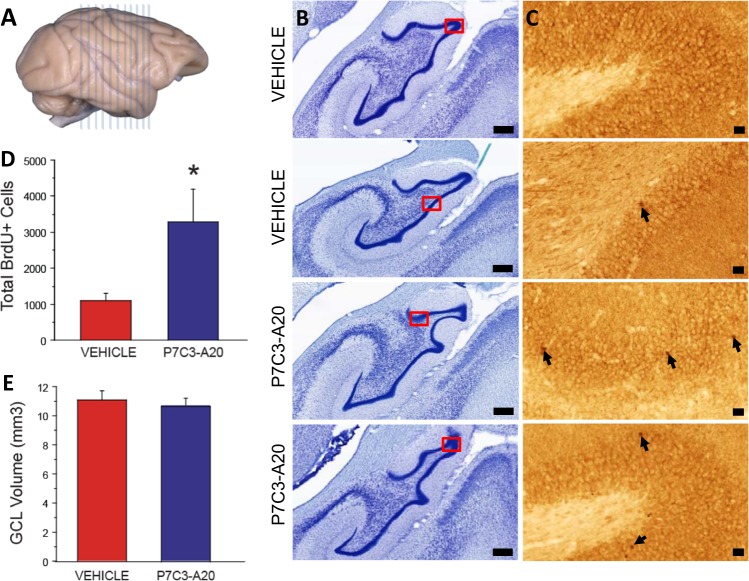
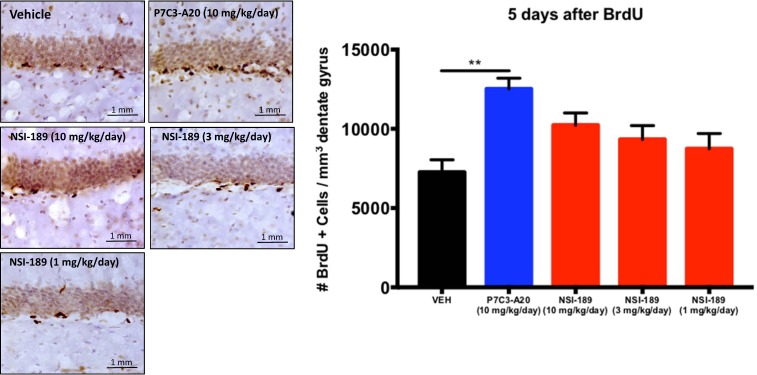
There is a critical need for translating basic science discoveries into new therapeutics for patients suffering from difficult to treat neuropsychiatric and neurodegenerative conditions. Previously, a target-agnostic in vivo screen in mice identified P7C3 aminopropyl carbazole as capable of enhancing the net magnitude of postnatal neurogenesis by protecting young neurons from death. Subsequently, neuroprotective efficacy of P7C3 compounds in a broad spectrum of preclinical rodent models has also been observed. An important next step in translating this work to patients is to determine whether P7C3 compounds exhibit similar efficacy in primates. Adult male rhesus monkeys received daily oral P7C3-A20 or vehicle for 38 weeks. During weeks 2-11, monkeys received weekly injection of 5'-bromo-2-deoxyuridine (BrdU) to label newborn cells, the majority of which would normally die over the following 27 weeks. BrdU+ cells were quantified using unbiased stereology. Separately in mice, the proneurogenic efficacy of P7C3-A20 was compared to that of NSI-189, a proneurogenic drug currently in clinical trials for patients with major depression. Orally-administered P7C3-A20 provided sustained plasma exposure, was well-tolerated, and elevated the survival of hippocampal BrdU+ cells in nonhuman primates without adverse central or peripheral tissue effects. In mice, NSI-189 was shown to be pro-proliferative, and P7C3-A20 elevated the net magnitude of hippocampal neurogenesis to a greater degree than NSI-189 through its distinct mechanism of promoting neuronal survival. This pilot study provides evidence that P7C3-A20 safely protects neurons in nonhuman primates, suggesting that the neuroprotective efficacy of P7C3 compounds is likely to translate to humans as well.
目前迫切需要将基础科学发现转化为治疗神经精神和神经退行性疾病患者的新疗法。此前,一项在小鼠体内进行的无靶点筛选发现,P7C3 氨基丙基咔唑能够通过保护年轻神经元免于死亡来增强出生后神经发生的净幅度。随后,还观察到 P7C3 化合物在广泛的临床前啮齿动物模型中的神经保护功效。将这项工作转化为患者的重要下一步是确定 P7C3 化合物在灵长类动物中是否表现出相似的疗效。成年雄性恒河猴每天口服 P7C3-A20 或载体 38 周。在第 2-11 周,猴子每周接受 5'-溴脱氧尿苷 (BrdU) 注射以标记新生细胞,其中大多数细胞通常会在接下来的 27 周内死亡。使用无偏立体学方法对 BrdU+细胞进行定量。另外,在小鼠中,将 P7C3-A20 的促神经发生功效与 NSI-189 进行了比较,后者是一种促神经发生药物,目前正在接受患有重度抑郁症的患者的临床试验。口服 P7C3-A20 可提供持续的血浆暴露,耐受性良好,并可提高非人类灵长类动物海马体 BrdU+细胞的存活率,而不会对中枢或外周组织产生不良反应。在小鼠中,NSI-189 被证明具有促增殖作用,而 P7C3-A20 通过促进神经元存活的独特机制,将海马体神经发生的净幅度提高到更大程度。这项初步研究提供了证据表明,P7C3-A20 可安全保护非人类灵长类动物的神经元,表明 P7C3 化合物的神经保护功效也可能在人类中得到体现。