Fejzo Marlena S, Arzy Daria, Tian Rayna, MacGibbon Kimber W, Mullin Patrick M
Division of Hematology-Oncology, David Geffen School of Medicine, University of California, Los Angeles, Los Angeles, CA, USA.
Department of Maternal-Fetal Medicine, Keck School of Medicine, University of Southern California, Los Angeles, CA, USA.
Geburtshilfe Frauenheilkd. 2018 Sep;78(9):866-870. doi: 10.1055/a-0661-0287. Epub 2018 Sep 14.
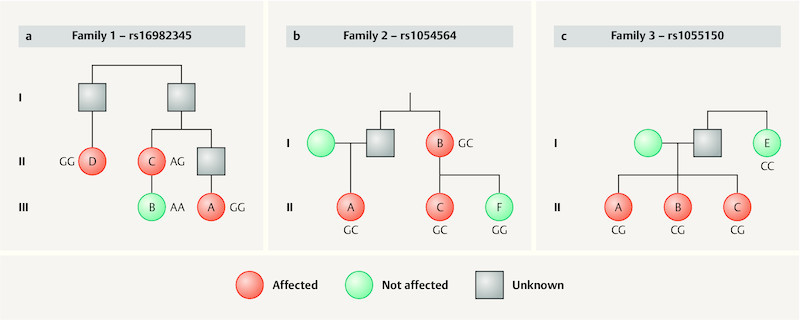
Hyperemesis gravidarum (HG), a pregnancy complication characterized by severe nausea and vomiting in pregnancy, occurs in up to 2% of pregnancies. It is associated with both maternal and fetal morbidity. HG is highly heritable and recurs in approximately 80% of women. In a recent genome-wide association study, it was shown that placentation, appetite, and the cachexia gene are linked to HG. The purpose of this study was to explore whether alleles linked to overexpression of GDF15 protein segregate with the condition in families, and whether the GDF15 risk allele is associated with recurrence of HG. We analyzed overexpression alleles for segregation with disease using exome-sequencing data from 5 HG families. We compared the allele frequency of the GDF15 risk allele, rs16982345, in patients who had recurrence of HG with its frequency in those who did not have recurrence. Single nucleotide polymorphisms (SNPs) linked to higher levels of GDF15 segregated with disease in HG families. The risk allele, rs16982345, was associated with an 8-fold higher risk of recurrence of HG. The findings of this study support the hypothesis that is involved in the pathogenesis of both familial and recurrent cases of HG. The findings may be applicable when counseling women with a familial history of HG or recurrent HG. The GDF15-GFRAL brainstem-activated pathway was recently identified and therapies to treat conditions of abnormal appetite are under development. Based on our findings, patients carrying variants associated with GDF15 overexpression should be included in future studies of GDF15-GFRAL-based therapeutics. If safe, this approach could reduce maternal and fetal morbidity.
妊娠剧吐(HG)是一种妊娠并发症,其特征为孕期严重恶心和呕吐,发生率高达2%的妊娠。它与母婴发病均有关联。HG具有高度遗传性,约80%的女性会复发。在最近一项全基因组关联研究中,表明胎盘形成、食欲和恶病质基因与HG有关。本研究的目的是探讨与生长分化因子15(GDF15)蛋白过表达相关的等位基因在家族中是否与该疾病共分离,以及GDF15风险等位基因是否与HG复发相关。我们使用来自5个HG家族的外显子测序数据,分析过表达等位基因与疾病的共分离情况。我们比较了HG复发患者中GDF15风险等位基因rs16982345的等位基因频率与其在未复发患者中的频率。与较高水平GDF15相关的单核苷酸多态性(SNP)在HG家族中与疾病共分离。风险等位基因rs16982345与HG复发风险高8倍相关。本研究结果支持GDF15参与HG家族性和复发性病例发病机制的假说。这些发现可能适用于为有HG家族史或复发性HG的女性提供咨询时。最近确定了GDF15 - GFRAL脑干激活途径,治疗食欲异常病症的疗法正在研发中。基于我们的发现,携带与GDF15过表达相关变异的患者应纳入未来基于GDF15 - GFRAL的治疗研究中。如果安全,这种方法可以降低母婴发病率。