Luthra Sakshi, Rominski Anna, Sander Peter
Institute of Medical Microbiology, University of Zurich, Zurich, Switzerland.
National Center for Mycobacteria, Zurich, Switzerland.
Front Microbiol. 2018 Sep 12;9:2179. doi: 10.3389/fmicb.2018.02179. eCollection 2018.
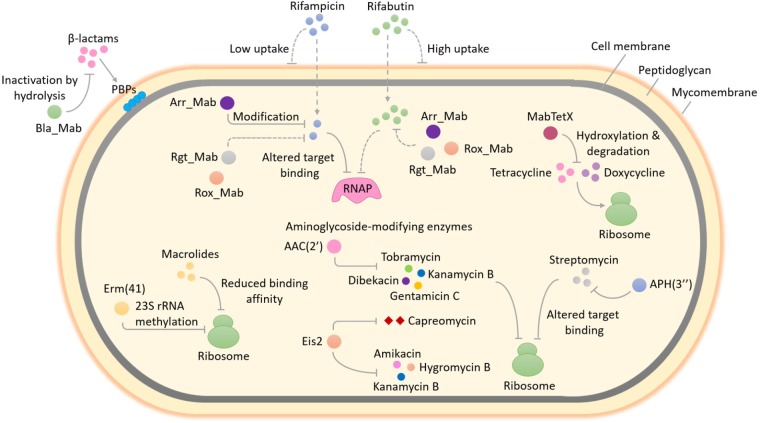
The incidence and prevalence of non-tuberculous mycobacterial (NTM) infections have been increasing worldwide and lately led to an emerging public health problem. Among rapidly growing NTM, is the most pathogenic and drug resistant opportunistic germ, responsible for disease manifestations ranging from "curable" skin infections to only "manageable" pulmonary disease. Challenges in treatment stem from the bacteria's high-level innate resistance and comprise long, costly and non-standardized administration of antimicrobial agents, poor treatment outcomes often related to adverse effects and drug toxicities, and high relapse rates. Drug resistance in is conferred by an assortment of mechanisms. Clinically acquired drug resistance is normally conferred by mutations in the target genes. Intrinsic resistance is attributed to low permeability of cell envelope as well as to (multi)drug export systems. However, expression of numerous enzymes by , which can modify either the drug-target or the drug itself, is the key factor for the pathogen's phenomenal resistance to most classes of antibiotics used for treatment of other moderate to severe infectious diseases, like macrolides, aminoglycosides, rifamycins, β-lactams and tetracyclines. In 2009, when genome sequence became available, several research groups worldwide started studying antibiotic resistance mechanisms. At first, lack of tools for genetic manipulation severely delayed research endeavors. Nevertheless, the last 5 years, significant progress has been made towards the development of conditional expression and homologous recombination systems for . As a result of recent research efforts, an erythromycin ribosome methyltransferase, two aminoglycoside acetyltransferases, an aminoglycoside phosphotransferase, a rifamycin ADP-ribosyltransferase, a β-lactamase and a monooxygenase were identified to frame the complex and multifaceted intrinsic resistome of , which clearly contributes to complications in treatment of this highly resistant pathogen. Better knowledge of the underlying mechanisms of drug resistance in could improve selection of more effective chemotherapeutic regimen and promote development of novel antimicrobials which can overwhelm the existing resistance mechanisms. This article reviews the currently elucidated molecular mechanisms of antibiotic resistance in , with a focus on its drug-target-modifying and drug-modifying enzymes.
非结核分枝杆菌(NTM)感染的发病率和患病率在全球范围内一直在上升,最近导致了一个新出现的公共卫生问题。在快速生长的NTM中,[具体菌名未给出]是最具致病性和耐药性的机会性致病菌,可导致从“可治愈”的皮肤感染到仅“可控制”的肺部疾病等各种疾病表现。[具体菌名未给出]治疗面临的挑战源于该细菌的高水平固有耐药性,包括抗菌药物的长期、昂贵且不规范使用,治疗效果不佳往往与不良反应和药物毒性有关,以及高复发率。[具体菌名未给出]的耐药性由多种机制赋予。临床获得性耐药通常由靶基因突变赋予。固有耐药性归因于[具体菌名未给出]细胞壁的低通透性以及(多)药物外排系统。然而,[具体菌名未给出]表达多种酶,这些酶可以修饰药物靶点或药物本身,这是该病原体对用于治疗其他中度至重度传染病的大多数抗生素类药物具有显著耐药性的关键因素,如大环内酯类、氨基糖苷类、利福霉素类、β-内酰胺类和四环素类。2009年,当[具体菌名未给出]的基因组序列可用时,全球多个研究小组开始研究[具体菌名未给出]的抗生素耐药机制。起初,缺乏用于[具体菌名未给出]基因操作的工具严重延迟了研究工作。然而,在过去的5年里,在开发[具体菌名未给出]的条件表达和同源重组系统方面取得了重大进展。由于最近的研究努力,鉴定出一种红霉素核糖体甲基转移酶、两种氨基糖苷乙酰转移酶、一种氨基糖苷磷酸转移酶、一种利福霉素ADP-核糖基转移酶、一种β-内酰胺酶和一种单加氧酶,以构建[具体菌名未给出]复杂且多方面的固有耐药组,这显然导致了治疗这种高度耐药病原体时出现并发症。更好地了解[具体菌名未给出]耐药性的潜在机制可以改善更有效化疗方案的选择,并促进能够克服现有耐药机制的新型抗菌药物的开发。本文综述了目前阐明的[具体菌名未给出]抗生素耐药的分子机制,重点关注其药物靶点修饰酶和药物修饰酶。