Colen Cynthia G, Krueger Patrick M, Boettner Bethany L
Department of Sociology, Ohio State University, 238 Townshend Hall, 1885 Neil Ave. Mall, Columbus, OH 43210, USA.
Department of Health & Behavioral Sciences, University of Colorado, Denver, USA.
SSM Popul Health. 2018 Jul 25;6:125-135. doi: 10.1016/j.ssmph.2018.07.004. eCollection 2018 Dec.
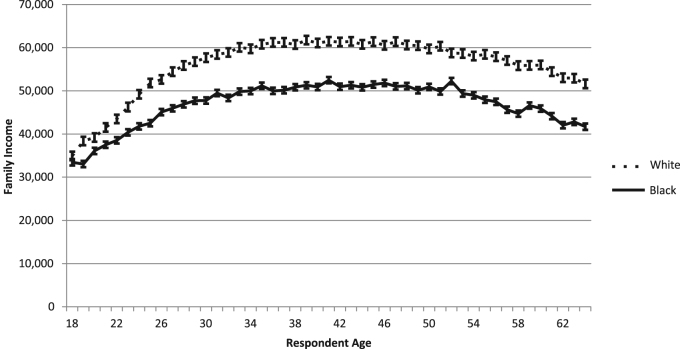
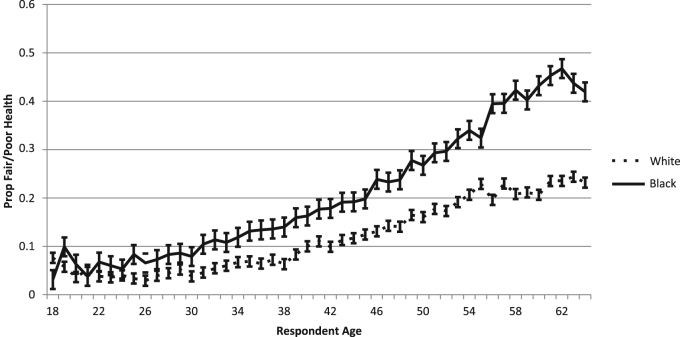
Although racial inequalities in health are well documented, much less is known about the underlying mechanisms that create and sustain these population patterns, especially among nonpoor subgroups. Using 20 waves of data from the Panel Study of Income Dynamics (PSID), we estimate the magnitude of the Black/White gap in self-rated health among middle-income, working-age (18-65) adults and explore potential sources of this disparity. Findings from multilevel regression models suggest that intragenerational gains in family income result in significantly smaller improvements in self-rated health for middle-class African-Americans than similarly situated Whites. We also note that childhood disadvantage predicts subsequent health trajectories in adulthood, but does little to explain the Black/White gap in the association between family income and self-rated health. We conclude that middle-class status provides restricted health returns to upward mobility for African-Americans and this differential relationship cannot be accounted for by greater exposure to early life disadvantage.
尽管健康方面的种族不平等有充分的文献记载,但对于造成并维持这些人口模式的潜在机制,我们所知甚少,尤其是在非贫困亚群体中。利用收入动态研究小组(PSID)的20波数据,我们估算了中等收入、工作年龄(18 - 65岁)成年人中黑人/白人自我评估健康差距的大小,并探究了这种差异的潜在根源。多层次回归模型的结果表明,与处境相似的白人相比,中产阶级非裔美国人家庭收入的代内增长所带来的自我评估健康改善要小得多。我们还注意到,童年时期的不利条件预示着成年后的健康轨迹,但对解释家庭收入与自我评估健康之间的黑人/白人差距作用不大。我们得出结论,中产阶级身份为非裔美国人向上流动带来的健康回报有限,而且这种差异关系不能用早年更多地暴露于不利条件来解释。