Knee Expert Center, Vijfkamplaan 8, 5624 EB, Eindhoven, The Netherlands.
Radboud University Medical Center, Research Institute for Health Sciences, IQ Healthcare, Nijmegen, The Netherlands.
Knee Surg Sports Traumatol Arthrosc. 2019 Feb;27(2):549-555. doi: 10.1007/s00167-018-5149-2. Epub 2018 Sep 27.
Athletes who meet return to play (RTP) criteria after anterior cruciate ligament reconstruction (ACLR) rehabilitation still have a substantially increased risk of second ACL injury. One of the contributing factors to this increased risk could be that the RTP criteria are often not tested in an ecologically valid environment and in a fatigued state. The purpose of this cross-sectional case-control study was to investigate the influence of neuromuscular fatigue on both movement quantity and quality in fully-rehabilitated soccer players after ACLR and to compare them with healthy soccer players.
ACL-reconstructed soccer players (n = 14) and healthy soccer players (n = 19) participated in the study and were matched by playing level and training hours. RTP measurements were performed on the soccer field, in both a non-fatigued and fatigued state. The RTP measurements focussed on both movement quantity (hop tests) and quality [countermovement jump with a Landing Error Scoring System (LESS) score].
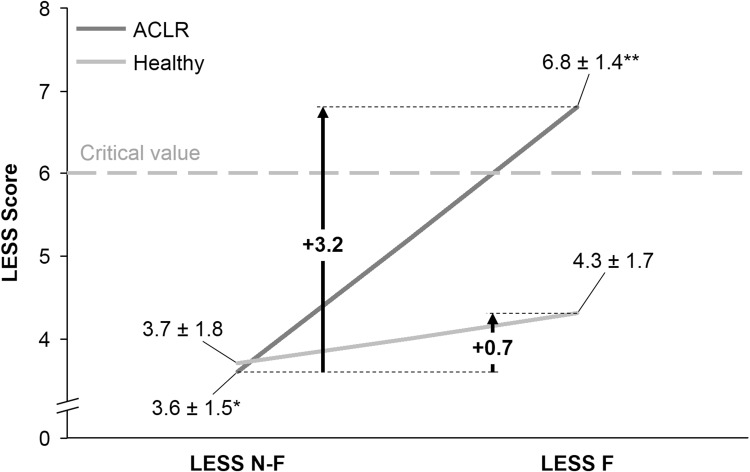
Movement quantity did not differ between ACL-reconstructed and healthy soccer players, both expressed in absolute values and the LSI-D/ND (calculated as dominant/non-dominant*100%). However, movement quality decreased more in the ACL-reconstructed soccer players in the fatigued state compared to the non-fatigued state.
Ideally, RTP measurements should focus on movement quality and should be conducted on the soccer field in a fatigued state, creating an ecologically valid environment. The LSI-D/ND can be used as an outcome parameter for RTP measurements of movement quantity and should be at least 95%.
Therapeutic, Level III.
在经历前交叉韧带重建(ACLR)康复后达到重返赛场(RTP)标准的运动员,其再次发生前交叉韧带损伤的风险仍然显著增加。导致这种风险增加的一个因素可能是,RTP 标准通常不在生态有效环境中和疲劳状态下进行测试。本横断面病例对照研究的目的是调查在 ACLR 后完全康复的足球运动员的神经肌肉疲劳对运动数量和质量的影响,并将其与健康足球运动员进行比较。
14 名 ACL 重建的足球运动员和 19 名健康足球运动员参加了这项研究,并根据比赛水平和训练时间进行匹配。在非疲劳和疲劳状态下,在足球场上进行 RTP 测量。RTP 测量侧重于运动数量(跳跃测试)和质量[反跳落地错误评分系统(LESS)评分的纵跳]。
ACL 重建的足球运动员和健康足球运动员在绝对数值和 LSI-D/ND(计算为优势/非优势*100%)方面的运动数量没有差异。然而,在疲劳状态下,ACL 重建的足球运动员的运动质量比非疲劳状态下下降更多。
理想情况下,RTP 测量应侧重于运动质量,并应在疲劳状态下在足球场上进行,以创造一个生态有效的环境。LSI-D/ND 可作为运动数量 RTP 测量的结果参数,应至少为 95%。
治疗,III 级。