Department of Anesthesiology, Radboud University Medical Center, Nijmegen, The Netherlands.
Department of Intensive Care Medicine, Amsterdam UMC, Vrije Universiteit Amsterdam, Postbox 7057, 1007, MB, Amsterdam, The Netherlands.
Crit Care. 2018 Sep 27;22(1):238. doi: 10.1186/s13054-018-2172-0.
Diaphragm dysfunction develops frequently in ventilated intensive care unit (ICU) patients. Both disuse atrophy (ventilator over-assist) and high respiratory muscle effort (ventilator under-assist) seem to be involved. A strong rationale exists to monitor diaphragm effort and titrate support to maintain respiratory muscle activity within physiological limits. Diaphragm electromyography is used to quantify breathing effort and has been correlated with transdiaphragmatic pressure and esophageal pressure. The neuromuscular efficiency index (NME) can be used to estimate inspiratory effort, however its repeatability has not been investigated yet. Our goal is to evaluate NME repeatability during an end-expiratory occlusion (NMEoccl) and its use to estimate the pressure generated by the inspiratory muscles (Pmus).
This is a prospective cohort study, performed in a medical-surgical ICU. A total of 31 adult patients were included, all ventilated in neurally adjusted ventilator assist (NAVA) mode with an electrical activity of the diaphragm (EAdi) catheter in situ. At four time points within 72 h five repeated end-expiratory occlusion maneuvers were performed. NMEoccl was calculated by delta airway pressure (ΔPaw)/ΔEAdi and was used to estimate Pmus. The repeatability coefficient (RC) was calculated to investigate the NMEoccl variability.
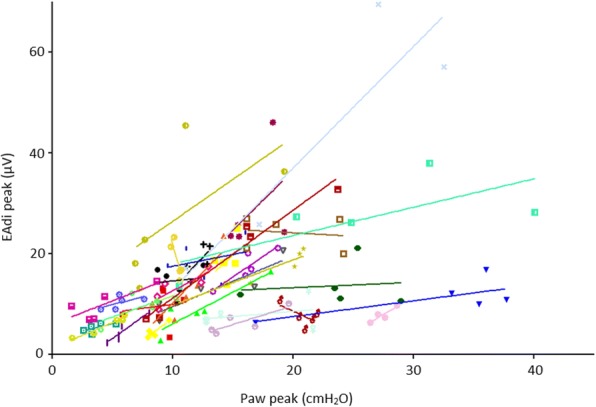
A total number of 459 maneuvers were obtained. At time T = 0 mean NMEoccl was 1.22 ± 0.86 cmHO/μV with a RC of 82.6%. This implies that when NMEoccl is 1.22 cmHO/μV, it is expected with a probability of 95% that the subsequent measured NMEoccl will be between 2.22 and 0.22 cmH2O/μV. Additional EAdi waveform analysis to correct for non-physiological appearing waveforms, did not improve NMEoccl variability. Selecting three out of five occlusions with the lowest variability reduced the RC to 29.8%.
Repeated measurements of NMEoccl exhibit high variability, limiting the ability of a single NMEoccl maneuver to estimate neuromuscular efficiency and therefore the pressure generated by the inspiratory muscles based on EAdi.
在接受通气治疗的重症加强护理病房(ICU)患者中,经常会出现膈肌功能障碍。过度通气辅助(呼吸机过度辅助)和高呼吸肌做功(呼吸机辅助不足)似乎都与此相关。因此,有充分的理由来监测膈肌做功并调整支持力度,以将呼吸肌活动维持在生理范围内。膈肌肌电图可用于量化呼吸做功,并已与跨膈压和食管压相关联。神经肌肉效率指数(NME)可用于估计吸气努力,但尚未对其重复性进行研究。我们的目标是评估在呼气末阻断(NMEoccl)期间的 NME 重复性,并使用它来估计吸气肌产生的压力(Pmus)。
这是一项前瞻性队列研究,在一个内科-外科重症监护病房进行。共纳入 31 名成年患者,所有患者均在神经调节通气辅助(NAVA)模式下通气,膈肌电活动(EAdi)导管在位。在 72 小时内的四个时间点,进行了五次重复的呼气末阻断操作。通过气道压力(ΔPaw)/ΔEAdi 计算 NMEoccl,并使用它来估计 Pmus。计算重复性系数(RC)以研究 NMEoccl 的变异性。
共获得 459 次操作。在 T=0 时,平均 NMEoccl 为 1.22±0.86 cmHO/μV,RC 为 82.6%。这意味着当 NMEoccl 为 1.22 cmHO/μV 时,预计随后测量的 NMEoccl 有 95%的概率在 2.22 和 0.22 cmH2O/μV 之间。对非生理出现的 EAdi 波进行额外的分析以进行校正,并没有改善 NMEoccl 的变异性。选择五个阻断操作中的三个,其变异性最低,将 RC 降低至 29.8%。
重复测量 NMEoccl 表现出高度的变异性,限制了单次 NMEoccl 操作估计神经肌肉效率的能力,从而限制了基于 EAdi 估计吸气肌产生的压力的能力。