Grams Samantha Torres, Kimoto Karen Yumi Mota, Azevedo Elen Moda de Oliveira, Lança Marina, Albuquerque André Luis Pereira de, Brito Christina May Moran de, Yamaguti Wellington Pereira
Department of Rehabilitation, Hospital Sírio-Libanês (HSL), São Paulo, São Paulo, Brazil.
Department of Rehabilitation, Hospital Sírio-Libanês (HSL), São Paulo, São Paulo, Brazil; Department of Pulmonary Function-Núcleo Avançado de Tórax (NAT), Hospital Sírio-Libanês (HSL), São Paulo, São Paulo, Brazil.
PLoS One. 2015 Sep 11;10(9):e0137825. doi: 10.1371/journal.pone.0137825. eCollection 2015.
Maximal Inspiratory Pressure (MIP) is considered an effective method to estimate strength of inspiratory muscles, but still leads to false positive diagnosis. Although MIP assessment with unidirectional expiratory valve method has been used in patients undergoing mechanical ventilation, no previous studies investigated the application of this method in subjects without artificial airway.
This study aimed to compare the MIP values assessed by standard method (MIPsta) and by unidirectional expiratory valve method (MIPuni) in subjects with spontaneous breathing without artificial airway. MIPuni reproducibility was also evaluated.
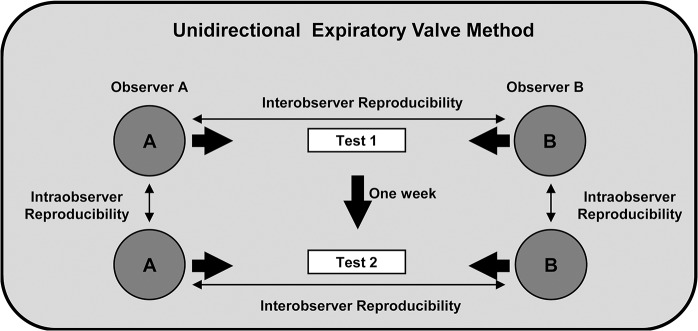
This was a crossover design study, and 31 subjects performed MIPsta and MIPuni in a random order. MIPsta measured MIP maintaining negative pressure for at least one second after forceful expiration. MIPuni evaluated MIP using a unidirectional expiratory valve attached to a face mask and was conducted by two evaluators (A and B) at two moments (Tests 1 and 2) to determine interobserver and intraobserver reproducibility of MIP values. Intraclass correlation coefficient (ICC[2,1]) was used to determine intraobserver and interobserver reproducibility.
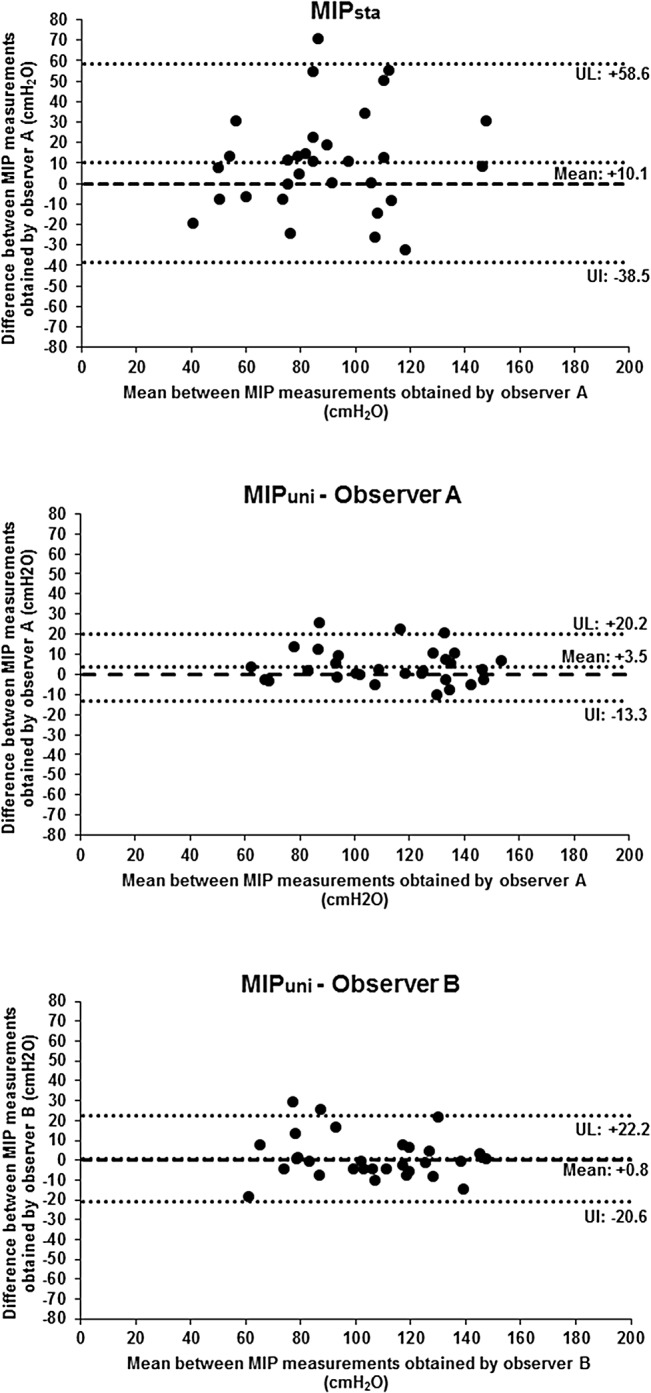
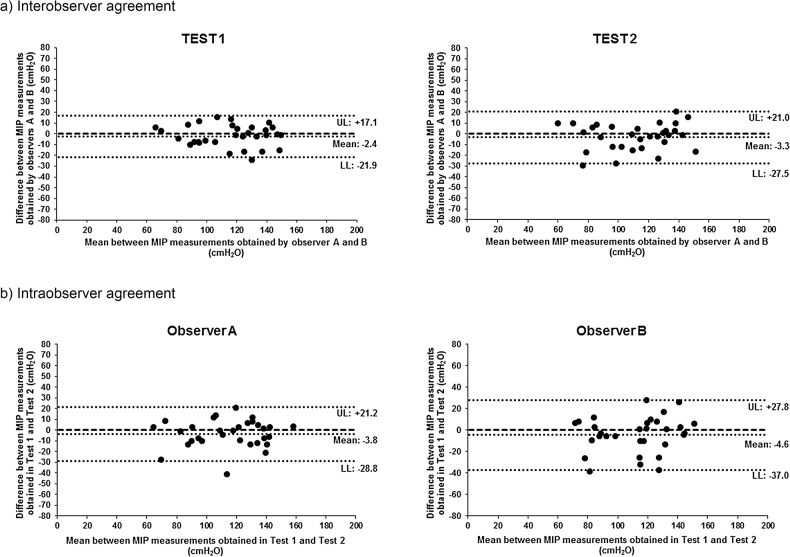
The mean values for MIPuni were 14.3% higher (-117.3 ± 24.8 cmH2O) than the mean values for MIPsta (-102.5 ± 23.9 cmH2O) (p<0.001). Interobserver reproducibility assessment showed very high correlation for Test 1 (ICC[2,1] = 0.91), and high correlation for Test 2 (ICC[2,1] = 0.88). The assessment of the intraobserver reproducibility showed high correlation for evaluator A (ICC[2,1] = 0.86) and evaluator B (ICC[2,1] = 0.77).
MIPuni presented higher values when compared with MIPsta and proved to be reproducible in subjects with spontaneous breathing without artificial airway.
最大吸气压(MIP)被认为是评估吸气肌力量的有效方法,但仍会导致假阳性诊断。尽管单向呼气阀法进行MIP评估已用于机械通气患者,但此前尚无研究探讨该方法在无人工气道受试者中的应用。
本研究旨在比较标准方法(MIPsta)和单向呼气阀法(MIPuni)评估无人工气道自主呼吸受试者的MIP值。还评估了MIPuni的可重复性。
这是一项交叉设计研究,31名受试者以随机顺序进行MIPsta和MIPuni检测。MIPsta在用力呼气后保持负压至少一秒钟来测量MIP。MIPuni使用连接到面罩的单向呼气阀评估MIP,由两名评估者(A和B)在两个时间点(测试1和测试2)进行,以确定MIP值的观察者间和观察者内可重复性。组内相关系数(ICC[2,1])用于确定观察者内和观察者间的可重复性。
MIPuni的平均值比MIPsta的平均值高14.3%(-117.3±24.8 cmH2O)(-102.5±23.9 cmH2O)(p<0.001)。观察者间可重复性评估显示测试1相关性非常高(ICC[2,1]=0.91),测试2相关性高(ICC[2,1]=0.88)。观察者内可重复性评估显示评估者A相关性高(ICC[2,1]=0.86),评估者B相关性高(ICC[2,1]=0.77)。
与MIPsta相比,MIPuni的值更高,并且在无人工气道自主呼吸的受试者中被证明具有可重复性。