Schonberg Christina, Marcus Gary F, Johnson Scott P
University of Wisconsin, Madison, USA.
NYU, USA.
Infant Behav Dev. 2018 Nov;53:64-80. doi: 10.1016/j.infbeh.2018.08.003. Epub 2018 Sep 24.
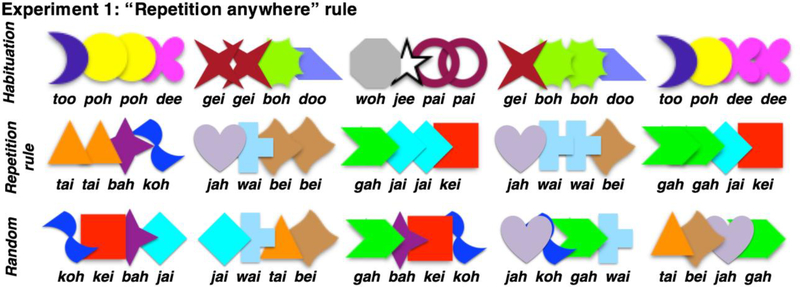
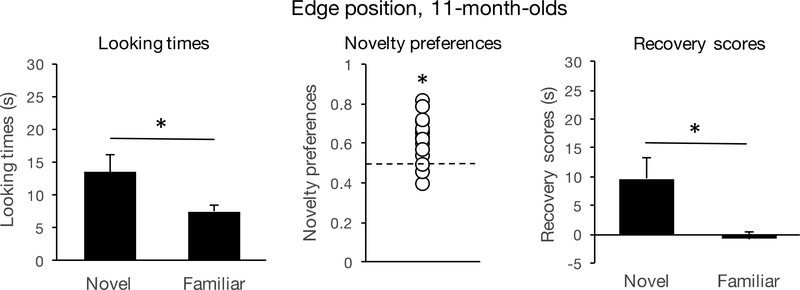
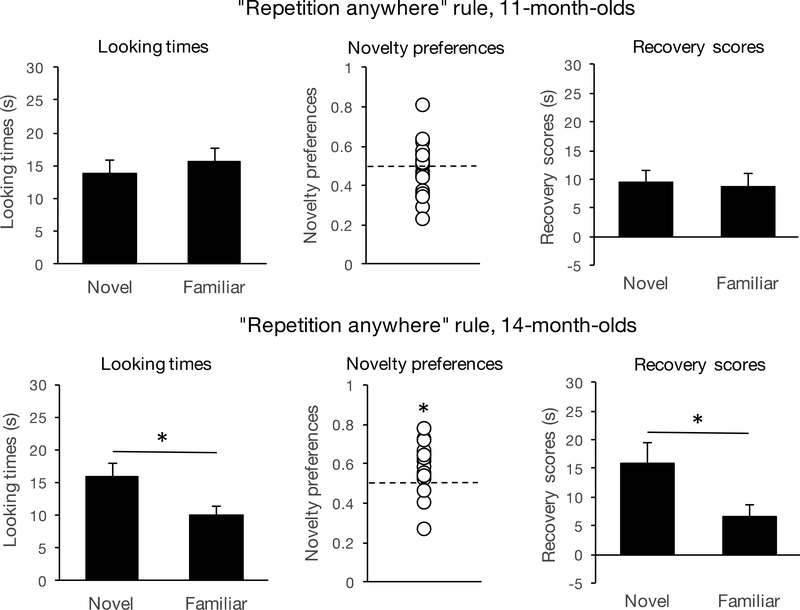
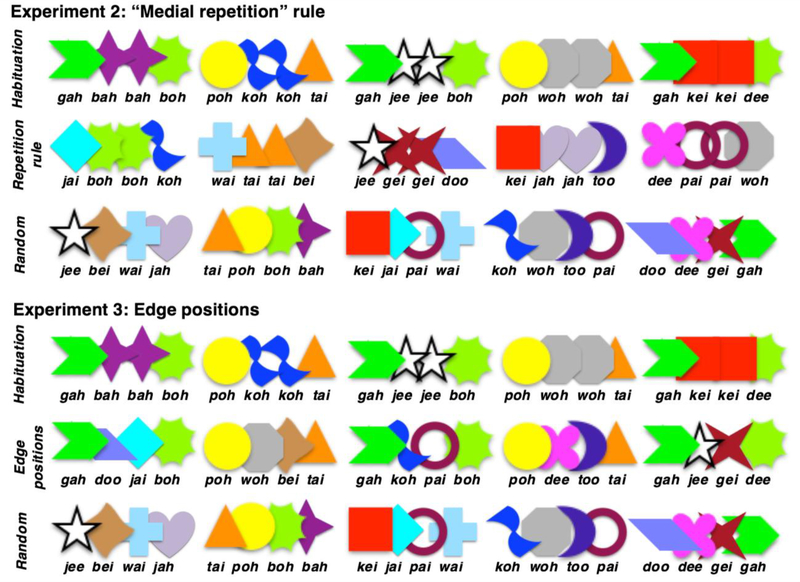
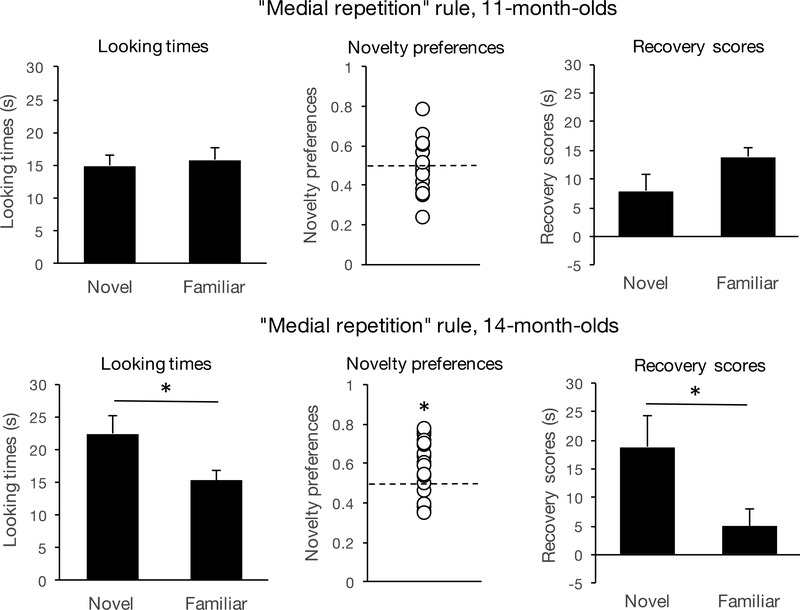
We asked whether 11- and 14- month-old infants' abstract rule learning, an early form of analogical reasoning, is susceptible to processing constraints imposed by limits in attention and memory for sequence position. We examined 11- and 14- month-old infants' learning and generalization of abstract repetition rules ("repetition anywhere," Experiment 1 or "medial repetition," Experiment 2) and ordering of specific items (edge positions, Experiment 3) in 4-item sequences. Infants were habituated to sequences containing repetition- and/or position-based structure and then tested with "familiar" vs. "novel" (random) sequences composed of new items. Eleven-month-olds (N = 40) failed to learn abstract repetition rules, but 14-month-olds (N = 40) learned rules under both conditions. In Experiment 3, 11-month-olds (N = 20) learned item edge positions in sequences identical to those in Experiment 2. We conclude that infant sequence learning is constrained by item position in similar ways as in adults.
我们探究了11个月和14个月大婴儿的抽象规则学习(类比推理的早期形式)是否容易受到由对序列位置的注意力和记忆限制所施加的处理约束。我们考察了11个月和14个月大婴儿对抽象重复规则(“任意位置重复”,实验1;或“中间重复”,实验2)的学习与泛化,以及在4个项目序列中特定项目的排序(边缘位置,实验3)。婴儿先熟悉包含基于重复和/或位置结构的序列,然后用由新项目组成的“熟悉”与“新颖”(随机)序列进行测试。11个月大的婴儿(N = 40)未能学习抽象重复规则,但14个月大的婴儿(N = 40)在两种条件下都学习到了规则。在实验3中,11个月大的婴儿(N = 20)学习了与实验2中相同序列里项目的边缘位置。我们得出结论,婴儿的序列学习与成人一样,受到项目位置的类似方式的约束。