Center for International Blood and Marrow Transplant Research, Minneapolis, MN.
Program in Bioinformatics and Computational Biology, University of Minnesota, Minneapolis, MN.
Blood Adv. 2018 Oct 9;2(19):2419-2429. doi: 10.1182/bloodadvances.2018019513.
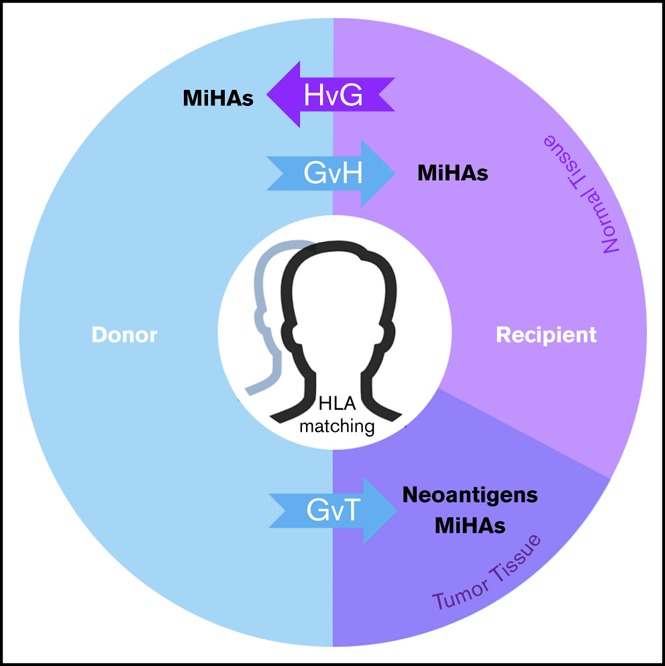
Allogeneic hematopoietic stem cell transplantation (allo-HCT) is a curative option for blood cancers, but the coupled effects of graft-versus-tumor and graft-versus-host disease (GVHD) limit its broader application. Outcomes improve with matching at HLAs, but other factors are required to explain residual risk of GVHD. In an effort to identify genetic associations outside the major histocompatibility complex, we conducted a genome-wide clinical outcomes study on 205 acute myeloid leukemia patients and their fully HLA-A-, HLA-B-, HLA-C-, HLA-DRB1-, and HLA-DQB1-matched (10/10) unrelated donors. HLA-DPB1 T-cell epitope permissibility mismatches were observed in less than half (45%) of acute GVHD cases, motivating a broader search for genetic factors affecting clinical outcomes. A novel bioinformatics workflow adapted from neoantigen discovery found no associations between acute GVHD and known, HLA-restricted minor histocompatibility antigens (MiHAs). These results were confirmed with microarray data from an additional 988 samples. On the other hand, Y-chromosome-encoded single-nucleotide polymorphisms in 4 genes (PCDH11Y, USP9Y, UTY, and NLGN4Y) did associate with acute GVHD in male patients with female donors. Males in this category with acute GVHD had more Y-encoded variant peptides per patient with higher predicted HLA-binding affinity than males without GVHD who matched X-paralogous alleles in their female donors. Methods and results described here have an immediate impact for allo-HCT, warranting further development and larger genomic studies where MiHAs are clinically relevant, including cancer immunotherapy, solid organ transplant, and pregnancy.
异基因造血干细胞移植(allo-HCT)是血液癌症的一种治疗选择,但移植物抗白血病和移植物抗宿主病(GVHD)的联合作用限制了其更广泛的应用。在 HLA 匹配的情况下,结果会有所改善,但还需要其他因素来解释 GVHD 的残余风险。为了在主要组织相容性复合体之外寻找遗传关联,我们对 205 例急性髓系白血病患者及其完全 HLA-A、HLA-B、HLA-C、HLA-DRB1 和 HLA-DQB1 匹配(10/10)的无关供体进行了全基因组临床结局研究。在不到一半(45%)的急性 GVHD 病例中观察到 HLA-DPB1 T 细胞表位许可性错配,这促使我们更广泛地寻找影响临床结局的遗传因素。一种从新抗原发现中改编的新型生物信息学工作流程发现,急性 GVHD 与已知的 HLA 受限次要组织相容性抗原(MiHAs)之间没有关联。这些结果在另外 988 个样本的微阵列数据中得到了验证。另一方面,在女性供体的男性患者中,4 个基因(PCDH11Y、USP9Y、UTY 和 NLGN4Y)中的 Y 染色体编码的单核苷酸多态性与急性 GVHD 相关。在女性供体中与 X 等位基因匹配的男性患者中,患有急性 GVHD 的男性患者每个患者的 Y 编码变异肽更多,且预测 HLA 结合亲和力更高。这里描述的方法和结果对 allo-HCT 具有直接影响,需要进一步开发和更大的基因组研究,其中 MiHAs 在临床相关,包括癌症免疫治疗、实体器官移植和妊娠。