Finnish Red Cross Blood Service, Helsinki, Finland.
Stem Cell Transplantation Unit, Department of Hematology, Comprehensive Cancer Center, Helsinki University Hospital, Helsinki, Finland.
Front Immunol. 2019 Jul 16;10:1625. doi: 10.3389/fimmu.2019.01625. eCollection 2019.
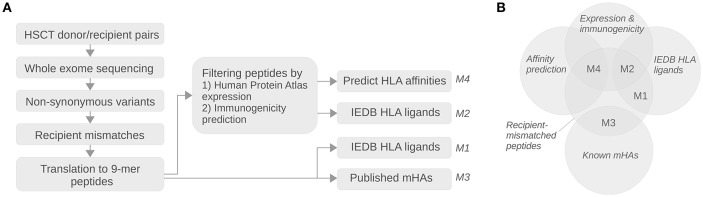
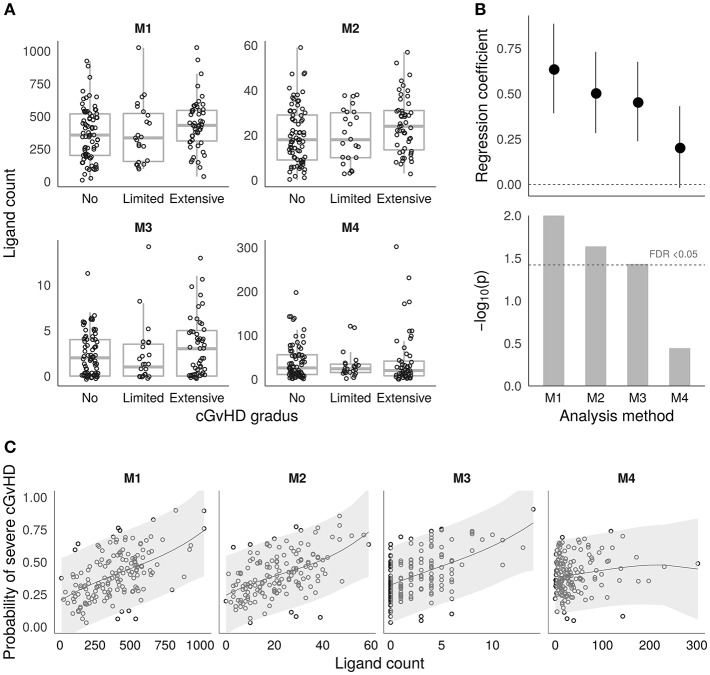
Genetic mismatches in protein coding genes between allogeneic hematopoietic stem cell transplantation (allo-HSCT) recipient and donor can elicit an alloimmunity response via peptides presented by the recipient HLA receptors as minor histocompatibility antigens (mHAs). While the impact of individual mHAs on allo-HSCT outcome such as graft-vs.-host and graft-vs.-leukemia effects has been demonstrated, it is likely that established mHAs constitute only a small fraction of all immunogenic non-synonymous variants. In the present study, we have analyzed the genetic mismatching in 157 exome-sequenced sibling allo-HSCT pairs to evaluate the significance of polymorphic HLA class I associated peptides on clinical outcome. We applied computational mismatch estimation approaches based on experimentally verified HLA ligands available in public repositories, published mHAs, and predicted HLA-peptide affinites, and analyzed their associations with chronic graft-vs.-host disease (cGvHD) grades. We found that higher estimated recipient mismatching consistently increased the risk of severe cGvHD, suggesting that HLA-presented mismatching influences the likelihood of long-term complications in the patient. Furthermore, computational approaches focusing on estimation of HLA-presentation instead of all non-synonymous mismatches indiscriminately may be beneficial for analysis sensitivity and could help identify novel mHAs.
在异基因造血干细胞移植(allo-HSCT)受者和供者的蛋白质编码基因之间存在遗传不匹配,这些不匹配可以通过受者 HLA 受体呈递的肽作为次要组织相容性抗原(mHA)引发同种异体免疫反应。虽然已经证明了个别 mHA 对 allo-HSCT 结果的影响,例如移植物抗宿主病和移植物抗白血病效应,但已确定的 mHA 可能只构成所有免疫原性非同义变异的一小部分。在本研究中,我们分析了 157 对经过外显子组测序的同胞 allo-HSCT 对,以评估与临床结果相关的多态性 HLA Ⅰ类相关肽的意义。我们应用了基于实验验证的公共存储库中可用的 HLA 配体、已发表的 mHA 和预测的 HLA-肽亲和力的计算错配估计方法,并分析了它们与慢性移植物抗宿主病(cGvHD)分级的关联。我们发现,受者错配估计值越高,严重 cGvHD 的风险就越高,这表明 HLA 呈递的错配影响了患者发生长期并发症的可能性。此外,专注于 HLA 呈递而不是不加区分地对所有非同义错配进行估计的计算方法可能有助于提高分析敏感性,并有助于识别新的 mHA。