Clinical and Population Perinatal Health Research, Kolling Institute, Northern Sydney Local Health District, St Leonards, New South Wales, Australia.
Northern Clinical School, The University of Sydney, St Leonards, Australia.
PLoS One. 2018 Sep 28;13(9):e0203195. doi: 10.1371/journal.pone.0203195. eCollection 2018.
Increasing rates of postpartum haemorrhage and obstetric transfusion mean that more women are entering subsequent pregnancies with a history of blood transfusion. This study investigates subsequent pregnancy outcomes of women with a prior obstetric red cell transfusion, compared to women without a transfusion.
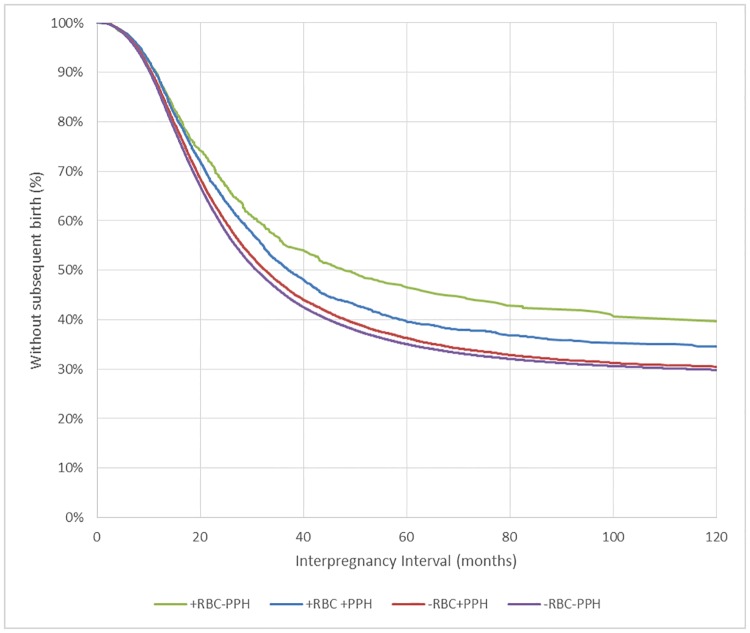
All women with a first pregnancy resulting in a liveborn singleton infant of at least 20 weeks gestation delivering in hospitals in New South Wales, Australia, between 2003 and 2012 were included in the study, with followup for second births until June 2015. Linked hospital and births data were used to identify women with a transfusion and/or postpartum haemorrhage in their first birth, time to second pregnancy and adverse birth outcomes (including transfusion, postpartum haemorrhage and severe morbidity) in their subsequent birth.
There were 358,384 singleton births to primiparous women, with 1.4% receiving an obstetric blood transfusion. Sixty-three percent of women had at least one subsequent birth. The relative risk (RR) of requiring a transfusion in a second birth was 4.9 (95% CI 4.1,6.1) for women with a previous transfusion compared with women without. The risk (RR) of severe morbidity in a second birth was 4.1 times higher (95% CI 2.2,7.4) for those receiving a transfusion without haemorrhage in their first birth compared with women with neither haemorrhage nor transfusion.
It is important to consider a woman's history of transfusion and/or haemorrhage as part of her obstetric history to ensure management in a manner that minimises risk in subsequent pregnancies.
产后出血和产科输血的发生率不断增加,这意味着更多的女性在随后的妊娠中都有输血史。本研究比较了有产科红细胞输血史的女性与无输血史的女性随后妊娠的结局。
本研究纳入了 2003 年至 2012 年期间在澳大利亚新南威尔士州医院分娩的第一胎活产单胎妊娠至少 20 周的所有女性,并随访至 2015 年 6 月,以了解第二胎妊娠情况和随后分娩的不良结局(包括输血、产后出血和严重并发症)。利用医院和分娩数据的链接,确定第一胎分娩中有输血和/或产后出血的女性、第二胎妊娠时间以及随后分娩中的不良结局(包括输血、产后出血和严重并发症)。
共有 358384 例初产妇分娩,其中 1.4%接受产科输血。63%的女性至少有一次后续分娩。与无输血史的女性相比,有输血史的女性在第二胎分娩中需要输血的相对风险(RR)为 4.9(95%CI 4.1,6.1)。与既无出血也无输血的女性相比,在第一胎分娩中无出血但接受输血的女性在第二胎分娩中发生严重并发症的风险(RR)高 4.1 倍(95%CI 2.2,7.4)。
重要的是要将女性的输血和/或出血史作为其产科史的一部分来考虑,以确保在后续妊娠中以降低风险的方式进行管理。