
支链氨基酸转氨酶 1(BCAT1)在发生不良临床事件的非酒精性脂肪性肝病患者中过度表达且低甲基化:一项初步研究。
Branched chain amino acid transaminase 1 (BCAT1) is overexpressed and hypomethylated in patients with non-alcoholic fatty liver disease who experience adverse clinical events: A pilot study.
机构信息
Division of Gastroenterology, Department of Medicine, Duke University Health System, Durham, NC, United States of America.
Biostatistics and Bioinformatics, Duke University, Durham, NC, United States of America.
出版信息
PLoS One. 2018 Sep 28;13(9):e0204308. doi: 10.1371/journal.pone.0204308. eCollection 2018.
BACKGROUND AND OBJECTIVES
Although the burden of non-alcoholic fatty liver disease (NAFLD) continues to increase worldwide, genetic factors predicting progression to cirrhosis and decompensation in NAFLD remain poorly understood. We sought to determine whether gene expression profiling was associated with clinical decompensation and death in patients with NAFLD, and to assess whether altered DNA methylation contributes to these changes in gene expression.
METHODS
We performed a retrospective analysis of 86 patients in the Duke NAFLD Clinical Database and Biorepository with biopsy-proven NAFLD whose liver tissue was previously evaluated for gene expression and DNA methylation using array based technologies. We assessed the prospective development of liver and cardiovascular disease related outcomes, including hepatic decompensation as identified by the development of ascites, hepatic encephalopathy, hepatocellular carcinoma, or variceal bleeding as well as stroke and myocardial infarction via medical chart review.
RESULTS
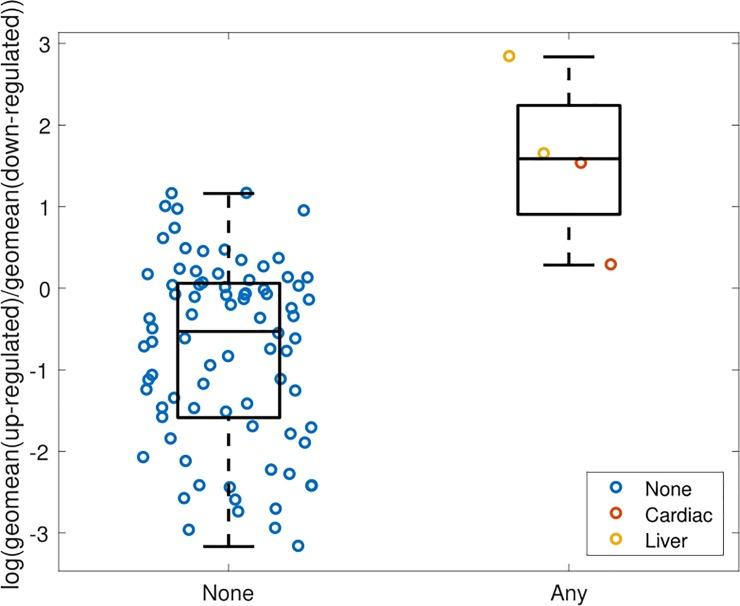
Of the 86 patients, 47 had F0-F1 fibrosis and 39 had F3-F4 fibrosis at index liver biopsy. Gene expression probe sets (n = 54,675) were analyzed; 42 genes showed significant differential expression (p<0.05) and a two-fold change in expression between patients with and without any outcome. Two expression probes of the branched chain amino-acid transaminase 1 (BCAT1) gene were upregulated (p = 0.02; fold change 2.1 and 2.2 respectively) in patients with a clinical outcome. Methylation of three of the 34 BCAT1 CpG methylation probes were significantly inversely correlated with BCAT1 expression specific to the probes predictive of clinical deterioration.
CONCLUSION
We found differential gene expression, correlated to changes in DNA methylation, at multiple BCAT1 loci in patients with cardiovascular outcomes and/or hepatic decompensation. BCAT1 catalyzes the transformation of alpha-ketoglutarate to glutamate and has been linked to the presence and severity of NAFLD, possibly through derangements in the balance between glutamate and alpha-ketoglutarate. Given the potential for BCAT1 to identify patients at risk for poor outcomes, and the potential therapeutic implications, these results should be validated in larger prospective studies.
背景与目的
尽管非酒精性脂肪性肝病(NAFLD)的负担在全球范围内持续增加,但预测 NAFLD 进展为肝硬化和失代偿的遗传因素仍知之甚少。我们试图确定基因表达谱是否与 NAFLD 患者的临床失代偿和死亡相关,并评估 DNA 甲基化的改变是否导致这些基因表达的变化。
方法
我们对杜克大学 NAFLD 临床数据库和生物库中 86 例经活检证实的 NAFLD 患者进行了回顾性分析,这些患者的肝组织先前使用基于阵列的技术进行了基因表达和 DNA 甲基化评估。我们通过病历审查评估了与肝脏和心血管疾病相关的结局的前瞻性发展,包括腹水、肝性脑病、肝细胞癌或静脉曲张出血以及中风和心肌梗死等肝失代偿的发生。
结果
在 86 例患者中,47 例患者在初次肝活检时存在 F0-F1 纤维化,39 例患者存在 F3-F4 纤维化。分析了 54675 个基因表达探针集;42 个基因的表达差异有统计学意义(p<0.05),并且在有或没有任何结局的患者之间表达变化两倍。两个支链氨基酸转氨酶 1(BCAT1)基因的表达探针上调(p = 0.02;倍数变化分别为 2.1 和 2.2)在有临床结局的患者中。BCAT1 基因的 34 个 CpG 甲基化探针中的 3 个的甲基化与特定于预测临床恶化的探针的 BCAT1 表达呈显著负相关。
结论
我们发现,在心血管结局和/或肝失代偿的患者中,多个 BCAT1 基因座存在差异基因表达,与 DNA 甲基化的变化相关。BCAT1 催化α-酮戊二酸转化为谷氨酸,并与 NAFLD 的存在和严重程度相关,可能通过谷氨酸和α-酮戊二酸之间的平衡失调。鉴于 BCAT1 有可能识别出预后不良的患者,以及潜在的治疗意义,这些结果应在更大的前瞻性研究中得到验证。


 Zotero 插件