
院外心搏骤停伴心肺复苏到达医院后持续发作 - 体外心肺复苏术对存活率和神经功能结局无影响。
Refractory out-of-hospital cardiac arrest with ongoing cardiopulmonary resuscitation at hospital arrival - survival and neurological outcome without extracorporeal cardiopulmonary resuscitation.
机构信息
Department of Cardiology 2142, The Heart Centre, Copenhagen University Hospital Rigshospitalet, Blegdamsvej 9, 2100, Copenhagen O, Denmark.
Emergency Medical Services, Copenhagen, Denmark.
出版信息
Crit Care. 2018 Sep 29;22(1):242. doi: 10.1186/s13054-018-2176-9.
BACKGROUND
The prognosis in refractory out-of-hospital cardiac arrest (OHCA) with ongoing cardiopulmonary resuscitation (CPR) at hospital arrival is often considered dismal. The use of extracorporeal cardiopulmonary resuscitation (eCPR) for perfusion enhancement during resuscitation has shown variable results. We aimed to investigate outcome in refractory OHCA patients managed conservatively without use of eCPR.
METHODS
We included consecutive OHCA patients with refractory arrest or prehospital return of spontaneous circulation (ROSC) in the Copenhagen area in 2002-2011.
RESULTS
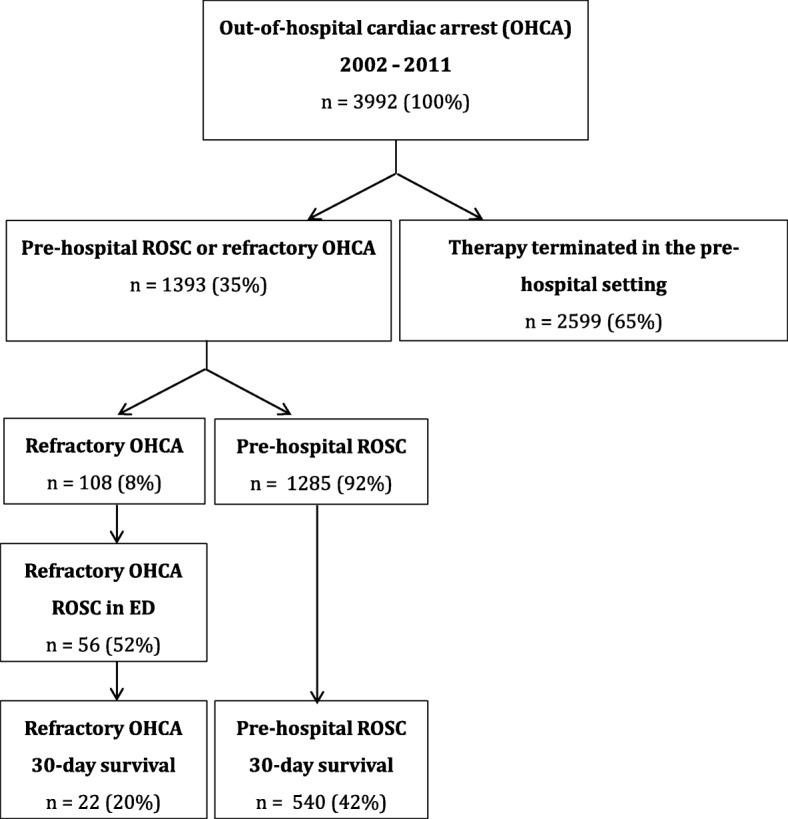
A total of 3992 OHCA patients with resuscitation attempts were included; in 2599, treatment was terminated prehospital, and 1393 (35%) were brought to the hospital either with ROSC (n = 1285, 92%) or with refractory OHCA (n = 108, 8%). Of patients brought in with refractory OHCA, 56 (52%) achieved ROSC in the emergency department. There were no differences between patients with refractory OHCA or prehospital ROSC with regard to age, sex, comorbidities, or etiology of OHCA. Time to emergency medical services (EMS) arrival was similar, whereas time to ROSC (when ROSC was achieved) was longer in refractory OHCA patients (EMS, 6 (5-9] vs. 7 [5-10] min, p = 0.8; ROSC, 15 [9-22] vs. 27 [20-41] min, p < 0.001). Independent factors associated with transport with refractory OHCA instead of prehospital termination of therapy were OHCA in public (OR, 3.6 [95% CI, 2.2-5.8]; p < 0.001), witnessed OHCA (OR, 3.7 [2.0-7.1]; p < 0.001), shockable rhythm (OR, 3.0 [1.9-4.7]; p < 0.001), younger age (OR, 1.2 [1.1-1.2]; p < 0.001), and later calendar year (OR, 1.4 [1.2-1.6]; p < 0.001). Thirty-day survival was 20% in patients with refractory OHCA compared with 42% in patients with prehospital ROSC (p < 0.001). Four of 28 refractory OHCA patients with duration of resuscitation > 60 min achieved ROSC. No difference in favorable neurological outcome in patients surviving to discharge was found (prehospital ROSC 84% vs. refractory OHCA 86%; p = 0.7).
CONCLUSIONS
Survival after refractory OHCA with ongoing CPR at hospital arrival was significantly lower than among patients with prehospital ROSC. Despite a lower survival, the majority of survivors with both refractory OHCA and prehospital ROSC were discharged with a similar degree of favorable neurological outcome, indicating that continued efforts in spite of refractory OHCA are not in vain and may still lead to favorable outcome even without eCPR.
背景
在到达医院时持续进行心肺复苏(CPR)的难治性院外心脏骤停(OHCA)的预后通常被认为很差。在复苏期间使用体外心肺复苏(eCPR)来增强灌注的效果显示出不同的结果。我们旨在研究不使用 eCPR 进行保守治疗的难治性 OHCA 患者的结果。
方法
我们纳入了 2002 年至 2011 年哥本哈根地区难治性 OHCA 患者的连续病例;这些患者在复苏尝试中出现难治性心脏骤停或院前自主循环恢复(ROSC)。
结果
共纳入 3992 例接受复苏尝试的 OHCA 患者;其中 2599 例在院前终止治疗,1393 例(35%)被带到医院,要么伴有 ROSC(n=1285,92%),要么伴有难治性 OHCA(n=108,8%)。在难治性 OHCA 患者中,有 56 例(52%)在急诊科实现了 ROSC。难治性 OHCA 患者或院前 ROSC 患者在年龄、性别、合并症或 OHCA 病因方面没有差异。到达急救医疗服务(EMS)的时间相似,而在难治性 OHCA 患者中,达到 ROSC 的时间更长(EMS,6[5-9]与 7[5-10]分钟,p=0.8;ROSC,15[9-22]与 27[20-41]分钟,p<0.001)。与院前终止治疗相比,与难治性 OHCA 一起转运的独立因素是公共场合的 OHCA(OR,3.6[95%CI,2.2-5.8];p<0.001)、目击 OHCA(OR,3.7[2.0-7.1];p<0.001)、可除颤节律(OR,3.0[1.9-4.7];p<0.001)、年龄较小(OR,1.2[1.1-1.2];p<0.001)和较晚的日历年份(OR,1.4[1.2-1.6];p<0.001)。与院前 ROSC 患者(42%)相比,难治性 OHCA 患者的 30 天生存率为 20%(p<0.001)。在复苏时间>60 分钟的 28 例难治性 OHCA 患者中,有 4 例实现了 ROSC。在存活至出院的患者中,未发现神经功能良好的结局存在差异(院前 ROSC 84%与难治性 OHCA 86%;p=0.7)。
结论
在到达医院时持续进行 CPR 的难治性 OHCA 后,生存率明显低于院前 ROSC 患者。尽管生存率较低,但大多数难治性 OHCA 和院前 ROSC 幸存者出院时都有相似程度的良好神经功能结局,这表明尽管存在难治性 OHCA,继续努力并不是徒劳的,即使没有 eCPR,仍可能导致良好的结局。


 Zotero 插件