Corsello Tiziana, Komaravelli Narayana, Casola Antonella
Department of Pediatrics, University of Texas Medical Branch at Galveston, Galveston, TX 77555, USA.
Department of Microbiology and Immunology, University of Texas Medical Branch at Galveston, Galveston, TX 77555, USA.
Antioxidants (Basel). 2018 Sep 28;7(10):129. doi: 10.3390/antiox7100129.
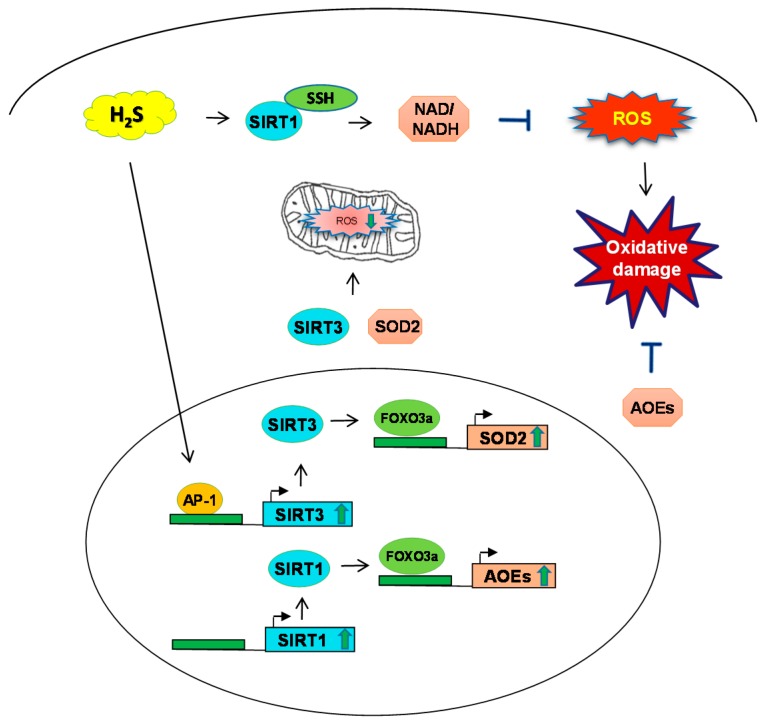
Hydrogen sulfide (H₂S) has arisen as a critical gasotransmitter signaling molecule modulating cellular biological events related to health and diseases in heart, brain, liver, vascular systems and immune response. Three enzymes mediate the endogenous production of H₂S: cystathione β-synthase (), cystathione γ-lyase () and 3-mercaptopyruvate sulfurtransferase (). and localizations are organ-specific. is a mitochondrial and cytosolic enzyme. The generation of H₂S is firmly regulated by these enzymes under normal physiological conditions. Recent studies have highlighted the role of H₂S in cellular redox homeostasis, as it displays significant antioxidant properties. H₂S exerts antioxidant effects through several mechanisms, such as quenching reactive oxygen species (ROS) and reactive nitrogen species (RNS), by modulating cellular levels of glutathione (GSH) and thioredoxin () or increasing expression of antioxidant enzymes (AOE), by activating the transcription factor nuclear factor (erythroid-derived 2)-like 2 (). H₂S also influences the activity of the histone deacetylase protein family of sirtuins, which plays an important role in inhibiting oxidative stress in cardiomyocytes and during the aging process by modulating AOE gene expression. This review focuses on the role of H₂S in and sirtuin signaling pathways as they are related to cellular redox homeostasis.
硫化氢(H₂S)已成为一种关键的气体信号分子,可调节与心脏、大脑、肝脏、血管系统和免疫反应中的健康和疾病相关的细胞生物学事件。三种酶介导H₂S的内源性产生:胱硫醚β-合酶()、胱硫醚γ-裂解酶()和3-巯基丙酮酸硫转移酶()。 和 的定位具有器官特异性。 是一种线粒体和胞质酶。在正常生理条件下,H₂S的生成受到这些酶的严格调控。最近的研究强调了H₂S在细胞氧化还原稳态中的作用,因为它具有显著的抗氧化特性。H₂S通过多种机制发挥抗氧化作用,例如通过调节细胞内谷胱甘肽(GSH)和硫氧还蛋白()的水平或增加抗氧化酶(AOE)的表达来淬灭活性氧(ROS)和活性氮(RNS),通过激活转录因子核因子(红细胞衍生2)样2()。H₂S还影响沉默调节蛋白家族的组蛋白去乙酰化酶的活性,该家族通过调节AOE基因表达在抑制心肌细胞氧化应激和衰老过程中起重要作用。本综述重点关注H₂S在与细胞氧化还原稳态相关的 和沉默调节蛋白信号通路中的作用。