• 文献检索
  • 文档翻译
  • 深度研究
  • 学术资讯
  • Suppr Zotero 插件Zotero 插件
  • 邀请有礼
  • 套餐&价格
  • 历史记录
应用&插件
Suppr Zotero 插件Zotero 插件浏览器插件Mac 客户端Windows 客户端微信小程序
定价
高级版会员购买积分包购买API积分包
服务
文献检索文档翻译深度研究API 文档MCP 服务
关于我们
关于 Suppr公司介绍联系我们用户协议隐私条款
关注我们

Suppr 超能文献

核心技术专利:CN118964589B侵权必究
粤ICP备2023148730 号-1Suppr @ 2026

文献检索

告别复杂PubMed语法,用中文像聊天一样搜索,搜遍4000万医学文献。AI智能推荐,让科研检索更轻松。

立即免费搜索

文件翻译

保留排版,准确专业,支持PDF/Word/PPT等文件格式,支持 12+语言互译。

免费翻译文档

深度研究

AI帮你快速写综述,25分钟生成高质量综述,智能提取关键信息,辅助科研写作。

立即免费体验

基于预测的空谱自适应高光谱压缩感知算法。

A Prediction-Based Spatial-Spectral Adaptive Hyperspectral Compressive Sensing Algorithm.

机构信息

College of Life Information & Instrument Engineering, Hangzhou Dianzi University, Hangzhou 310018, China.

出版信息

Sensors (Basel). 2018 Sep 30;18(10):3289. doi: 10.3390/s18103289.

DOI:10.3390/s18103289
PMID:30274352
原文链接:https://pmc.ncbi.nlm.nih.gov/articles/PMC6210895/
Abstract

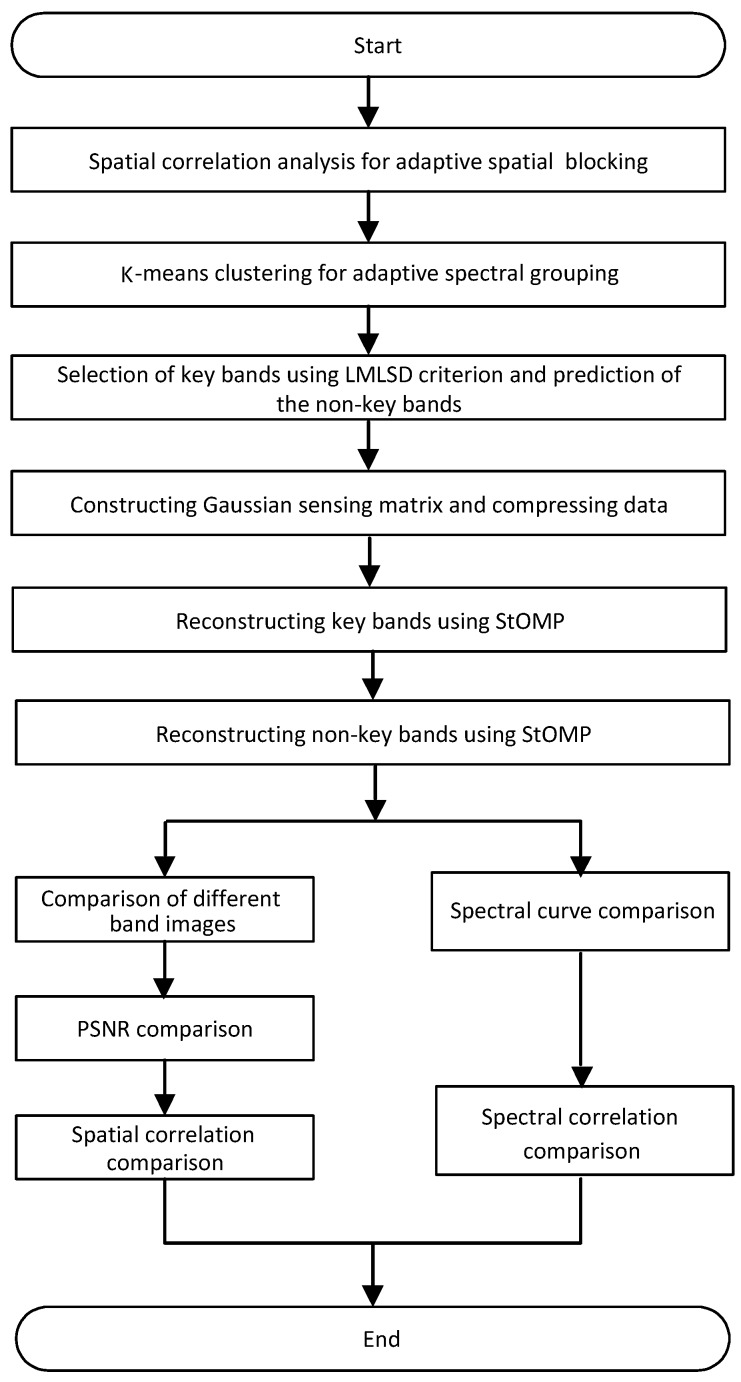
In order to improve the performance of storage and transmission of massive hyperspectral data, a prediction-based spatial-spectral adaptive hyperspectral compressive sensing (PSSAHCS) algorithm is proposed. Firstly, the spatial block size of hyperspectral images is adaptively obtained according to the spatial self-correlation coefficient. Secondly, a k-means clustering algorithm is used to group the hyperspectral images. Thirdly, we use a local means and local standard deviations (LMLSD) algorithm to find the optimal image in the group as the key band, and the non-key bands in the group can be smoothed by linear prediction. Fourthly, the random Gaussian measurement matrix is used as the sampling matrix, and the discrete cosine transform (DCT) matrix serves as the sparse basis. Finally, the stagewise orthogonal matching pursuit (StOMP) is used to reconstruct the hyperspectral images. The experimental results show that the proposed PSSAHCS algorithm can achieve better evaluation results-the subjective evaluation, the peak signal-to-noise ratio, and the spatial autocorrelation coefficient in the spatial domain, and spectral curve comparison and correlation between spectra-reconstructed performance in the spectral domain-than those of single spectral compression sensing (SSCS), block hyperspectral compressive sensing (BHCS), and adaptive grouping distributed compressive sensing (AGDCS). PSSAHCS can not only compress and reconstruct hyperspectral images effectively, but also has strong denoise performance.

摘要

为了提高海量高光谱数据的存储和传输性能,提出了一种基于预测的空谱自适应高光谱压缩感知(PSSAHCS)算法。首先,根据空间自相关系数自适应地获得高光谱图像的空间块大小。其次,使用 k-means 聚类算法对高光谱图像进行分组。然后,我们使用局部均值和局部标准差(LMLSD)算法在组中找到最佳图像作为关键带,组中非关键带可以通过线性预测进行平滑。第四,使用随机高斯测量矩阵作为采样矩阵,离散余弦变换(DCT)矩阵作为稀疏基。最后,使用分阶段正交匹配追踪(StOMP)来重构高光谱图像。实验结果表明,所提出的 PSSAHCS 算法可以获得更好的评估结果-主观评估、峰值信噪比和空间域中的空间自相关系数,以及光谱域中的光谱曲线比较和光谱相关性-比单光谱压缩感知(SSCS)、块高光谱压缩感知(BHCS)和自适应分组分布式压缩感知(AGDCS)更好。PSSAHCS 不仅可以有效地压缩和重构高光谱图像,而且具有很强的去噪性能。
https://cdn.ncbi.nlm.nih.gov/pmc/blobs/f46c/6210895/d8572ade671e/sensors-18-03289-g020.jpg
https://cdn.ncbi.nlm.nih.gov/pmc/blobs/f46c/6210895/c04f2c88a71a/sensors-18-03289-g001.jpg
https://cdn.ncbi.nlm.nih.gov/pmc/blobs/f46c/6210895/1bf8f04ff817/sensors-18-03289-g002.jpg
https://cdn.ncbi.nlm.nih.gov/pmc/blobs/f46c/6210895/690ad56e0005/sensors-18-03289-g003.jpg
https://cdn.ncbi.nlm.nih.gov/pmc/blobs/f46c/6210895/053d19b6376f/sensors-18-03289-g004.jpg
https://cdn.ncbi.nlm.nih.gov/pmc/blobs/f46c/6210895/3d365b9c26d7/sensors-18-03289-g005.jpg
https://cdn.ncbi.nlm.nih.gov/pmc/blobs/f46c/6210895/b9078a5e5c99/sensors-18-03289-g006.jpg
https://cdn.ncbi.nlm.nih.gov/pmc/blobs/f46c/6210895/2dbaf35591c3/sensors-18-03289-g007.jpg
https://cdn.ncbi.nlm.nih.gov/pmc/blobs/f46c/6210895/f9bd94ab0034/sensors-18-03289-g008.jpg
https://cdn.ncbi.nlm.nih.gov/pmc/blobs/f46c/6210895/cdbce095b673/sensors-18-03289-g009.jpg
https://cdn.ncbi.nlm.nih.gov/pmc/blobs/f46c/6210895/baa53a2679d7/sensors-18-03289-g010.jpg
https://cdn.ncbi.nlm.nih.gov/pmc/blobs/f46c/6210895/1616d4e65767/sensors-18-03289-g011.jpg
https://cdn.ncbi.nlm.nih.gov/pmc/blobs/f46c/6210895/08184a3e3b98/sensors-18-03289-g012.jpg
https://cdn.ncbi.nlm.nih.gov/pmc/blobs/f46c/6210895/264c0b46c304/sensors-18-03289-g013.jpg
https://cdn.ncbi.nlm.nih.gov/pmc/blobs/f46c/6210895/dbbfe1947f61/sensors-18-03289-g014.jpg
https://cdn.ncbi.nlm.nih.gov/pmc/blobs/f46c/6210895/b83c1394cf9a/sensors-18-03289-g015.jpg
https://cdn.ncbi.nlm.nih.gov/pmc/blobs/f46c/6210895/98c069644c54/sensors-18-03289-g016a.jpg
https://cdn.ncbi.nlm.nih.gov/pmc/blobs/f46c/6210895/6a0867b94dc9/sensors-18-03289-g017a.jpg
https://cdn.ncbi.nlm.nih.gov/pmc/blobs/f46c/6210895/c8ca4590ef8a/sensors-18-03289-g018a.jpg
https://cdn.ncbi.nlm.nih.gov/pmc/blobs/f46c/6210895/197fc82138af/sensors-18-03289-g019.jpg
https://cdn.ncbi.nlm.nih.gov/pmc/blobs/f46c/6210895/d8572ade671e/sensors-18-03289-g020.jpg
https://cdn.ncbi.nlm.nih.gov/pmc/blobs/f46c/6210895/c04f2c88a71a/sensors-18-03289-g001.jpg
https://cdn.ncbi.nlm.nih.gov/pmc/blobs/f46c/6210895/1bf8f04ff817/sensors-18-03289-g002.jpg
https://cdn.ncbi.nlm.nih.gov/pmc/blobs/f46c/6210895/690ad56e0005/sensors-18-03289-g003.jpg
https://cdn.ncbi.nlm.nih.gov/pmc/blobs/f46c/6210895/053d19b6376f/sensors-18-03289-g004.jpg
https://cdn.ncbi.nlm.nih.gov/pmc/blobs/f46c/6210895/3d365b9c26d7/sensors-18-03289-g005.jpg
https://cdn.ncbi.nlm.nih.gov/pmc/blobs/f46c/6210895/b9078a5e5c99/sensors-18-03289-g006.jpg
https://cdn.ncbi.nlm.nih.gov/pmc/blobs/f46c/6210895/2dbaf35591c3/sensors-18-03289-g007.jpg
https://cdn.ncbi.nlm.nih.gov/pmc/blobs/f46c/6210895/f9bd94ab0034/sensors-18-03289-g008.jpg
https://cdn.ncbi.nlm.nih.gov/pmc/blobs/f46c/6210895/cdbce095b673/sensors-18-03289-g009.jpg
https://cdn.ncbi.nlm.nih.gov/pmc/blobs/f46c/6210895/baa53a2679d7/sensors-18-03289-g010.jpg
https://cdn.ncbi.nlm.nih.gov/pmc/blobs/f46c/6210895/1616d4e65767/sensors-18-03289-g011.jpg
https://cdn.ncbi.nlm.nih.gov/pmc/blobs/f46c/6210895/08184a3e3b98/sensors-18-03289-g012.jpg
https://cdn.ncbi.nlm.nih.gov/pmc/blobs/f46c/6210895/264c0b46c304/sensors-18-03289-g013.jpg
https://cdn.ncbi.nlm.nih.gov/pmc/blobs/f46c/6210895/dbbfe1947f61/sensors-18-03289-g014.jpg
https://cdn.ncbi.nlm.nih.gov/pmc/blobs/f46c/6210895/b83c1394cf9a/sensors-18-03289-g015.jpg
https://cdn.ncbi.nlm.nih.gov/pmc/blobs/f46c/6210895/98c069644c54/sensors-18-03289-g016a.jpg
https://cdn.ncbi.nlm.nih.gov/pmc/blobs/f46c/6210895/6a0867b94dc9/sensors-18-03289-g017a.jpg
https://cdn.ncbi.nlm.nih.gov/pmc/blobs/f46c/6210895/c8ca4590ef8a/sensors-18-03289-g018a.jpg
https://cdn.ncbi.nlm.nih.gov/pmc/blobs/f46c/6210895/197fc82138af/sensors-18-03289-g019.jpg
https://cdn.ncbi.nlm.nih.gov/pmc/blobs/f46c/6210895/d8572ade671e/sensors-18-03289-g020.jpg

相似文献

1
A Prediction-Based Spatial-Spectral Adaptive Hyperspectral Compressive Sensing Algorithm.基于预测的空谱自适应高光谱压缩感知算法。
Sensors (Basel). 2018 Sep 30;18(10):3289. doi: 10.3390/s18103289.
2
Adaptive Grouping Distributed Compressive Sensing Reconstruction of Plant Hyperspectral Data.植物高光谱数据的自适应分组分布式压缩感知重建。
Sensors (Basel). 2017 Jun 7;17(6):1322. doi: 10.3390/s17061322.
3
[Special decorrelation technique used for DWT-based hyperspectral image compression].[用于基于离散小波变换的高光谱图像压缩的特殊去相关技术]
Guang Pu Xue Yu Guang Pu Fen Xi. 2010 Jun;30(6):1619-23.
4
A novel hyperspectral compressive sensing framework of plant leaves based on multiple arbitrary-shape regions of interest.一种基于多个任意形状感兴趣区域的植物叶片新型高光谱压缩感知框架。
PeerJ Comput Sci. 2021 Nov 25;7:e802. doi: 10.7717/peerj-cs.802. eCollection 2021.
5
[Hyperspectral Band Selection Based on Spectral Clustering and Inter-Class Separability Factor].基于光谱聚类和类间可分离性因子的高光谱波段选择
Guang Pu Xue Yu Guang Pu Fen Xi. 2015 May;35(5):1357-64.
6
[A Novel Spatial-Spectral Sparse Representation for Hyperspectral Image Classification Based on Neighborhood Segmentation].基于邻域分割的高光谱图像分类的一种新型空间-光谱稀疏表示
Guang Pu Xue Yu Guang Pu Fen Xi. 2016 Sep;36(9):2919-24.
7
Distributed Compressed Hyperspectral Sensing Imaging Based on Spectral Unmixing.基于光谱解混的分布式压缩高光谱传感成像
Sensors (Basel). 2020 Apr 17;20(8):2305. doi: 10.3390/s20082305.
8
[Clustering of Hyperspectral Image Based on Spatial-Spectral Chinese Restaurant Process Mixture Model].基于空间-光谱中式餐馆过程混合模型的高光谱图像聚类
Guang Pu Xue Yu Guang Pu Fen Xi. 2016 Apr;36(4):1158-62.
9
Low-Rank and Sparse Matrix Recovery for Hyperspectral Image Reconstruction Using Bayesian Learning.基于贝叶斯学习的低秩稀疏矩阵恢复用于高光谱图像重建
Sensors (Basel). 2022 Jan 4;22(1):343. doi: 10.3390/s22010343.
10
[Reconstruction of Water Hyperspectral Remote Sensing Reflectance Based on Sparse Representation and Its Application].基于稀疏表示的水体高光谱遥感反射率重建及其应用
Huan Jing Ke Xue. 2019 Jan 8;40(1):200-210. doi: 10.13227/j.hjkx.201804210.

引用本文的文献

1
Lossless and Near-Lossless Compression Algorithms for Remotely Sensed Hyperspectral Images.用于遥感高光谱图像的无损和近无损压缩算法
Entropy (Basel). 2024 Apr 5;26(4):316. doi: 10.3390/e26040316.
2
Multi-Agent Systems for Resource Allocation and Scheduling in a Smart Grid.多智能体系统在智能电网中的资源分配与调度。
Sensors (Basel). 2022 Oct 22;22(21):8099. doi: 10.3390/s22218099.

本文引用的文献

1
Adaptive Grouping Distributed Compressive Sensing Reconstruction of Plant Hyperspectral Data.植物高光谱数据的自适应分组分布式压缩感知重建。
Sensors (Basel). 2017 Jun 7;17(6):1322. doi: 10.3390/s17061322.
2
An Intelligible Risk Stratification Model Based on Pairwise and Size Constrained Kmeans.一种基于成对和大小约束K均值的可理解风险分层模型。
IEEE J Biomed Health Inform. 2017 Sep;21(5):1288-1296. doi: 10.1109/JBHI.2016.2633403. Epub 2016 Nov 29.
3
Extensions of kmeans-type algorithms: a new clustering framework by integrating intracluster compactness and intercluster separation.
k 均值型算法的扩展:一种通过整合簇内紧凑性和簇间分离来实现聚类的新框架。
IEEE Trans Neural Netw Learn Syst. 2014 Aug;25(8):1433-46. doi: 10.1109/TNNLS.2013.2293795.
4
Ensemble pruning using spectral coefficients.基于谱系数的集成剪枝。
IEEE Trans Neural Netw Learn Syst. 2013 Apr;24(4):673-8. doi: 10.1109/TNNLS.2013.2239659.
5
A compressive sensing and unmixing scheme for hyperspectral data processing.一种用于高光谱数据处理的压缩感知与解混方法。
IEEE Trans Image Process. 2012 Mar;21(3):1200-10. doi: 10.1109/TIP.2011.2167626. Epub 2011 Sep 12.