Lin Han-Wei, Lee I-Te
Division of Endocrinology and Metabolism, Department of Internal Medicine, Taichung Veterans General Hospital, Taichung City.
School of Medicine, National Yang-Ming University, Taipei City.
Medicine (Baltimore). 2018 Sep;97(39):e12644. doi: 10.1097/MD.0000000000012644.
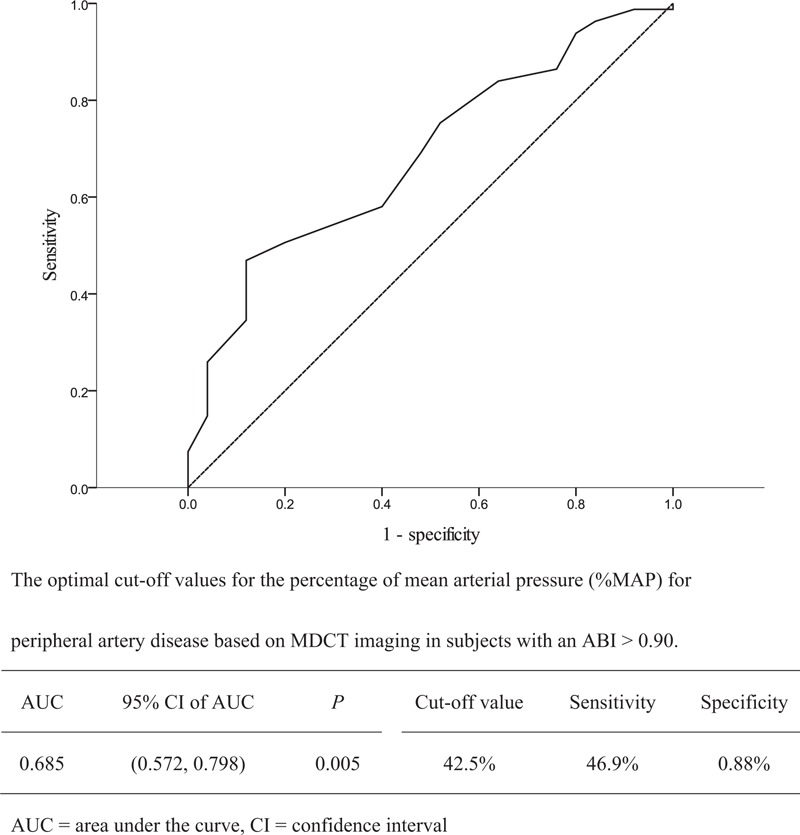
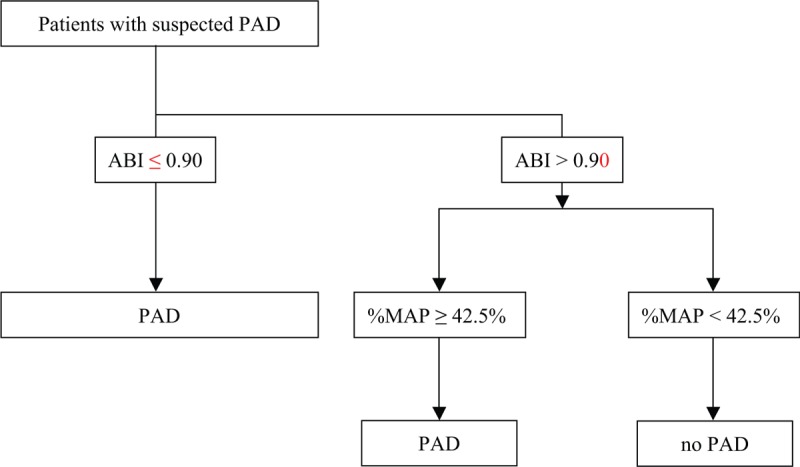
The ankle-brachial index (ABI) is a noninvasive method for screening for peripheral artery disease (PAD). However, false-negative findings of the ABI may limit its clinical use. The percentage of mean arterial pressure (%MAP) calculated from pulse volume recording has been reported to predict all-cause mortality. We hypothesized that the %MAP would be helpful to screen for PAD in subjects with a normal ABI. We examined whether using a combination of the ABI and %MAP would provide greater diagnostic sensitivity for PAD than using the ABI alone.In this cross-sectional study, we retrospectively reviewed the medical records of patients who had undergone multiple detector computed tomography (MDCT) angiography of the lower extremities following measurement of the ABI with pulse volume recording. PAD was diagnosed based on MDCT angiography.A total of 215 lower extremities of 114 patients were included in our analyses. An optimal cut-off %MAP value of 42.5% was used to diagnose PAD based on MDCT in patients with an ABI > 0.90. Using a combination of an ABI < 0.90 and a %MAP ≥ 42.5% as diagnostic criteria for PAD resulted in better sensitivity (76.9%) than using the ABI alone (56.5% for an ABI < 0.90 and 63.4% for an ABI < 1.00). Using logistic regression analysis, we found that patients having both an ABI < 0.90 and an ABI > 0.90 with a %MAP ≥ 42.5% had a significantly higher risk of PAD than those having an ABI > 0.90 with a %MAP < 42.5% (odds ratio = 7.165, P = .006; odds ratio = 12.544, P < .001; respectively).Both the sensitivity and specificity were better when using a combination of an ABI ≤ 0.90 and a %MAP ≥ 42.5% than when using a low or borderline ABI. The %MAP is helpful for PAD screening in subjects with an ABI > 0.90.
踝臂指数(ABI)是一种用于筛查外周动脉疾病(PAD)的非侵入性方法。然而,ABI的假阴性结果可能会限制其临床应用。据报道,通过脉搏容积记录计算得出的平均动脉压百分比(%MAP)可预测全因死亡率。我们假设%MAP有助于筛查ABI正常的受试者中的PAD。我们研究了联合使用ABI和%MAP是否比单独使用ABI对PAD具有更高的诊断敏感性。
在这项横断面研究中,我们回顾性分析了在通过脉搏容积记录测量ABI后接受下肢多排螺旋计算机断层扫描(MDCT)血管造影的患者的病历。根据MDCT血管造影诊断PAD。
我们的分析共纳入了114例患者的215条下肢。对于ABI>0.90的患者,基于MDCT使用42.5%的最佳%MAP截断值来诊断PAD。将ABI<0.90和%MAP≥42.5%联合用作PAD的诊断标准,其敏感性(76.9%)高于单独使用ABI(ABI<0.90时为56.5%,ABI<1.00时为63.4%)。通过逻辑回归分析,我们发现ABI<0.90以及ABI>0.90且%MAP≥42.5%的患者患PAD的风险显著高于ABI>0.90且%MAP<42.5%的患者(优势比分别为7.165,P=0.006;优势比为12.544,P<0.001)。
与使用低或临界ABI时相比,联合使用ABI≤0.90和%MAP≥42.5%时,敏感性和特异性均更好。%MAP有助于筛查ABI>0.90的受试者中的PAD。