Faculties of Medicine and Engineering, The University of Sheffield, Sheffield, United Kingdom.
Department of Clinical Biochemistry, Manchester University NHS Foundation Trust, Manchester Academic Health Science Centre, The University of Manchester, Manchester, United Kingdom.
J Clin Endocrinol Metab. 2019 Mar 1;104(3):765-772. doi: 10.1210/jc.2018-01172.
Population studies frequently measure cortisol as a marker of stress, and excess cortisol is associated with increased mortality. Cortisol has a circadian rhythm, and frequent blood sampling is impractical to assess cortisol exposure. We investigated measuring salivary cortisone and examined the sampling frequency required to determine cortisol exposure.
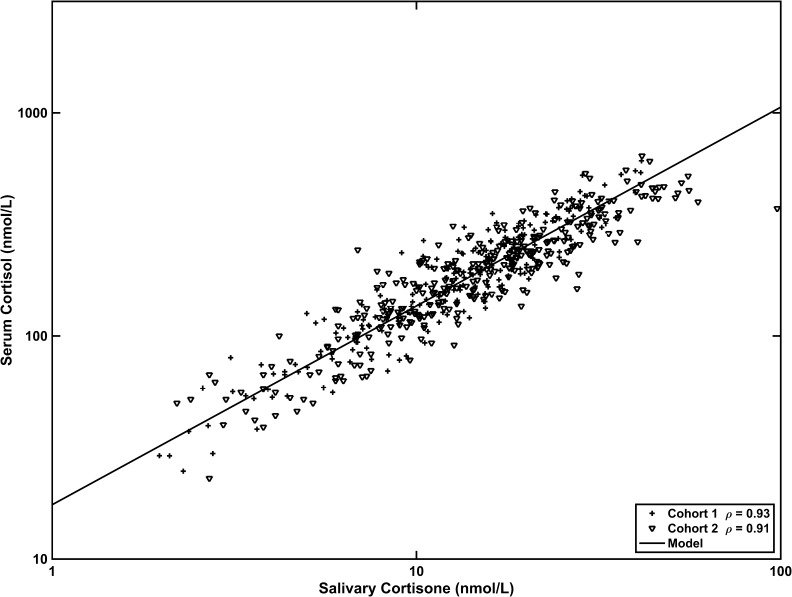
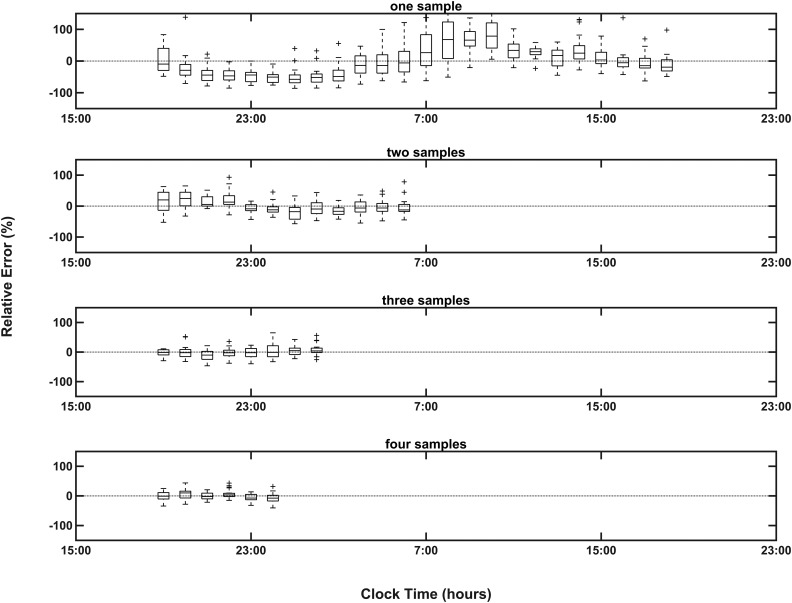
Serum and saliva with cortisol and cortisone were measured by liquid chromatography-tandem mass spectrometry in independent cohorts. The relationship between serum cortisol and salivary cortisone was analyzed in cohort 1 using a linear mixed effects model. The resulting fixed effects component was applied to cohort 2. Saliva cannot easily be collected when a patient is sleeping, so we determined the minimum sampling required to estimate cortisol exposure [estimated area under the curve (eAUC)] using 24-hour cortisol profiles (AUC24) and calculated the relative error (RE) for eAUC.
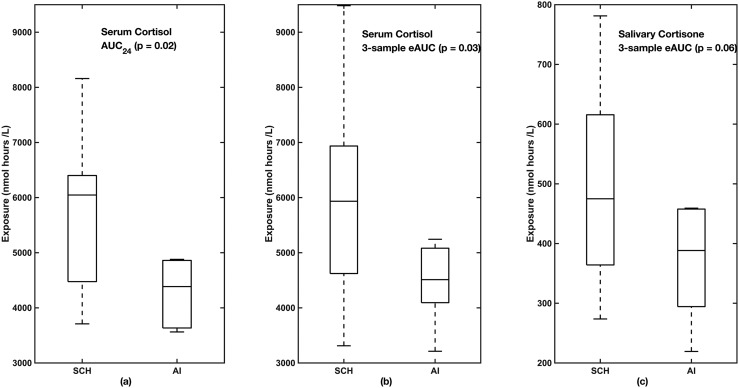
More than 90% of variability in salivary cortisone could be accounted for by change in serum cortisol. A single serum cortisol measurement was a poor estimate of AUC24, especially in the morning or last thing at night (RE >68%); however, three equally spaced samples gave a median RE of 0% (interquartile range, -15.6% to 15.1%). In patients with adrenal incidentalomas, eAUC based on three serum cortisol samples showed a difference between those with autonomous cortisol secretion and those without (P = 0.03).
Accepting that most people sleep 7 to 8 hours, ∼8-hourly salivary cortisone measurements provide a noninvasive method of estimating 24-hour cortisol exposure for population studies.
人群研究常常用皮质醇作为压力的标志物,而皮质醇过多与死亡率的增加有关。皮质醇有昼夜节律,频繁采血评估皮质醇暴露是不切实际的。我们研究了唾液考的松的测量,并检验了确定皮质醇暴露所需的采样频率。
在独立的队列中,通过液相色谱-串联质谱法测量血清和唾液中的皮质醇和考的松。使用线性混合效应模型分析队列 1 中血清皮质醇和唾液考的松之间的关系。将得到的固定效应成分应用于队列 2。由于患者在睡眠时唾液不易采集,我们确定了估计皮质醇暴露[估计曲线下面积(eAUC)]所需的最小采样量,使用 24 小时皮质醇谱(AUC24),并计算 eAUC 的相对误差(RE)。
超过 90%的唾液考的松变化可以用血清皮质醇的变化来解释。单次血清皮质醇测量对 AUC24 的估计较差,尤其是在早上或晚上最后一次(RE>68%);然而,三个等距的样本中位数 RE 为 0%(四分位间距,-15.6%至 15.1%)。在意外发现肾上腺瘤的患者中,基于三个血清皮质醇样本的 eAUC 显示出有自主皮质醇分泌的患者和没有自主皮质醇分泌的患者之间存在差异(P=0.03)。
如果接受大多数人每天睡眠 7 到 8 小时,那么大约 8 小时一次的唾液考的松测量为人群研究提供了一种非侵入性的估计 24 小时皮质醇暴露的方法。