Kenya Medical Research Institute, P.O. Box 54840 00200, Mbagathi Road, Nairobi, Kenya.
University of Washington, Jefferson St. Seattle WA 98104, Nairobi, 908, Kenya.
BMC Psychiatry. 2018 Oct 1;18(1):318. doi: 10.1186/s12888-018-1904-7.
Few longitudinal studies have examined associations between risk factors during pregnancy and mental health outcomes during the postpartum period. We used a cohort study design to estimate the prevalence, incidence and correlates of significant postpartum depressive symptoms in Kenyan women.
We recruited adult women residing in an urban, resource-poor setting and attending maternal and child health clinics in two public hospitals in Nairobi, Kenya. A translated Kiswahili Edinburgh Postpartum Depression Scale was used to screen for depressive symptoms at baseline assessment in the 3rd trimester and follow up assessment at 6-10 weeks postpartum. Information was collected on potential demographic, psychosocial and clinical risk variables. Potential risk factors for postpartum depression were evaluated using multivariate logistic regression analysis.
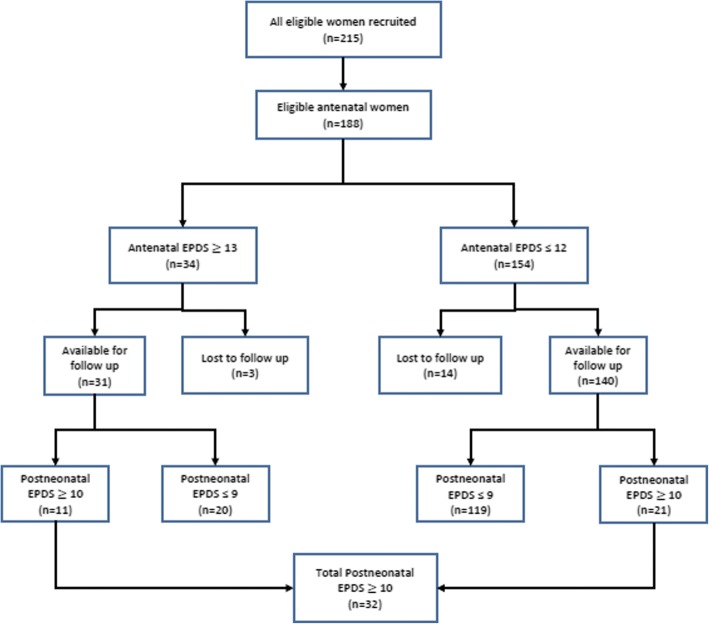
Out of the 171 women who were followed up at 6-10 weeks postpartum, 18.7% (95% CI: 13.3-25.5) were found to have postpartum depression using an EPDS cut off of 10. In multivariate analyses, the odds of having postpartum depression was increased more than seven-fold in the presence of conflict with partner (OR = 7.52, 95% CI: 2.65-23.13). The association between antepartum and postpartum depression was quite strong but did not reach statistical significance (OR = 3.37, 95% CI: 0.98-11.64).
The high prevalence of significant postnatal depressive symptoms among Kenyan women underscores the need for addressing this public health burden. Depression screening and psychosocial support interventions that address partner conflict resolution should be offered as part of maternal health care.
很少有纵向研究调查过孕期风险因素与产后心理健康结果之间的关系。我们使用队列研究设计,估计肯尼亚妇女产后出现明显抑郁症状的患病率、发病率和相关因素。
我们招募了居住在城市、资源匮乏地区的成年女性,并在肯尼亚内罗毕的两家公立医院的母婴保健诊所参加研究。在妊娠第 3 个月末的基线评估和产后 6-10 周的随访评估中,使用翻译后的斯瓦希里语爱丁堡产后抑郁量表来筛查抑郁症状。收集了潜在的人口统计学、心理社会和临床风险变量信息。使用多变量逻辑回归分析评估产后抑郁的潜在风险因素。
在 171 名在产后 6-10 周接受随访的女性中,使用 EPDS 截断值为 10 分,有 18.7%(95%CI:13.3-25.5)被诊断为产后抑郁症。在多变量分析中,存在伴侣冲突的情况下,产后抑郁症的发生几率增加了 7 倍以上(OR=7.52,95%CI:2.65-23.13)。产前和产后抑郁之间的关联虽然很强,但没有达到统计学意义(OR=3.37,95%CI:0.98-11.64)。
肯尼亚妇女产后出现明显抑郁症状的高患病率凸显了应对这一公共卫生负担的必要性。应将针对伴侣冲突解决的抑郁筛查和心理社会支持干预措施作为产妇保健的一部分提供。