Institute for Behavioral and Community Health, School of Public Health, San Diego State University, 9245 Sky Park Ct., Suite 221, San Diego, CA, 92123, USA.
School of Nursing, University of North Carolina, Carrington Hall, Campus Box #7460, Chapel Hill, NC, 97599, USA.
Int J Behav Nutr Phys Act. 2018 Oct 1;15(1):95. doi: 10.1186/s12966-018-0714-0.
Few children consume sufficient servings of fruits and vegetables. Interventions aiming to improve children's dietary intake often target parent level factors, but limited research has examined the mediating role of parental factors on children's dietary intake. This study examined 10-month follow up data from the Entre Familia: Reflejos de Salud (Within the Family: Reflections of Health) trial to investigate (1) intervention effects on children's dietary intake, both sustained and new changes, and (2) whether changes in mothers' dietary intake, her parenting strategies, and behavioral strategies to promoting healthy eating in the home mediated changes in children's dietary intake.
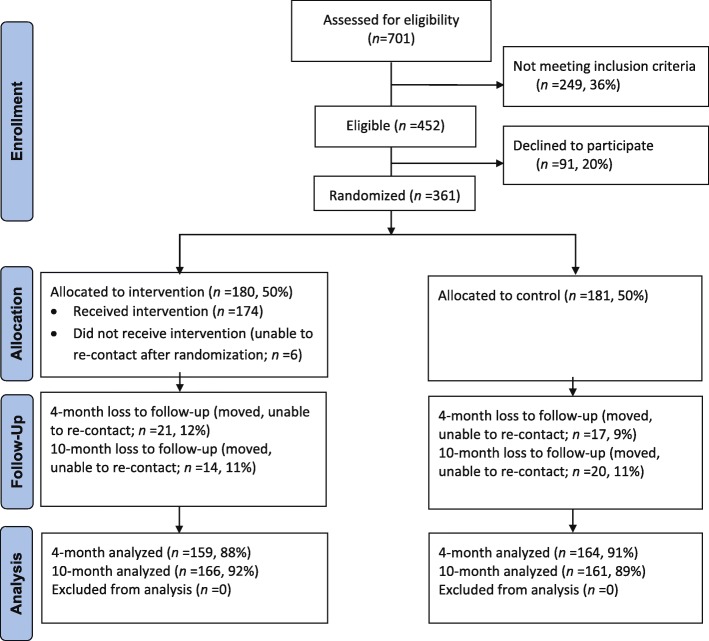
Participants were 361 Mexican-origin families living in Imperial County, California. Families were randomly assigned to a 4-month dietary intervention or a delayed treatment control group. The intervention was delivered by promotoras (community health workers) via home visits and telephone calls. Assessments occurred at baseline, and 4- and 10-months post-baseline.
At 10-months post-baseline, sustained intervention effects were observed on children's reported intake of varieties of vegetables, with differences getting larger over time. However, differential intervention effects on fast food were not sustained due to significant reductions in the control group compared with smaller changes in the intervention group. New intervention effects were observed on servings of sugar-sweetened beverages. However, the intervention continued to have no effect on children's reported fruit and vegetable servings, and varieties of fruits consumed. Mother-reported behavioral strategies to increase fiber and lower fat mediated the relationship between the intervention and children's intake of varieties of vegetables. Mothers' percent energy from fat and behavioral strategies to lower fat were mediators of children's daily servings of sugar-sweetened beverages.
This study suggests that a promotora-led family based intervention can provide mothers with skills to promote modest changes in children's diet. Examining the parent related mechanisms of change will inform future interventions on important targets for improving children's diet.
https://clinicaltrials.gov/ . NCT02441049 . Retrospectively registered 05.06.2015.
很少有孩子能摄入足够的水果和蔬菜。旨在改善儿童饮食摄入的干预措施通常针对父母层面的因素,但有限的研究已经检验了父母因素对儿童饮食摄入的中介作用。本研究通过对“家庭中的健康:反思”(Entre Familia: Reflejos de Salud)试验的 10 个月随访数据进行了检验,以调查(1)干预对儿童饮食摄入的持续和新变化的影响,以及(2)母亲饮食摄入、育儿策略和在家中促进健康饮食的行为策略的变化是否中介了儿童饮食摄入的变化。
参与者是 361 个生活在加利福尼亚州帝国县的墨西哥裔美国家庭。家庭被随机分配到为期 4 个月的饮食干预组或延迟治疗对照组。干预措施由 promotoras(社区卫生工作者)通过家访和电话提供。评估在基线时、4 个月和 10 个月时进行。
在基线后 10 个月,儿童报告的蔬菜品种摄入量持续存在干预效果,且差异随时间增大。然而,由于对照组的显著减少,快餐的差异干预效果没有持续,而干预组的变化较小。在含糖饮料的摄入量上观察到新的干预效果。然而,干预措施继续对儿童报告的水果和蔬菜摄入量以及食用的水果品种没有影响。母亲报告的增加纤维和降低脂肪的行为策略中介了干预与儿童蔬菜品种摄入量之间的关系。母亲的脂肪能量百分比和降低脂肪的行为策略是儿童每日含糖饮料摄入量的中介因素。
本研究表明,以 promotora 为主导的家庭为基础的干预措施可以为母亲提供技能,以促进儿童饮食的适度变化。检验变化的父母相关机制将为改善儿童饮食的未来干预措施提供重要目标。
https://clinicaltrials.gov/ 。NCT02441049。2015 年 5 月 6 日回顾性注册。