Centre for Maternal and Newborn Health, Liverpool School of Tropical Medicine, Liverpool, United Kingdom.
PLoS One. 2018 Oct 4;13(10):e0203606. doi: 10.1371/journal.pone.0203606. eCollection 2018.
To determine retention of knowledge and skills after standardised "skills and drills" training in Emergency Obstetric Care.
Longitudinal cohort study.
Ghana, Malawi, Nigeria, Kenya, Tanzania and Sierra Leone.
609 maternity care providers, of whom 455 were nurse/midwives (NMWs).
Knowledge and skills assessed before and after training, and, at 3, 6, 9 and 12 months. Analysis of variance to explore differences in scores by country and level of healthcare facility for each cadre. Mixed effects regression analysis to account for potential explanatory factors including; facility type, years of experience providing maternity care, months since training and number of repeat assessments.
Change in knowledge and skills.
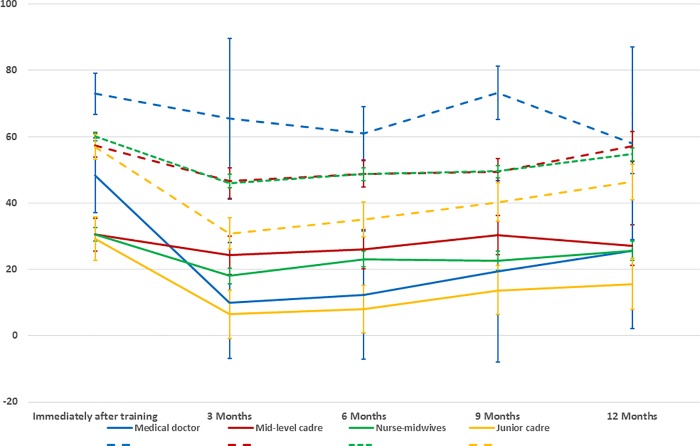
Before training the overall mean (SD) score for skills was 48.8% (11.6%) and 65.6% (10.7%). for knowledge. After training the mean (95% CI) relative improvement in knowledge was 30.8% (29.1% - 32.6%) and 59.8% (58.6%- 60.9%) for skills. Mean scores for knowledge and skills at each subsequent assessment remained between those immediately post-training and those at 3 months. NMWs who attended all four assessments demonstrated statistically better retention of skills (14.9%, 95% CI 7.8%, 22.0% p<0.001) but not knowledge (8.6%, 95% CI -0.3%, 17.4%. p = 0.06) compared to those who attended one or two assessments only. Health care facility level or experience were not determinants of retention.
After training, healthcare providers retain knowledge and skills for up to 12 months. This effect can likely be enhanced by short repeat skills-training sessions, or, 'fire drills'.
确定在产科急救“技能和操练”标准培训后知识和技能的保留情况。
纵向队列研究。
加纳、马拉维、尼日利亚、肯尼亚、坦桑尼亚和塞拉利昂。
609 名产科保健提供者,其中 455 名为护士/助产士(NMW)。
在培训前后以及 3、6、9 和 12 个月评估知识和技能。方差分析用于探索每个医务人员群体的国家和医疗保健机构水平的分数差异。混合效应回归分析用于解释因素,包括设施类型、提供产科护理的经验年限、培训后月份和重复评估次数。
知识和技能的变化。
培训前,技能的总体平均(SD)分数为 48.8%(11.6%),知识的平均(SD)分数为 65.6%(10.7%)。培训后,知识的相对改善平均值(95%CI)为 30.8%(29.1% - 32.6%),技能的相对改善平均值(95%CI)为 59.8%(58.6%- 60.9%)。在随后的每次评估中,知识和技能的平均分数都介于培训后立即评估的分数和 3 个月评估的分数之间。参加了全部四次评估的 NMW 表现出更好的技能保留率(14.9%,95%CI 7.8%,22.0%p<0.001),而不是知识(8.6%,95%CI -0.3%,17.4%。p = 0.06)与仅参加一次或两次评估的 NMW 相比。医疗保健机构的级别或经验不是保留的决定因素。
培训后,医疗保健提供者可在 12 个月内保留知识和技能。通过短期重复技能培训课程或“消防演习”,可以增强这种效果。