Network System Research Institute, National Institute of Information and Communications Technology, Koganei, Tokyo, Japan.
Department of System Design Engineering, Keio University, Yokohama, Kanagawa, Japan.
PLoS One. 2018 Oct 4;13(10):e0205161. doi: 10.1371/journal.pone.0205161. eCollection 2018.
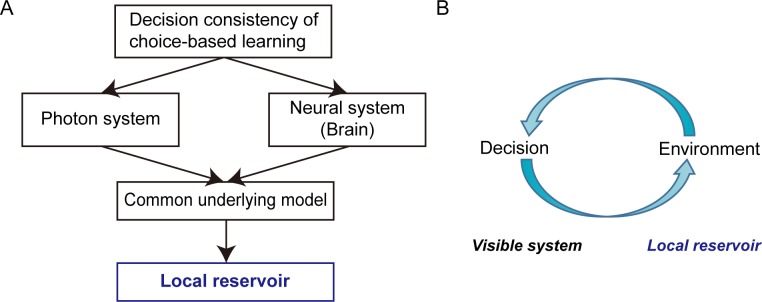
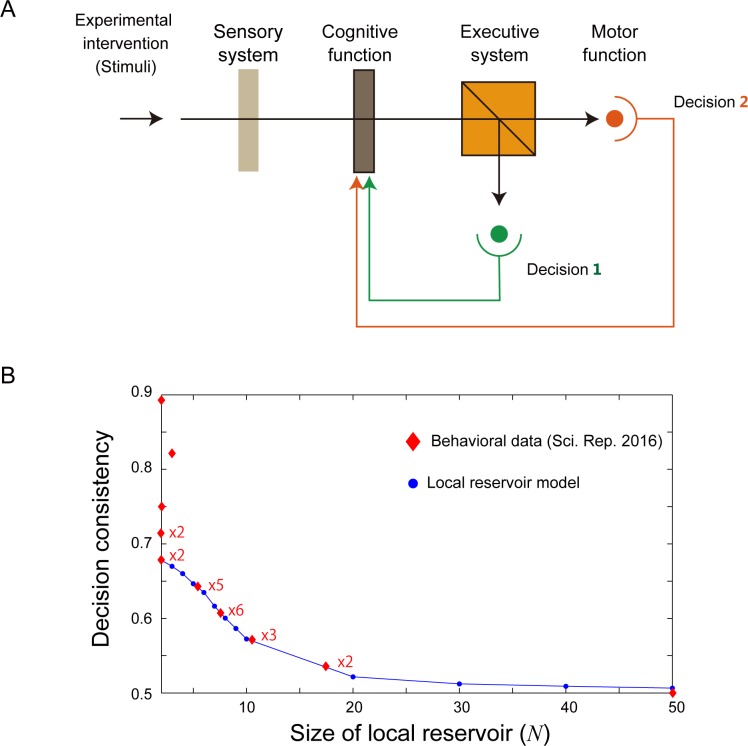
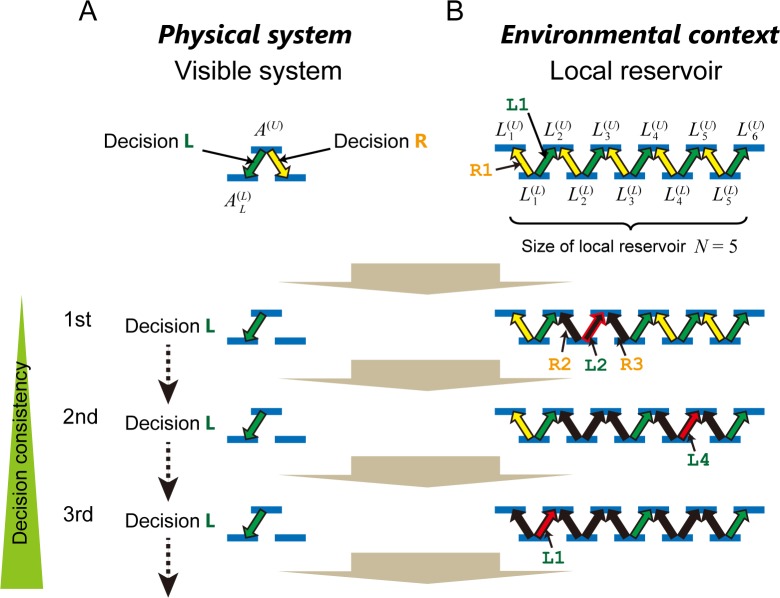
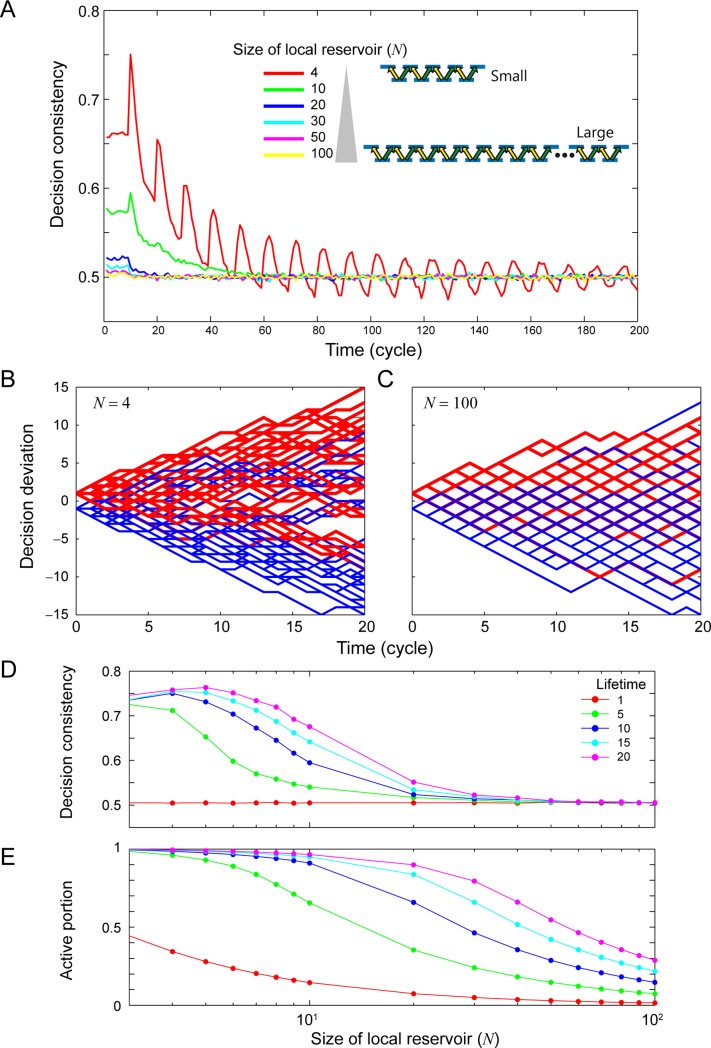
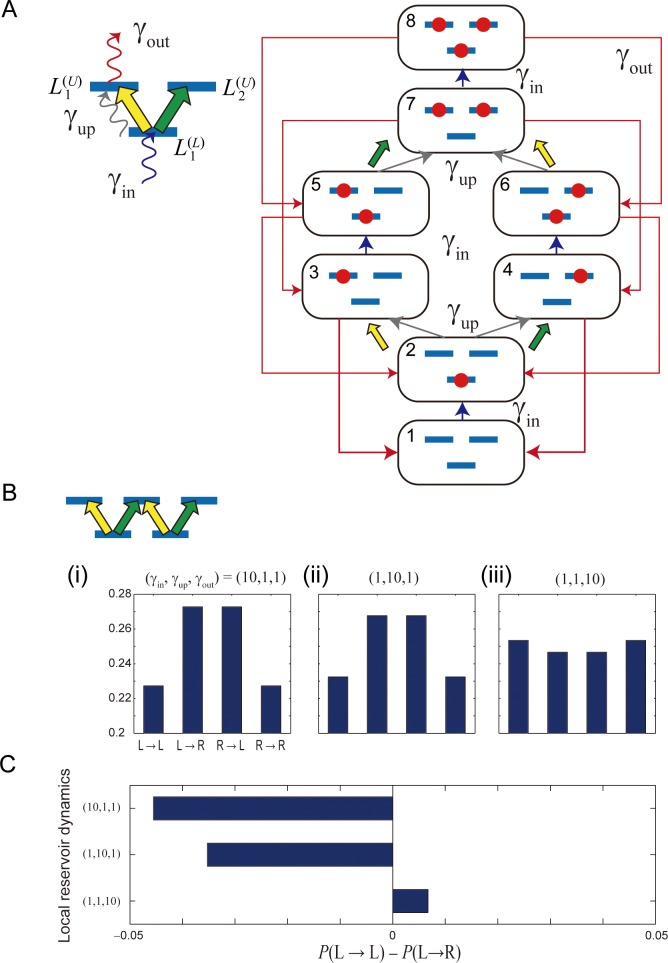
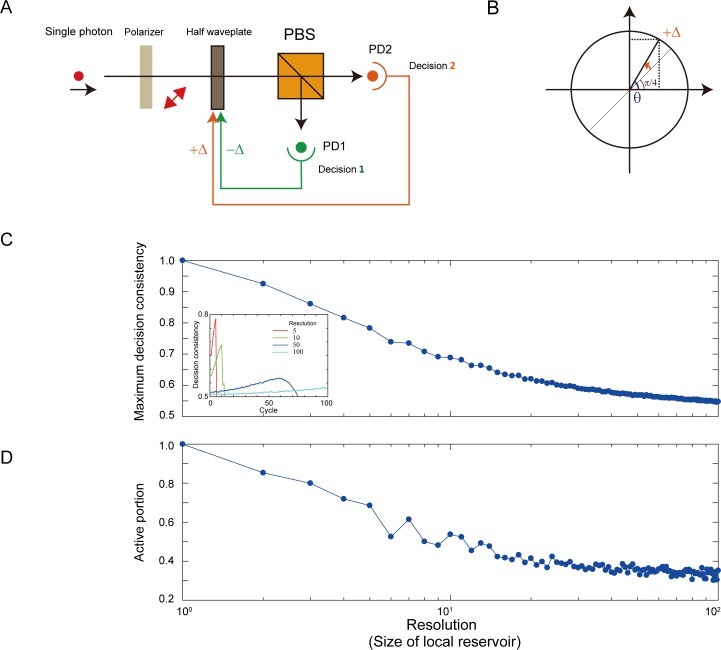
Decision making based on behavioral and neural observations of living systems has been extensively studied in brain science, psychology, neuroeconomics, and other disciplines. Decision-making mechanisms have also been experimentally implemented in physical processes, such as single photons and chaotic lasers. The findings of these experiments suggest that there is a certain common basis in describing decision making, regardless of its physical realizations. In this study, we propose a local reservoir model to account for choice-based learning (CBL). CBL describes decision consistency as a phenomenon where making a certain decision increases the possibility of making that same decision again later. This phenomenon has been intensively investigated in neuroscience, psychology, and other related fields. Our proposed model is inspired by the viewpoint that a decision is affected by its local environment, which is referred to as a local reservoir. If the size of the local reservoir is large enough, consecutive decision making will not be affected by previous decisions, thus showing lower degrees of decision consistency in CBL. In contrast, if the size of the local reservoir decreases, a biased distribution occurs within it, which leads to higher degrees of decision consistency in CBL. In this study, an analytical approach for characterizing local reservoirs is presented, as well as several numerical demonstrations. Furthermore, a physical architecture for CBL based on single photons is discussed, and the effects of local reservoirs are numerically demonstrated. Decision consistency in human decision-making tasks and in recruiting empirical data is evaluated based on the local reservoir. This foundation based on a local reservoir offers further insights into the understanding and design of decision making.
基于对生物系统的行为和神经观察的决策制定,已经在脑科学、心理学、神经经济学和其他学科中得到了广泛研究。决策机制也已经在物理过程中得到了实验实现,例如单光子和混沌激光。这些实验的结果表明,无论其物理实现如何,在描述决策方面都存在一定的共同基础。在本研究中,我们提出了一个局部储层模型来解释基于选择的学习(CBL)。CBL 将决策一致性描述为一种现象,即做出某个决策会增加以后再次做出相同决策的可能性。这种现象在神经科学、心理学和其他相关领域得到了深入研究。我们提出的模型受到了这样一种观点的启发,即决策受到其局部环境的影响,我们称之为局部储层。如果局部储层的大小足够大,连续的决策制定将不会受到先前决策的影响,因此在 CBL 中表现出较低的决策一致性程度。相反,如果局部储层的大小减小,其中会出现偏置分布,从而导致 CBL 中更高的决策一致性程度。在本研究中,提出了一种用于描述局部储层的分析方法,并进行了一些数值演示。此外,还讨论了基于单光子的 CBL 的物理架构,并进行了数值演示。根据局部储层评估了人类决策任务和招聘实证数据中的决策一致性。基于局部储层的这种基础为理解和设计决策提供了进一步的见解。