Department of Psychology, Keio University, Mita, Minato-ku, Tokyo, Japan.
PLoS One. 2013 Aug 16;8(8):e72071. doi: 10.1371/journal.pone.0072071. eCollection 2013.
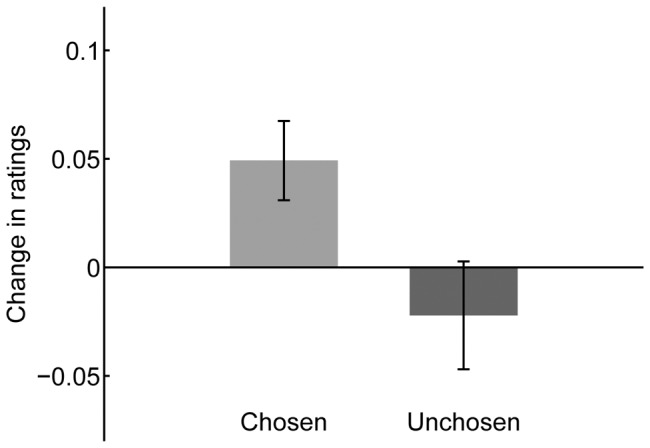
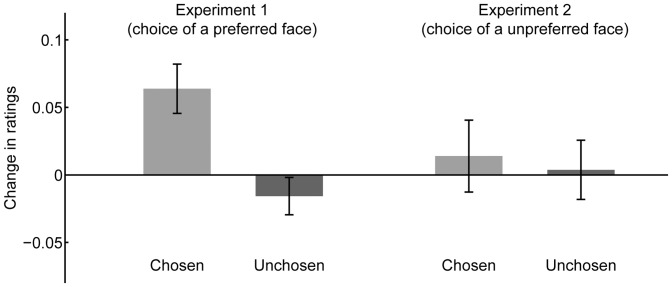
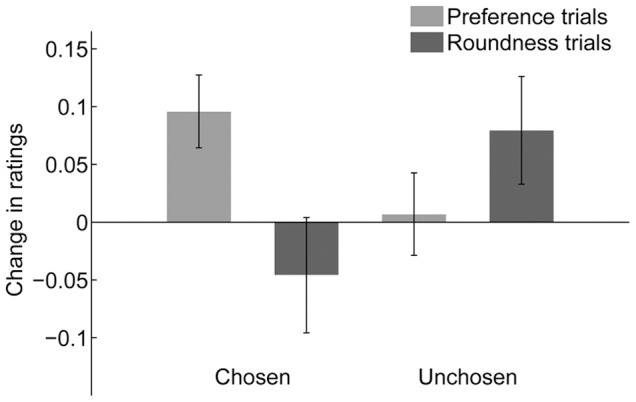
Behavioral choice alters one's preference rather than simply reflecting it. This effect to fit preferences with past choice, is known as "choice-induced preference change." After making a choice between two equally attractive options, one tends to rate the chosen option better than they initially did and/or the unchosen option worse. The present study examined how behavioral choice changes subsequent preference, using facial images for the choice options as well as blind choice techniques. Participants rated their facial preference for each face, and chose between two equally preferred faces and subsequently rated their facial preference. Results from four experiments demonstrated that randomly chosen faces were more preferred only after participants were required to choose "a preferred face," (in Experiment 1) but not "an unpreferred face," (in Experiment 2) or "a rounder face" (in Experiment 3). Further, preference change was still observed after participants were informed that choices were actually random (in Experiment 4). Our findings provide new and important implications characterizing the conditions under which random choice changes preference, and show that people are tempted to make a biased evaluation even after they know that they did not make the choice for themselves.
行为选择改变了一个人的偏好,而不仅仅是反映它。这种适应过去选择的偏好的效应被称为“选择诱导偏好改变”。在两个同样吸引人的选项之间做出选择后,人们往往会对所选选项的评价高于最初的评价,并且/或者对未选选项的评价更差。本研究使用面部图像作为选择选项以及盲目选择技术,考察了行为选择如何改变后续偏好。参与者对每张脸的面部偏好进行了评分,并在两个同样受欢迎的面孔之间进行了选择,然后对他们的面部偏好进行了评分。四项实验的结果表明,只有在参与者被要求选择“更喜欢的脸”时(实验 1),而不是“不那么喜欢的脸”(实验 2)或“更圆的脸”(实验 3),随机选择的面孔才会更受欢迎。此外,即使参与者被告知选择实际上是随机的(实验 4),偏好变化仍然存在。我们的研究结果提供了新的和重要的启示,说明了随机选择改变偏好的条件,并表明即使人们知道自己不是为自己做出的选择,他们也会倾向于做出有偏见的评价。