VIP Region, State Key Laboratory of Oncology in South China, Collaborative Innovation Center for Cancer Medicine, Sun Yat-Sen University Cancer Center, 651 Dongfeng East Road, Guangzhou, 510060, Guangdong, People's Republic of China.
Department of Pathology, State Key Laboratory of Oncology in South China, Collaborative Innovation Center for Cancer Medicine, Sun Yat-Sen University Cancer Center, Guangzhou, 510060, Guangdong, People's Republic of China.
J Transl Med. 2018 Oct 4;16(1):273. doi: 10.1186/s12967-018-1638-9.
Systemic inflammation and immune dysfunction has been proved to be significantly associated with cancer progression and metastasis in many cancer types, including colorectal cancer. We examined the prognostic significance of the systemic immune-inflammation index (SII) in patients with metastatic colorectal cancer (mCRC) and the relationship between the lymphocytic response to the tumor and this index.
This retrospective study evaluated 240 consecutive patients with newly diagnosed stage IV mCRC who underwent surgical resection. The SII values were calculated based on preoperative laboratory data regarding platelet, neutrophil, and lymphocyte counts. Tumor-infiltrating lymphocytes were evaluated using the surgical specimens. The overall survival and their 95% confidence interval (95% CI) were estimated by regression analyses and the Kaplan-Meier method.
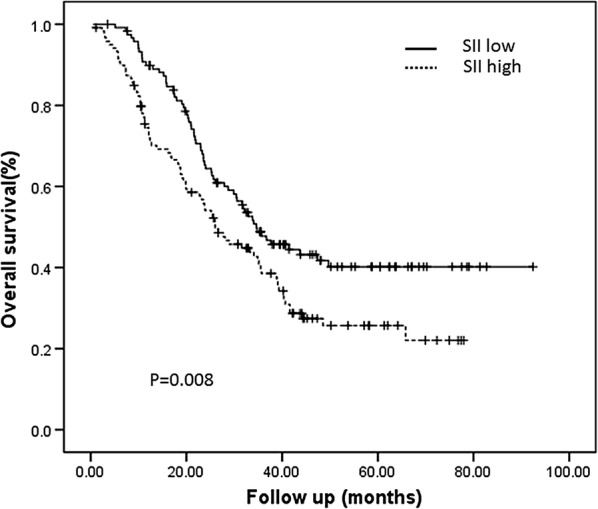
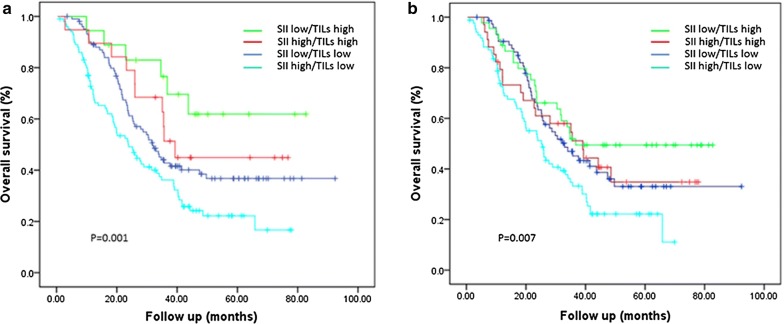
After a mean follow-up of 26.7 (1.1-92.4) months, 146 patients (60.8%) died. In the univariate analysis, a high SII was significantly associated with poor overall survival (P = 0.009). The multivariable analysis also confirmed that a high SII was independently associated with poor overall survival (hazard ratio: 1.462, 95% confidence interval 1.049-2.038, P = 0.025). The SII value was significantly correlated with the TILs value at the tumor's center (P = 0.04), but not at the invasive margin (P = 0.39). When we evaluated overall survival for groupings of the tumor-infiltrating lymphocytes and SII values, we identified three distinct prognostic groups. The group with low tumor-infiltrating lymphocyte values and high SII values had the worst prognosis.
A high SII value independently predicts poor clinical outcomes among patients with mCRC. In addition, combining the lymphocytic response to the tumor and SII could further enhance prognostication for mCRC.
系统性炎症和免疫功能障碍已被证明与许多癌症类型(包括结直肠癌)的癌症进展和转移密切相关。我们检查了全身免疫炎症指数(SII)在转移性结直肠癌(mCRC)患者中的预后意义以及肿瘤淋巴细胞反应与该指数之间的关系。
这项回顾性研究评估了 240 例接受手术切除的新诊断为 IV 期 mCRC 的连续患者。SII 值是根据术前实验室数据(血小板、中性粒细胞和淋巴细胞计数)计算得出的。使用手术标本评估肿瘤浸润淋巴细胞。通过回归分析和 Kaplan-Meier 方法估计总生存率及其 95%置信区间(95%CI)。
平均随访 26.7(1.1-92.4)个月后,146 例患者(60.8%)死亡。在单因素分析中,高 SII 与总生存率差显著相关(P=0.009)。多变量分析还证实,高 SII 与总生存率差独立相关(危险比:1.462,95%置信区间 1.049-2.038,P=0.025)。SII 值与肿瘤中心处的 TILs 值显著相关(P=0.04),但与浸润边缘无关(P=0.39)。当我们根据肿瘤浸润淋巴细胞和 SII 值的分组评估总生存率时,我们确定了三个不同的预后组。肿瘤浸润淋巴细胞值低和 SII 值高的组预后最差。
高 SII 值独立预测 mCRC 患者的临床结局不良。此外,结合肿瘤淋巴细胞反应和 SII 值可以进一步增强 mCRC 的预后预测。