Sterling Madeline R, Shaw Amy L, Leung Peggy Bk, Safford Monika M, Jones Christine D, Tsui Emma K, Delgado Diana
Division of General Internal Medicine, Department of Medicine, Weill Cornell Medicine, New York, NY, USA,
Division of Geriatrics and Palliative Medicine, Department of Medicine, Weill Cornell Medicine, New York, NY, USA.
J Multidiscip Healthc. 2018 Sep 25;11:481-492. doi: 10.2147/JMDH.S175512. eCollection 2018.
Home care workers (HCWs), which include home health aides and personal care aides, are increasingly used by heart failure (HF) patients for post-acute care and long-term assistance. Despite their growing presence, they have largely been left out of HF research and interventions. This systematic review was aimed to 1) describe utilization patterns of HCWs by adults with HF, 2) examine the effect of HCWs on HF outcomes, and 3) review HF interventions that involve HCWs.
Five electronic databases (Ovid MEDLINE, Ovid EMBASE, Cochrane Library [Wiley], CINAHL [EBSCO], and AgeLine [EBSCO]) were searched from inception through August 4, 2017. The yield was screened using prespecified inclusion and exclusion criteria. Two authors independently reviewed references and a third reviewer acted as an arbitrator when needed. Data were extracted from articles that met the inclusion criteria. The Downs and Black checklist was used for quality assessment. Due to study heterogeneity, a narrative synthesis was conducted.
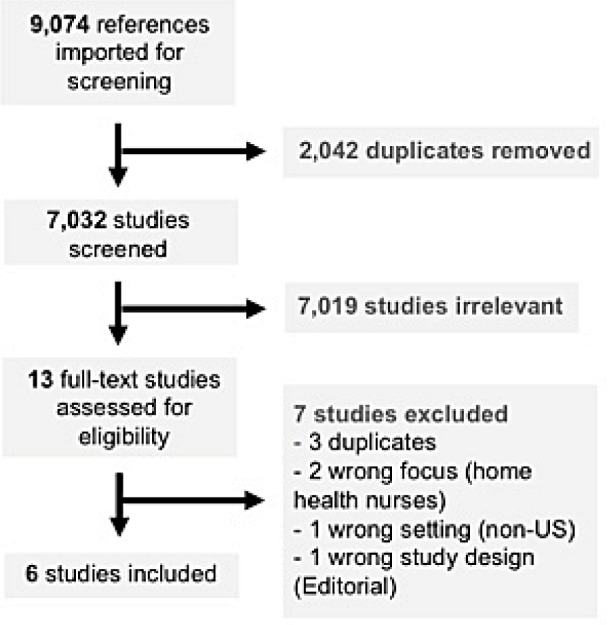
Of the 7,032 studies screened, 13 underwent full-text review, and six met the inclusion criteria. Two descriptive studies found that adults with HF who live alone and have functional and cognitive deficits utilize HCWs. While three retrospective cohort studies examined the association between having an HCW post-HF hospitalization and readmission rates, their findings were conflicting. One quasi-experimental study found that an HCW-delivered educational intervention improved HF patients' self-care abilities. Overall, despite some significant findings, the studies assessed were of poor-to-fair quality (Downs and Black score range: 10-16 [28 total points]), with most lacking methodological rigor.
Although HCWs are quite common, the literature on these paraprofessionals in HF is limited. Given the paucity of research in this area and the low quality of studies reviewed here, additional research is warranted on the potential role of HCWs in HF self-care and on outcomes among adults with HF.
包括家庭健康助理和个人护理助理在内的家庭护理工作者越来越多地被心力衰竭(HF)患者用于急性后期护理和长期协助。尽管他们的身影日益常见,但在HF研究和干预措施中,他们在很大程度上被忽视了。本系统评价旨在:1)描述成年HF患者对家庭护理工作者的使用模式;2)研究家庭护理工作者对HF结局的影响;3)回顾涉及家庭护理工作者的HF干预措施。
检索了五个电子数据库(Ovid MEDLINE、Ovid EMBASE、Cochrane图书馆[Wiley]、CINAHL[EBSCO]和AgeLine[EBSCO]),检索时间从建库至2017年8月4日。根据预先设定的纳入和排除标准对检索结果进行筛选。两名作者独立审阅参考文献,必要时第三名审阅者担任仲裁人。从符合纳入标准的文章中提取数据。使用唐斯和布莱克清单进行质量评估。由于研究的异质性,进行了叙述性综合分析。
在筛选的7032项研究中,13项进行了全文审阅,6项符合纳入标准。两项描述性研究发现,独居且有功能和认知缺陷的成年HF患者使用家庭护理工作者。三项回顾性队列研究考察了HF住院后有家庭护理工作者与再入院率之间的关联,但其结果相互矛盾。一项半实验性研究发现,由家庭护理工作者提供的教育干预提高了HF患者的自我护理能力。总体而言,尽管有一些显著发现,但所评估的研究质量较差至中等(唐斯和布莱克评分范围:10 - 16分[满分28分]),大多数研究缺乏方法学严谨性。
尽管家庭护理工作者相当常见,但关于这些辅助专业人员在HF方面的文献有限。鉴于该领域研究匮乏且本文所综述研究质量较低,有必要对家庭护理工作者在HF自我护理中的潜在作用以及成年HF患者的结局进行更多研究。