Tsuboi Kazuhito, Uyama Toru, Okamoto Yasuo, Ueda Natsuo
1Department of Biochemistry, Kagawa University School of Medicine, 1750-1 Ikenobe, Miki, Kagawa 761-0793 Japan.
2Department of Pharmacology, Kawasaki Medical School, 577 Matsushima, Kurashiki, Okayama 701-0192 Japan.
Inflamm Regen. 2018 Oct 1;38:28. doi: 10.1186/s41232-018-0086-5. eCollection 2018.
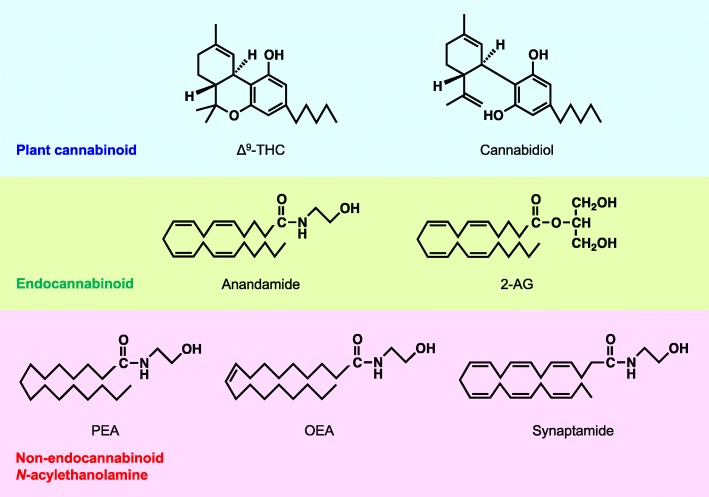
The plant contains cannabinoids represented by Δ-tetrahydrocannabinol, which exert psychoactivity and immunomodulation through cannabinoid CB1 and CB2 receptors, respectively, in animal tissues. Arachidonoylethanolamide (also referred to as anandamide) and 2-arachidonoylglycerol (2-AG) are well known as two major endogenous agonists of these receptors (termed "endocannabinoids") and show various cannabimimetic bioactivities. However, only 2-AG is a full agonist for CB1 and CB2 and mediates retrograde signals at the synapse, strongly suggesting that 2-AG is physiologically more important than anandamide. The metabolic pathways of these two endocannabinoids are completely different. 2-AG is mostly produced from inositol phospholipids via diacylglycerol by phospholipase C and diacylglycerol lipase and then degraded by monoacylglycerol lipase. On the other hand, anandamide is concomitantly produced with larger amounts of other -acylethanolamines via -acyl-phosphatidylethanolamines (NAPEs). Although this pathway consists of calcium-dependent -acyltransferase and NAPE-hydrolyzing phospholipase D, recent studies revealed the involvement of several new enzymes. Quantitatively major -acylethanolamines include palmitoylethanolamide and oleoylethanolamide, which do not bind to cannabinoid receptors but exert anti-inflammatory, analgesic, and anorexic effects through receptors such as peroxisome proliferator-activated receptor α. The biosynthesis of these non-endocannabinoid -acylethanolamines rather than anandamide may be the primary significance of this pathway. Here, we provide an overview of the biological activities and metabolisms of endocannabinoids (2-AG and anandamide) and non-endocannabinoid -acylethanolamines.
该植物含有以Δ-四氢大麻酚为代表的大麻素,它们在动物组织中分别通过大麻素CB1和CB2受体发挥精神活性和免疫调节作用。花生四烯酸乙醇胺(也称为阿南达胺)和2-花生四烯酸甘油酯(2-AG)是这些受体的两种主要内源性激动剂(称为“内源性大麻素”),并表现出各种拟大麻生物活性。然而,只有2-AG是CB1和CB2的完全激动剂,并在突触处介导逆行信号,这强烈表明2-AG在生理上比阿南达胺更重要。这两种内源性大麻素的代谢途径完全不同。2-AG主要通过磷脂酶C和二酰基甘油脂肪酶从肌醇磷脂经二酰基甘油产生,然后由单酰基甘油脂肪酶降解。另一方面,阿南达胺与大量其他酰基乙醇胺通过N-酰基磷脂酰乙醇胺(NAPEs)同时产生。尽管该途径由钙依赖性N-酰基转移酶和水解NAPEs的磷脂酶D组成,但最近的研究揭示了几种新酶的参与。定量上主要的酰基乙醇胺包括棕榈酰乙醇胺和油酰乙醇胺,它们不与大麻素受体结合,但通过过氧化物酶体增殖物激活受体α等受体发挥抗炎、镇痛和厌食作用。这些非内源性大麻素酰基乙醇胺而非阿南达胺的生物合成可能是该途径的主要意义。在这里,我们概述了内源性大麻素(2-AG和阿南达胺)和非内源性大麻素酰基乙醇胺的生物活性和代谢。