Morimoto Yoshihito, Miyawaki Kumika, Seki Reisuke, Watanabe Kazuhiro, Hirohara Masayoshi, Shinohara Takao
1Education and Research Center for Clinical Pharmacy, Showa Pharmaceutical University, 3-3165 Higashi-Tamagawagakuen, Machida, Tokyo, 194-8543 Japan.
2Department of Pharmacy, Kyorin University Hospital, 6-20-2 Shinkawa, Mitaka, Tokyo, 181-8611 Japan.
J Pharm Health Care Sci. 2018 Oct 1;4:26. doi: 10.1186/s40780-018-0122-2. eCollection 2018.
Vinorelbine is known to be effective in the treatment of non-small cell lung cancer and breast cancer. However, venous irritation is a common side effect. Although there have been some reports on risk factors for venous irritation in patients receiving vinorelbine, the factors evaluated have been limited and the results inconclusive. The aim of this study was to identify risk factors for venous irritation in patients receiving vinorelbine, and factors likely associated with venous irritation, including new factors such as hot compress with a hot towel for prevention of venous irritation.
We retrospectively reviewed patients treated with vinorelbine at Kyorin University Hospital, Japan, between March 2013 and December 2016 and divided them into the two groups according to whether or not they had venous irritation. Clinical characteristics were compared between the two groups.
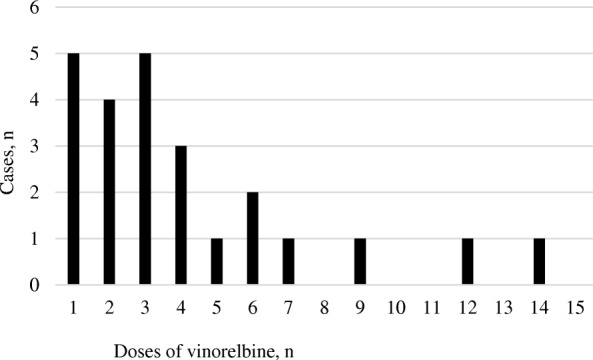
Venous irritation occurred in 24 (38.1%) of 63 patients who received vinorelbine. The median number of times vinorelbine was administered before onset of venous irritation was 3 (range 1-14). The group with venous irritation had a significantly lower body surface area than the group without venous irritation ( = 0.035). Low body surface area was also the only significant risk factor for vinorelbine-associated venous irritation in multivariate analysis (adjusted odds ratio 70.42 per 1 mdecrement, 95% confidence interval 1.54-3236.25, = 0.029). There was no association between the occurrence of venous irritation and the other covariates, such as use of a hot compress, history of diabetes mellitus, or use of a generic formulation of vinorelbine.
Low body surface area may be a risk factor for venous irritation in patients receiving vinorelbine. Use of hot compress with a hot towel did not prevent venous irritation.
长春瑞滨已知对非小细胞肺癌和乳腺癌有效。然而,静脉刺激是一种常见的副作用。虽然已有一些关于接受长春瑞滨治疗患者静脉刺激危险因素的报道,但所评估的因素有限且结果尚无定论。本研究的目的是确定接受长春瑞滨治疗患者静脉刺激的危险因素,以及可能与静脉刺激相关的因素,包括用于预防静脉刺激的新因素,如用热毛巾热敷。
我们回顾性分析了2013年3月至2016年12月在日本杏林大学医院接受长春瑞滨治疗的患者,并根据是否发生静脉刺激将他们分为两组。比较两组的临床特征。
63例接受长春瑞滨治疗的患者中有24例(38.1%)发生了静脉刺激。静脉刺激发生前长春瑞滨的给药中位数次数为3次(范围1 - 14次)。发生静脉刺激的组的体表面积显著低于未发生静脉刺激的组(P = 0.035)。在多变量分析中,低体表面积也是长春瑞滨相关静脉刺激的唯一显著危险因素(每降低1平方米调整优势比为70.42,95%置信区间为1.54 - 3236.25,P = 0.029)。静脉刺激的发生与其他协变量之间无关联,如是否使用热敷、糖尿病史或使用长春瑞滨的仿制制剂。
低体表面积可能是接受长春瑞滨治疗患者发生静脉刺激的危险因素。用热毛巾热敷并不能预防静脉刺激。