Faculty of Medical Sciences, Department of Comprehensive Clinical Oncology, Kyushu University, Fukuoka, Japan.
Research Institute for Diseases of the Chest, Graduate School of Medical Sciences, Kyushu University, Fukuoka, Japan.
Cancer Sci. 2018 Dec;109(12):3921-3933. doi: 10.1111/cas.13820. Epub 2018 Nov 13.
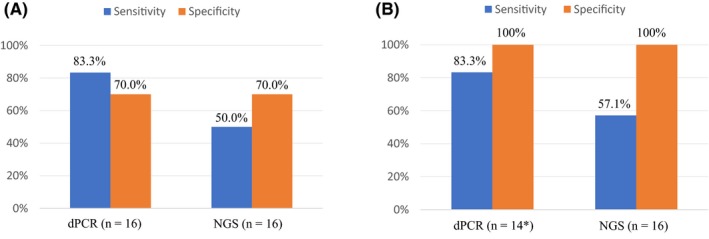
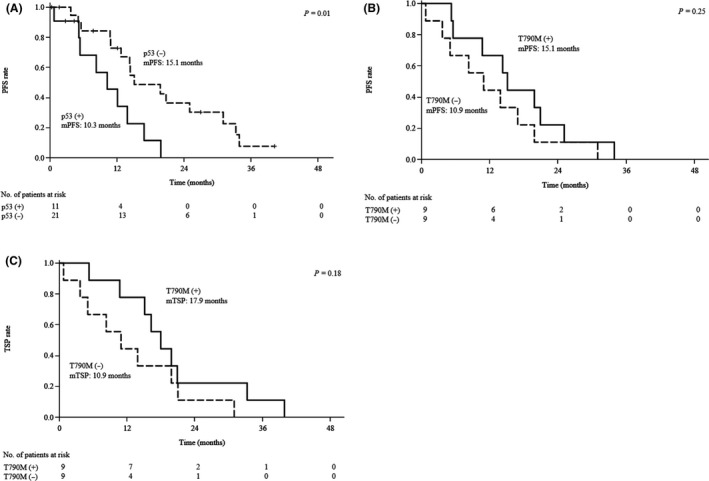
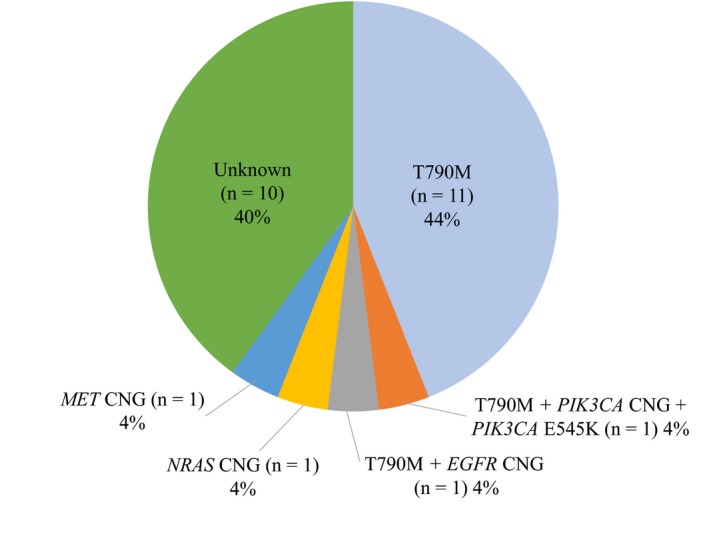
Liquid biopsy offers a potential alternative to tissue biopsy for detection of genetic alterations in cancer, and it has been introduced into clinical practice to detect the tyrosine kinase inhibitor (TKI) resistance-conferring T790M mutation of epidermal growth factor receptor (EGFR) in patients with non-small-cell lung cancer (NSCLC). We prospectively collected tumor and plasma samples from 25 NSCLC patients who harbored activating mutations of EGFR and experienced failure of treatment with afatinib. The samples were analyzed by digital PCR (dPCR) and next-generation sequencing (NGS). T790M was detected in plasma with a respective sensitivity and specificity of 83.3% and 70.0% by dPCR and 50.0% and 70.0% by NGS relative to analysis of corresponding tumor samples. Quantitation of T790M based on the ratio of the number of T790M alleles to that of activating mutation alleles (T/A ratio) improved the specificity of plasma analysis to 100% for both dPCR and NGS without a reduction in sensitivity. Although several afatinib resistance mechanisms other than T790M-including copy number gain of NRAS or MET-were identified in tumor samples, the corresponding genetic alterations were not detected in plasma. TP53 mutations were frequently identified in plasma and tumor samples, with most such mutations also having been detected before afatinib treatment. The presence of de novo TP53 mutations was associated with reduced progression-free survival. Quantitation of T790M in plasma is thus a clinically relevant approach to determine the T790M status of tumors. In addition, genetic alterations coexisting with EGFR mutations can affect the efficacy of EGFR-TKI treatment.
液体活检为检测癌症中的遗传改变提供了一种组织活检的潜在替代方法,它已被引入临床实践中,以检测非小细胞肺癌(NSCLC)患者中表皮生长因子受体(EGFR)的酪氨酸激酶抑制剂(TKI)耐药性赋予 T790M 突变。我们前瞻性地收集了 25 例携带 EGFR 激活突变且对阿法替尼治疗失败的 NSCLC 患者的肿瘤和血浆样本。通过数字 PCR(dPCR)和下一代测序(NGS)对样本进行分析。dPCR 和 NGS 检测血浆 T790M 的敏感性分别为 83.3%和 50.0%,特异性分别为 70.0%和 70.0%,与相应肿瘤样本的分析结果相对应。基于 T790M 等位基因数与激活突变等位基因数(T/A 比值)的定量,提高了 dPCR 和 NGS 血浆分析的特异性,达到 100%,而不降低敏感性。尽管在肿瘤样本中鉴定出了除 T790M 以外的几种阿法替尼耐药机制,包括 NRAS 或 MET 的拷贝数增加,但在血浆中未检测到相应的遗传改变。TP53 突变在血浆和肿瘤样本中频繁被鉴定出来,其中大多数突变也在阿法替尼治疗前被检测到。de novo TP53 突变的存在与无进展生存期的缩短有关。因此,血浆中 T790M 的定量是一种确定肿瘤 T790M 状态的临床相关方法。此外,与 EGFR 突变共存的遗传改变会影响 EGFR-TKI 治疗的疗效。