Yu Yongfeng, Ren Yongxin, Fang Jian, Cao Lejie, Liang Zongan, Guo Qisen, Han Sen, Ji Zimei, Wang Ye, Sun Yulan, Chen Yuan, Li Xingya, Xu Hua, Zhou Jianying, Jiang Liyan, Cheng Ying, Han Zhigang, Shi Jianhua, Chen Gongyan, Ma Rui, Fan Yun, Sun Sanyuan, Jiao Longxian, Jia Xiaoyun, Wang Linfang, Lu Puhan, Xu Qian, Luo Xian, Su Weiguo, Lu Shun
Department of Medical Oncology, Shanghai Chest Hospital, Shanghai Jiaotong University, Shanghai, China.
HUTCHMED, Shanghai, China.
Ther Adv Med Oncol. 2022 Oct 31;14:17588359221133546. doi: 10.1177/17588359221133546. eCollection 2022.
Savolitinib, a selective MET inhibitor, showed efficacy in patients with non-small cell lung cancer (NSCLC), including pulmonary sarcomatoid carcinoma (PSC), harbouring exon 14 skipping alteration (ex14).
To analyse , the association between circulating tumour DNA (ctDNA) biomarkers and clinical outcomes, including resistance, with savolitinib.
A multicentre, single-arm, open-label phase 2 study.
All enrolled patients with baseline plasma samples were included. Outcomes were objective response rate (ORR), progression-free survival (PFS) and overall survival (OS) by baseline ex14 and post-treatment clearance, coexisting gene alterations at baseline and disease progression.
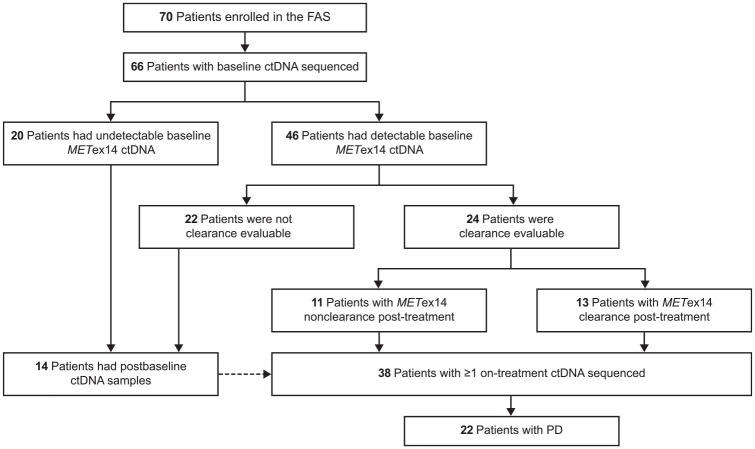
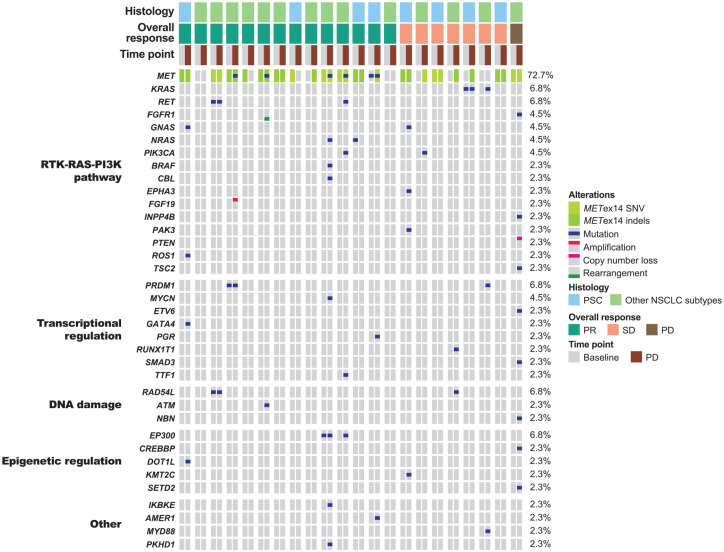
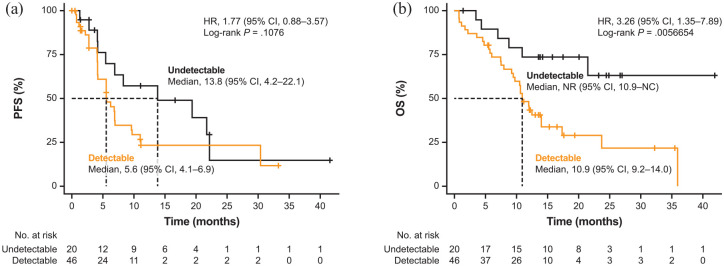
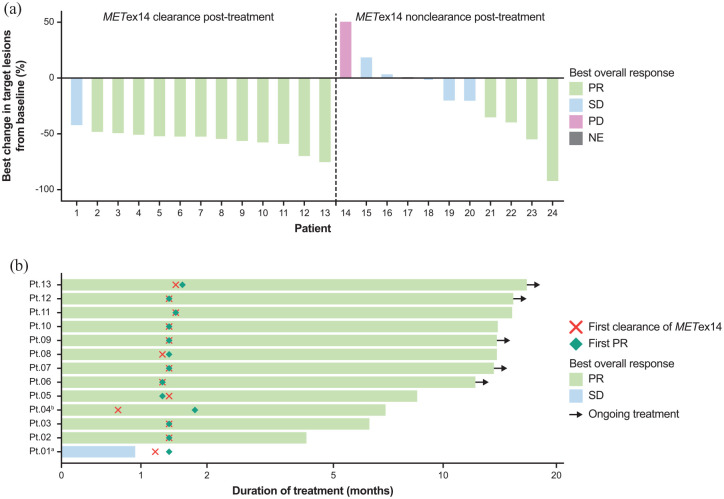
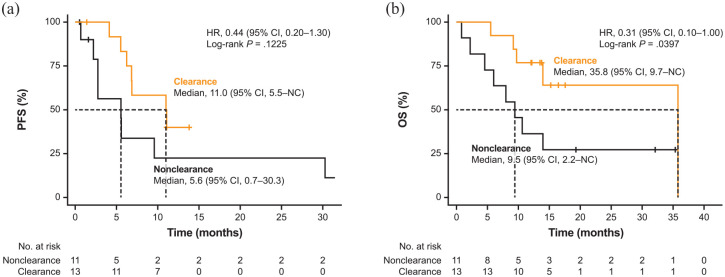
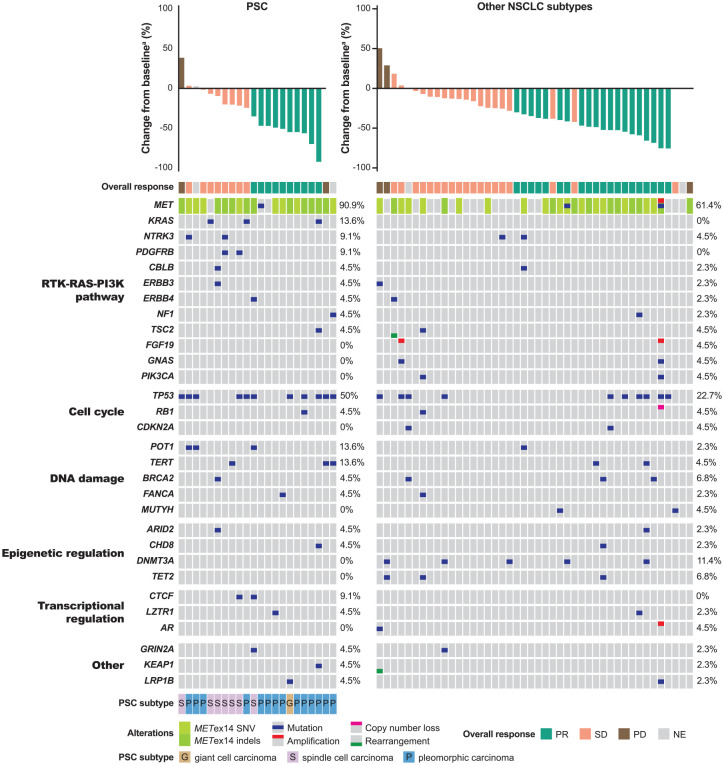
Among 66 patients with baseline ctDNA sequencing, 46 (70%) had detectable ex14. Frequent coexisting baseline gene alterations included and mutations. Patients with detectable baseline ex14 exhibited worse PFS [hazard ratio (HR), 1.77; 95% confidence interval (CI), 0.88-3.57; = 0.108] and OS (HR, 3.26; 95% CI, 1.35-7.89; = 0.006) than those without, despite showing a numerically higher ORR. Among 24 patients with baseline detectable ex14 and evaluable postbaseline samples, 13 achieved ex14 clearance post-treatment. Median time to first clearance was 1.3 months (range, 0.7-1.5). ex14 post-treatment clearance was associated with better ORR (92.3%; 95% CI, 64.0-99.8 36.4%; 95% CI, 10.9-69.2; = 0.0078), PFS (HR, 0.44; 95% CI, 0.2-1.3; = 0.1225) and OS (HR, 0.31; 95% CI, 0.1-1.0; = 0.0397) non-clearance. Among 22 patients with disease progression, 10 acquired pathway alterations (e.g. in RAS/RAF and PI3K/PTEN) alone or with secondary mutations (D1228H/N and Y1230C/H/S).
ctDNA biomarkers may allow for longitudinal monitoring of clinical outcomes with savolitinib in patients with ex14-positive PSC and other NSCLC subtypes. Specifically, undetectable baseline ex14 or post-treatment clearance may predict favourable clinical outcomes, while secondary mutations and other acquired gene alterations may explain resistance to savolitinib.
The trial was registered with ClinicalTrials.gov (NCT02897479) on 13 September 2016.
赛沃替尼是一种选择性MET抑制剂,在包括肺肉瘤样癌(PSC)且存在第14外显子跳跃突变(ex14)的非小细胞肺癌(NSCLC)患者中显示出疗效。
分析循环肿瘤DNA(ctDNA)生物标志物与赛沃替尼临床结局(包括耐药性)之间的关联。
一项多中心、单臂、开放标签的2期研究。
纳入所有有基线血浆样本的入组患者。结局指标为根据基线ex14及治疗后清除情况、基线时共存的基因改变以及疾病进展情况得出的客观缓解率(ORR)、无进展生存期(PFS)和总生存期(OS)。
在66例进行基线ctDNA测序的患者中,46例(70%)可检测到ex14。常见的共存基线基因改变包括 和 突变。可检测到基线ex14的患者与未检测到的患者相比,PFS更差[风险比(HR),1.77;95%置信区间(CI),0.88 - 3.57;P = 0.108],OS也更差(HR,3.26;95% CI,1.35 - 7.89;P = 0.006),尽管其ORR在数值上更高。在24例基线可检测到ex14且基线后样本可评估的患者中,13例在治疗后实现了ex14清除。首次清除的中位时间为1.3个月(范围,0.7 - 1.5)。治疗后ex14清除与更好的ORR(92.3%;95% CI,64.0 - 99.8 36.4%;95% CI,10.9 - 69.2;P = 0.0078)、PFS(HR,0.44;95% CI,0.2 - 1.3;P = 0.1225)和OS(HR,0.31;95% CI,0.1 - 1.0;P = 0.0397)相关,而未清除则相反。在22例疾病进展的患者中,10例单独获得通路改变(如RAS/RAF和PI3K/PTEN)或伴有继发性 突变(D1228H/N和Y1230C/H/S)。
ctDNA生物标志物可用于对ex14阳性PSC和其他NSCLC亚型患者使用赛沃替尼的临床结局进行纵向监测。具体而言,未检测到基线ex14或治疗后清除可能预示良好的临床结局,而继发性 突变和其他获得性基因改变可能解释对赛沃替尼的耐药性。
该试验于2016年9月13日在ClinicalTrials.gov(NCT02897479)注册。