Guthrie E P, Salyers A A
J Bacteriol. 1987 Mar;169(3):1192-9. doi: 10.1128/jb.169.3.1192-1199.1987.
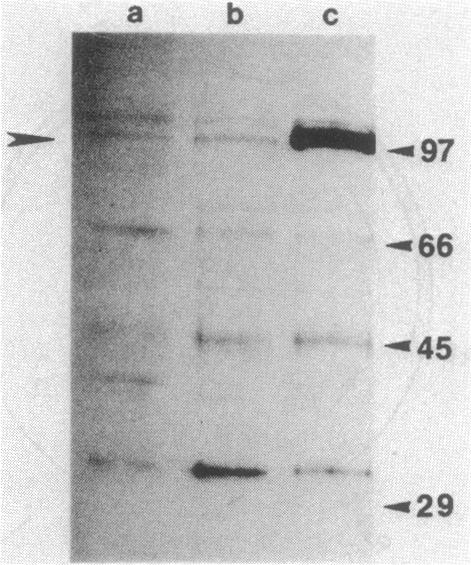
The chondroitin lyase II gene from Bacteroides thetaiotaomicron has previously been cloned in Escherichia coli on a 7.8-kilobase (kb) fragment (pA818). In E. coli, the chondroitin lyase II gene appeared to be expressed from a promoter that was about 0.5 kb from the beginning of the gene. However, when a subcloned 5-kb fragment from pA818 which contained the chondroitin lyase II gene and the promoter from which the gene is expressed in E. coli was introduced into B. thetaiotaomicron on a multicopy plasmid (pEG800), the chondroitin lyase specific activity of B. thetaiotaomicron was not altered. Further evidence that the promoter that is recognized in E. coli may not be the promoter from which the chondroitin lyase II gene is transcribed in B. thetaiotaomicron was obtained by making an insertion in the B. thetaiotaomicron chromosome at a point which is 1 kb upstream from the chondroitin lyase II gene. This insertion stopped synthesis of the chondroitin lyase II gene product, as would be predicted if the gene was part of an operon and was transcribed in B. thetaiotaomicron from a promoter that was at least 1 kb upstream from the chondroitin lyase II gene. A region of pA818 which was adjacent to the chondroitin lyase II gene and which included the region used to make the insertional mutation was found to code for chondro-4-sulfatase, an enzyme that breaks down one of the products of the chondroitin lyase reaction. The upstream insertion mutant of B. thetaiotaomicron which stopped synthesis of chondroitin lyase II had no detectable chondro-4-sulfatase activity. This mutant was still able to grow on chondroitin sulfate, although the rate of growth was slower than that of the wild type.
来自嗜热栖热放线菌的软骨素裂解酶II基因先前已在大肠杆菌中克隆于一个7.8千碱基(kb)的片段(pA818)上。在大肠杆菌中,软骨素裂解酶II基因似乎是从距该基因起始约0.5 kb的一个启动子表达的。然而,当将来自pA818的一个包含软骨素裂解酶II基因及其在大肠杆菌中表达该基因的启动子的5 kb亚克隆片段通过多拷贝质粒(pEG800)导入嗜热栖热放线菌时,嗜热栖热放线菌的软骨素裂解酶比活性并未改变。通过在嗜热栖热放线菌染色体上软骨素裂解酶II基因上游1 kb处进行插入,获得了进一步的证据,表明在大肠杆菌中识别的启动子可能不是嗜热栖热放线菌中软骨素裂解酶II基因转录的启动子。这种插入停止了软骨素裂解酶II基因产物的合成,正如如果该基因是操纵子的一部分且在嗜热栖热放线菌中从软骨素裂解酶II基因上游至少1 kb处的启动子转录所预测的那样。发现pA818中与软骨素裂解酶II基因相邻且包括用于产生插入突变的区域编码软骨素4 - 硫酸酯酶,该酶可分解软骨素裂解酶反应的一种产物。停止软骨素裂解酶II合成的嗜热栖热放线菌上游插入突变体没有可检测到的软骨素4 - 硫酸酯酶活性。该突变体仍然能够在硫酸软骨素上生长,尽管生长速率比野生型慢。